
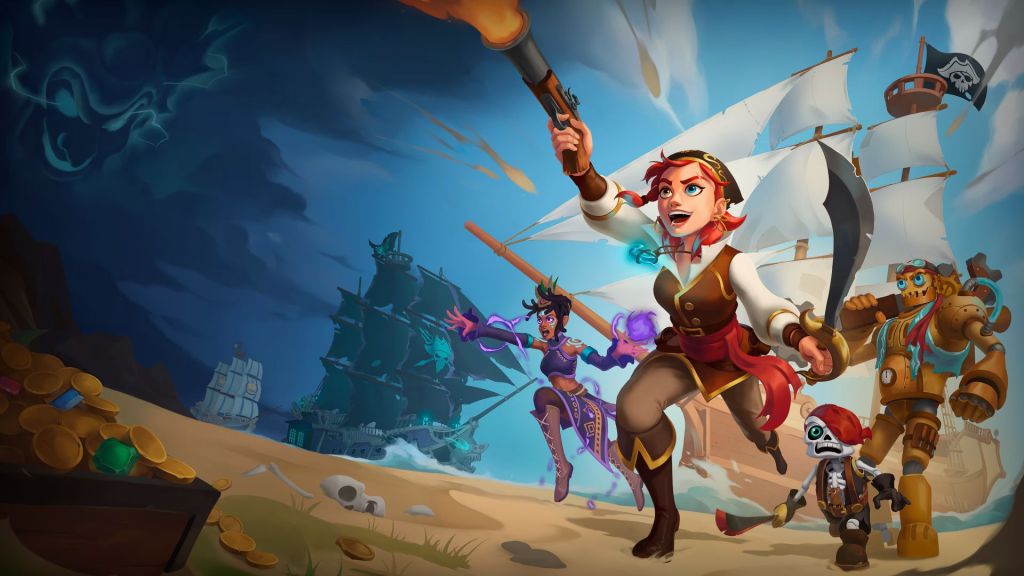
It’s time to man the mizzenmast, batten those hatches, and get a new plank to walk, because the briny seven seas be calling again. Aaargh, me mateys! Me cutlass be ready for a new pirate adventure and the burying of treasure!
Developer 3DClouds is attempting to fill that piratical itch with Trident’s Tale, a swashbuckling, seven seas-crossing tale of piracy, treasure hunting, and skeletons. You play as Ocean, a pirate wannabe who can’t wait to leave her island home. But when Ocean finds a hidden piece of the legendary Storm Trident, she puts herself in the crosshairs of a nefarious group of undead pirates also looking for all the pieces.

The Trident, you see, contains the power of a god and, if all the pieces are united, that power goes to the wielder. To survive, Ocean has to assemble a crew, find the remaining pieces, and become a legend in the process.
Trident’s Tale cribs it’s ideas from games that have come before about the golden age of piracy. As Trident’s Tale is an all-ages game that feels like it was made with kids in mind, those inspirations have been trimmed back to present an easy-to-get-to-grips-with adventure that spends as much of its time on land as it does at sea.
The gameplay is split into two distinct sections, both beholden to the idea of exploration. There’s a third person, on-foot adventure mode that combines melee combat with light puzzle solving and a healthy dose of platforming. There are, of course, ship sequences that see you explore a large, watery map full of islands and other ships – many of which you can scuttle to continue funding your voyage.

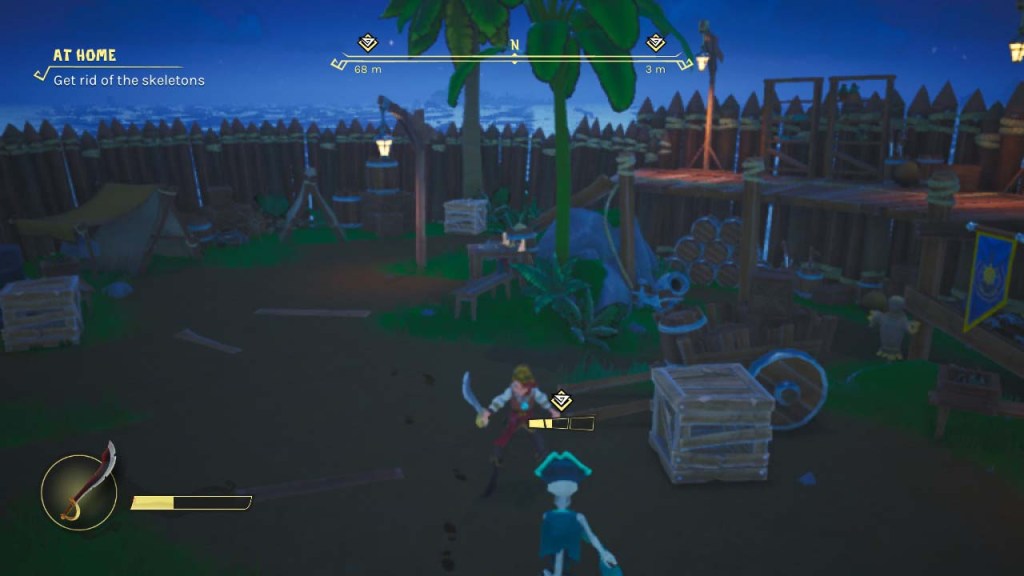
When you’re not swaying all over the poop deck (that’s real, look it up), your land-legs will be getting a good deal of use on the islands you can explore, either for side-quests and items, or to progress the story. There are resources to collect for a simple crafting system, basic platforming in many locations a nice sense of verticality, and lots of melee combat to go around. The undead will hound your every move. Thankfully, you have a trusty cutlass and pistol to deal with them.
Ocean has access to light and heavy attacks, a dash to get out of the way, and a pistol that is probably the most useful item in her arsenal. Each weapon has its own special ability, such as the pistols default ability to stun enemies briefly. Scattered across the game are recipes for new weapons, armour, and ship upgrades that use those shiny chunks of bone and iron you’ve been collecting. You can also simply upgrade your existing ones.
Ogh, and what would a pirate be without a crew? As you travel across the world, you’ll recruit more scallywags to your cause who, thankfully, provide more than just snarky quips while sailing. These crew members give you access to magical attacks for use in both melee and naval combat. A song that heals you while stunning enemies? I’ll take that please!
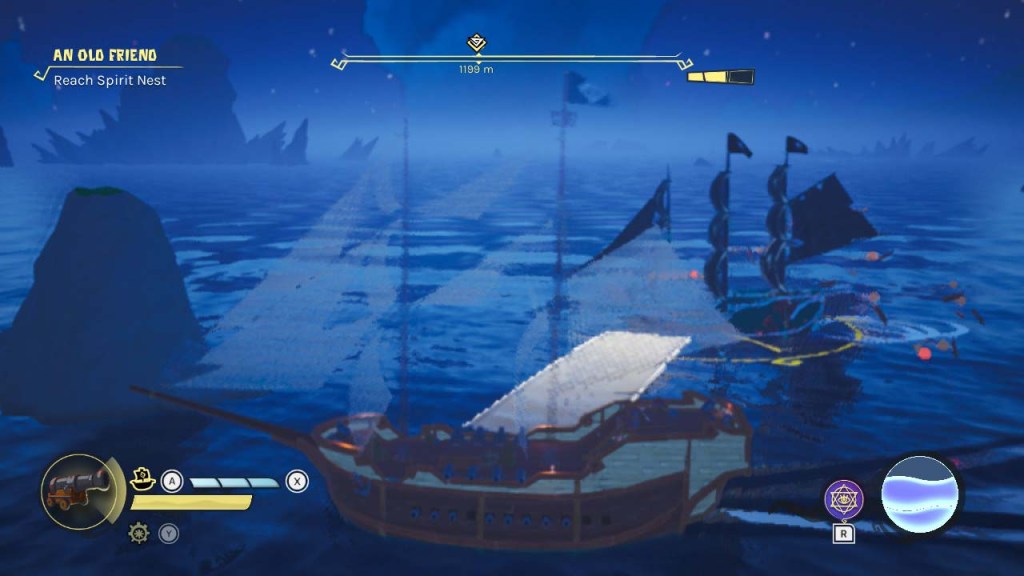
Ocean spends a lot of time sailing the seven seas so blue, so it’s nice that ship control and combat have been simplified as well. You raise your sails to get moving, with three settings for speed, and can pick up floating crates in the ocean to gain more resources. There are many islands to explore, either to continue the story, explore temples, find even more resources, or engage in side-quests.
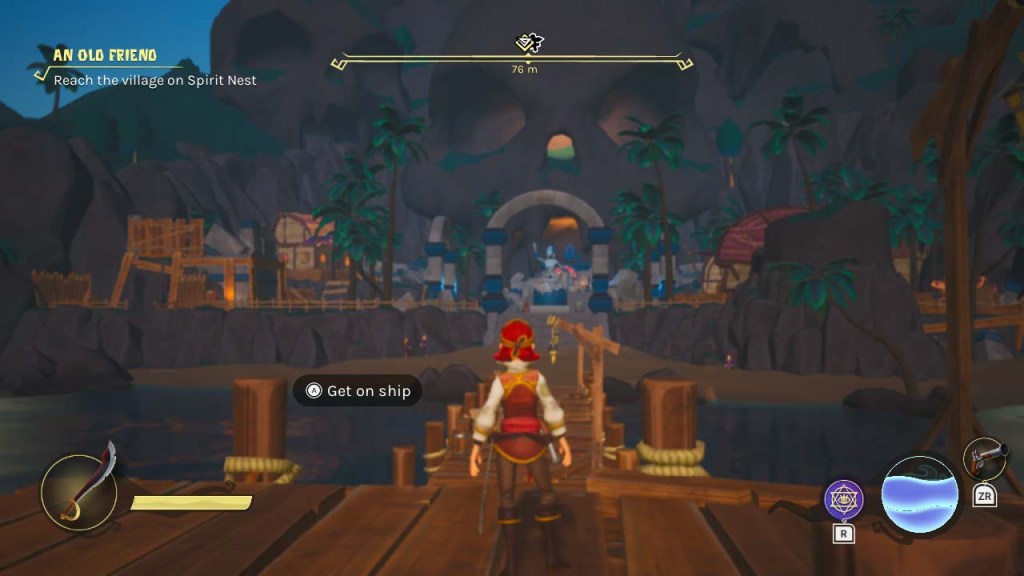
You can dock at harbours to make life easier or, if you’re close to an island, abandon the helm and dive into the cooling waters for a quick swim to shore, all of which is handled seamlessly. You can always fast-travel to your ship and islands you’ve already explored, which makes backtracking a breeze.
Where naval combat is concerned, the direction you’re looking aims your cannons. The only complication is adjusting the height of your shot for a broadside or judging the distance when using the front or rear cannons. When an enemy ship is on its last legs, you’ll get a boarding option that just nets you more resources before it’s scuttled. Sadly, there’s no actual boarding of other ships or fighting their crew which was a bit of a letdown.
The story is passable Saturday-afternoon, pulp fare with a humorous take on proceedings. How much that humour lands will depend on the player though. While I wasn’t too chuffed with much of the dialogue, I did enjoy some of the cringy pirate dad jokes during the loading screens. The voice acting is passable as well and the narrative gets the job done even if it doesn’t truly immerse you in the world or the supposedly high stakes.
Sadly, Trident’s Tale comes with some serious waterlogged issues that spoil the adventure. Some of those issues are design-related, but the rest are down to poor performance that seriously hampers the experience on the Nintendo Switch.
The camera position in combat when locked on is a complete pain as it drops low behind your character and obscures the actual combat, blocking your view of both the enemies and their incoming attacks. I stopped using the lock-on and kept the camera at a 3/4 view of the action, which made combat far more palatable as there’s a degree of auto-aim that’ll make sure you don’t miss.
This introduces the problem of the environment blocking the view depending on the area, but it’s less frustrating than the lock-on issues. on that note, the lock-on disengages as soon as you turn your back to an enemy, so pretty much every move that dashes back and out of harm’s way renders it useless. For a few battles where you really need the lock-on, this is a pain.
Most significant are the games visuals and performance issues that I’ assume’d hope are limited to the Switch and maybe the last-gen consoles. Bluntly put, this is another case of Unreal Engine and the Switch not mixing politely.
The stylised art style is nice enough, but the games resolution on Switch is so low that it really hampers visual clarity. Most of the time, it just looks very hazy, with everything from characters to foliage looking blurry and aliased to the point where it can even affect ship-based combat when your circular crosshair gets lost in the visual noise.
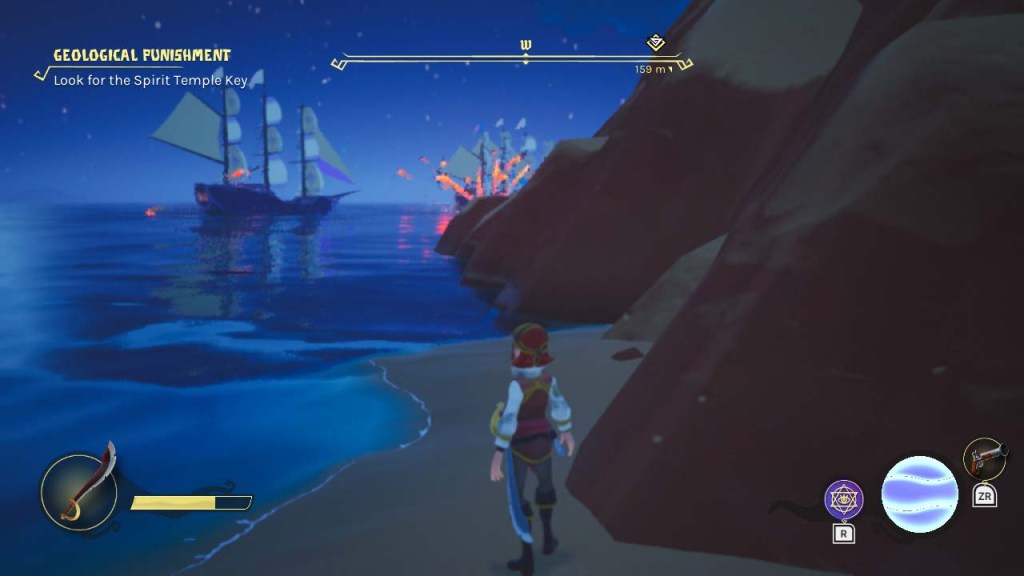
Pop-in, as we’ve come to expect from UE titles, is also present, with smaller environmental assets and props popping in mere feet from the player character. At one point, I wasn’t sure if the circular blob masquerading as a tree was meant to look that way or the textures simply hadn’t loaded in.
Finally, there’s the overall framerate which can create a sluggish feeling experience, particularly in combat against multiple opponents, where inputs don’t always register. It’s not unplayable mind you, but it feels like the Switch version of the game needs more optimisation. Surprisingly, the developers have managed to implement some fairly nice looking screen space reflections on water surfaces. It does help to make the water look nicer, but I’d gladly see this effect sacrificed in favour of a higher resolution and a more stable frame-rate.
Even with all these issues, I still found myself enjoying much my time with Trident’s Tale, especially once I ditched the lock-on for combat. There’s a fun, all-ages adventure here just waiting to be given a chance – but I don’t think the Switch version is the best way to experience it.
Pros:
- Simple fun designed for all ages
- Exploration and naval combat feels rewarding
- Plenty of crafting recipes to find
Cons:
- Runs at a low resolution on the Nintendo Switch with severe pop-in
- The poor framerate results in sluggish controls
- Some terrible dialogue
- A frustrating lock-on camera
Score: 5/10
Trident’s Tale was reviewed on Nintendo Switch using a code provided to gameblur by the publisher. It is also available on PC, Xbox One/Series S|X , and PS4/5.
 gameblur-v2.0