
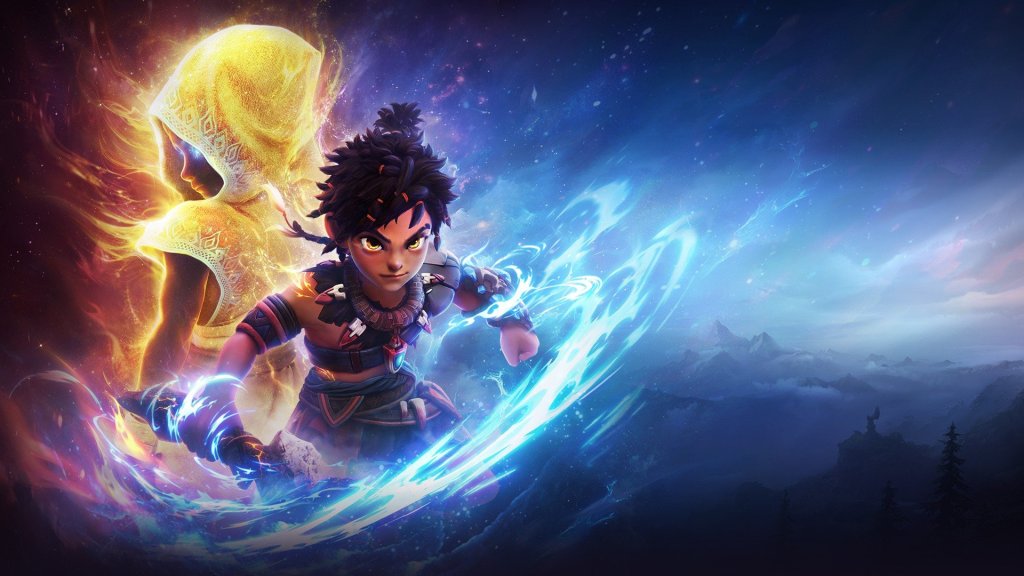
While Kaku: Ancient Seals bills itself as an open-world, action-adventure RPG, in reality – and spiritually – it feels a lot closer to the PS2- and PS3-era of large zone, action-platformers, like Jak & Daxter and Ratchet & Clank. Just with a sprinkling of modern ARPG mechanics. Make no mistake, that’s no slight against Kaku and developer BINGOBELL’s aspirations, as Kaku certainly goes big in just about every way it possibly can.
Set during some primeval era, Kaku throws you into the shoes of young Kaku himself. A quest to capture a flying piggy leads him to a bigger quest to save the world. Kaku is the anointed one and the future of the world – now split into four continents by way of a catastrophe – needs some serious saving. Kaku has to use his newly acquired godly powers and return elemental balance to the world.
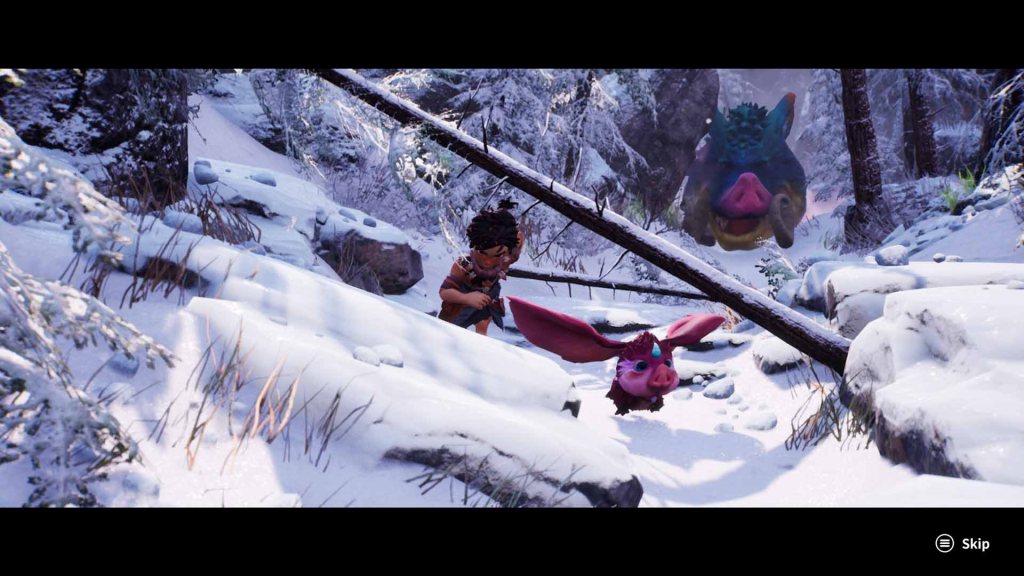
And Kaku’s quest isn’t just big, it’s massive. Because Kaku’s world is massive. There are four continents for you to run across to set things right in, populated by primeval creatures of all sorts, like savage tribes and elemental Lords that need to be taken down to right the elemental imbalance. All of which is rounded out by side-quests to take on, both brain teasing and environmental puzzles to solve, platforming challenges and puzzles, and lots and lots of combat.
If that sounds like a lot, that’s because it is. Like many open-world games, Kaku perhaps throws a little too much at you to do, a lot of which becomes repetitive by the time you’ve reached the second continent and the play-style and story-flow is established. So while I did eventually wear myself out on finding shrine keys and collecting all the various items you need for upgrades and crafting, the exploration and platforming still managed to keep me hooked. And a lot of that is down to the games world design.
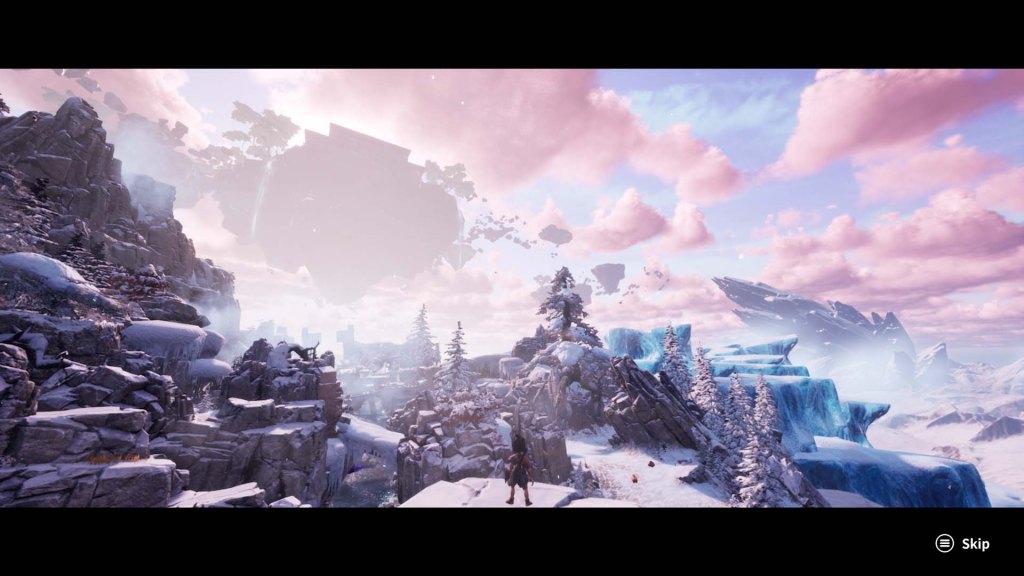
Each continent is home to a different biome, from wet marshlands to dry-as-bone deserts and freezing glaciers, providing a nice variety of gorgeous locales to explore. Because each area is so large, Kaku is dotted with teleportation pillars for you to unlock via a fun puzzle game that has you sliding blocks to certain positions within a set number of moves.
Although you can approach any continent at any time (even jumping between them during missions), Kaku’s environments are less open-world and more open-zone, as each continent is broken up into different regions and temples that you load into. This is a good idea as it helps to make each area more navigable, while providing greater variation and themes. Invisible walls do, unfortunately, pop up when you reach the edge of the games map, which both looks and feels awkward.
The platforming, which is one of the games highlights for me, is very traditional, with the ability to double-jump and air dash to navigate the pitfalls around you. We’re talking moving platforms, spiked and fire platforms, and switches you need to hit while riding platforms that are moving or falling apart. In short, it’s fairly traditional stuff for 3D platformers but it is done well.
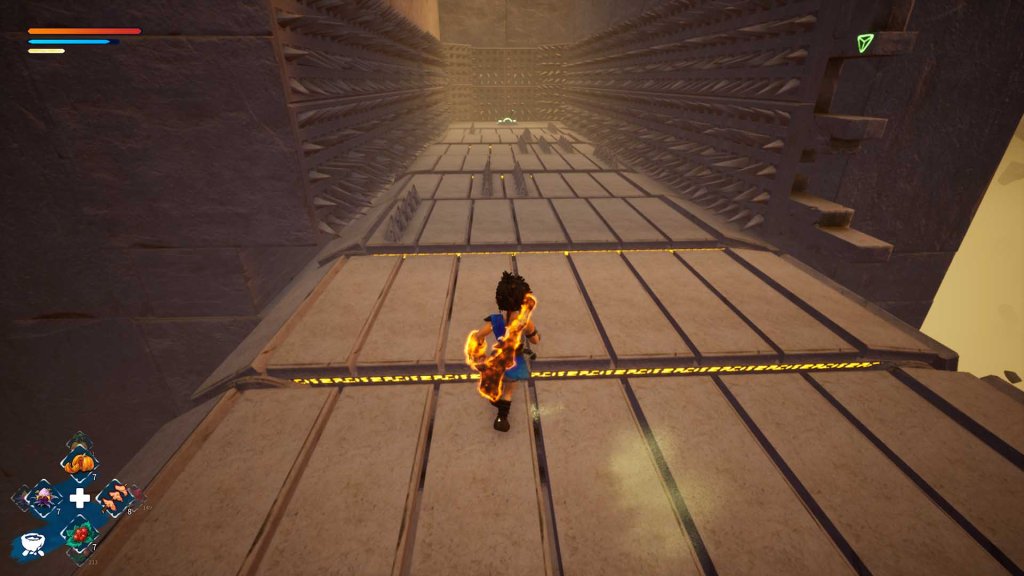
Combat is where you start to see more modern mechanics with enemies that have massive health and stun bars. Kaku has a light attack, an arm guard attack that damages the stun bar, and a wide range of combat skills to unlock, These range from more melee attacks, ranged attacks, and what is, essentially, a super mode that heals you while giving you access to godly weapons and damage output for short durations.
The said, combat is easily the weakest aspect for me. The enemies being bullet sponges are just one of the many combat issues that eventually had me kiting enemies from a distance when I could, or just avoiding them completely when I could. A lot of that comes down to Kaku’s combat speed and animations that feel too slow coming out of or transitioning between attacks. When you combine Kaku’s slow move-set with enemy attacks that briefly stun you and many enemy attacks, especially projectiles, that are really fast, all too often you get stuck in stun-lock loops and pummelled in mobs. Enemies also do pretty hefty damage, even when you start to upgrade Kaku’s stats.
I also found a fair amount of cheap enemy placement in environments that require lots of platforming with deadly drops beneath you. Large enemies on small ledges with little room to manoeuvre is just a giant no.
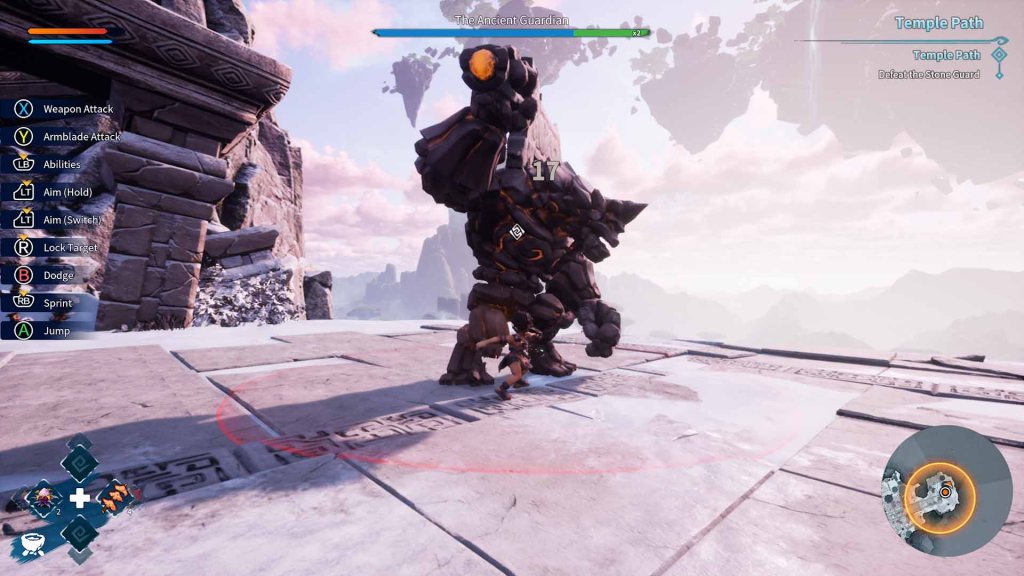
Boss fights tend to go big with giant enemies that have multiple health bars and attack patterns you need to pay attention to. While they’re generally more fun to engage than common mobs, they’re still plagued by the same combat issues which can be aggravating when you’ve taken a boss down to it’s last health bar, only to be stun-locked and knocked off a platform to your instant death, and have to restart the entire fight.
One thing you’re going to have to do is upgrade to keep Kaku alive. If you don’t, you’ll quickly watch your health disappear in a flash while dishing out single points of damage to groups of enemies.
There are a fair amount of crafting materials to gather: from shards that drop from enemies you use to upgrade your base abilities, to various ores and plants for healing and inventory expansion. There’s a very light crafting system for cooking beneficial foods and creating elemental ammo for your slingshot. Armour and weapons can’t be crafted or upgraded; instead, they’re dropped from bosses or picked up from chests and have buffs associated with them The most you can do is socket them with ruins that add incremental perks like ten percent more health.
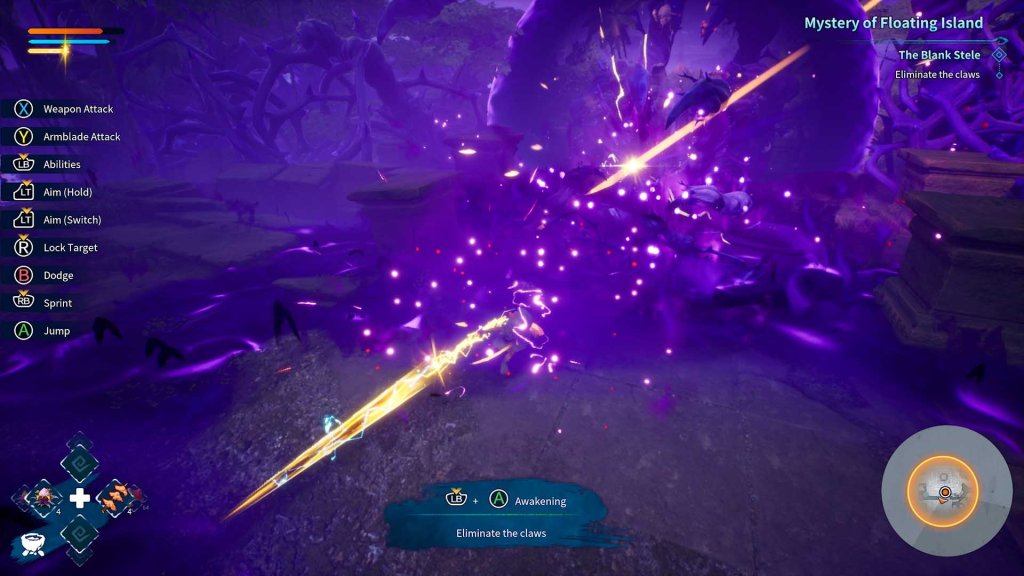
What you really want to do is rapidly upgrade Kaku’s inventory limit, how much food he can carry, his health, stamina, attack, and defence – everything really. Attack, defence, and item limits are easily upgraded in a sort of spirit realm, where you channel crafting items into unlocking higher tiers of damage and defence. Kaku’s skill tree has a variety of useful attacks and you can also only upgrade them here (at launch, the skill tree video is bugged though as it plays the same video for each of Kaku’s skills instead of showing the correct one per skill).
Following in Breath of The Wilds footsteps, there are small puzzle-platforming temples in the spirit realm you need to complete to upgrade health and stamina. These formed some of my favourite moments in Kaku, as they required you to use the bulk of your platforming skills in bite-sized moments that didn’t outstay their welcome.
That said, upgrading doesn’t make the combat and it’s surprising difficulty, any better but it does make fights shorter. Even when I’d upgraded Kaku’s damage output to its fourth tier, I still preferred to avoid fighting unless I had no other choice.
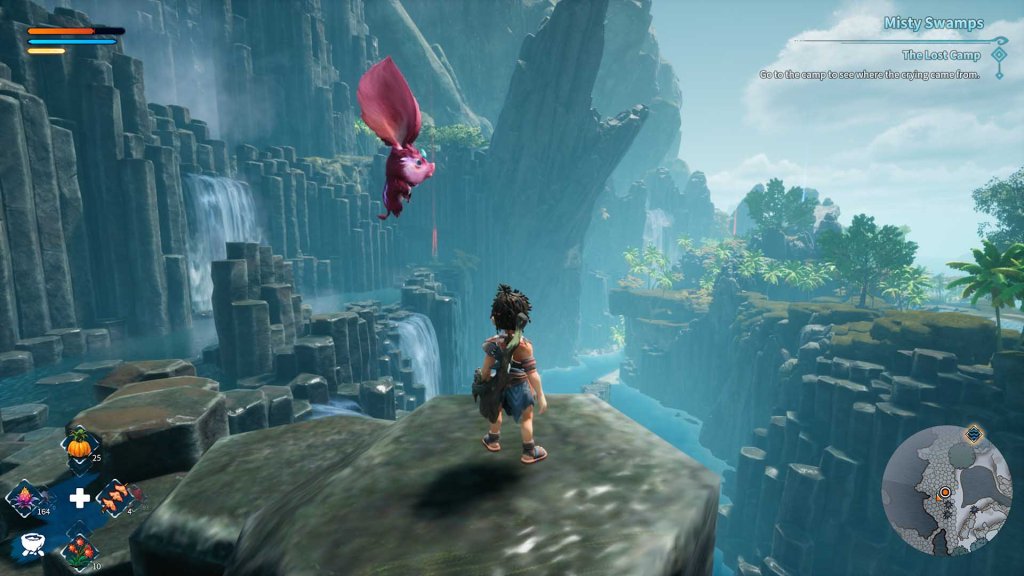
Returning to the positives, Kaku is a mostly gorgeous game. While I don’t think the cut-scenes do a great job of showcasing this, the scenery when you’re exploring Kaku’s world are, oftentimes, quite stunning. There’s a wonderfully massive sense of scale captured by the environment design that always made it a pleasure for me to see what was around the next bend.
While Kaku has some issues and kid-friendly visuals that belie its high combat difficulty (and the occasional frustrating platforming moment), BINGOBELLS adventure still manages to feel like a fun return to action-platformers of old. If you can overlook the frustrating combat system that could do with some fine-tuning, there’s still plenty of fun to be had in its primeval world.
Pros:
- A massive multi-zoned world to explore
- Beautiful environments that create an epic sense of scale
- Fun platforming, puzzling, and exploration gameplay
Cons:
- The combat feels overly difficult and mechanics need fine-tuning
- Some poor/cheap enemy placement
- Repetitive area side-quests and tasks for upgrades
Score: 7/10
Kaku: Ancient Seals was reviewed on Xbox Series S|X using a code provided by the publisher. It is also available on PC and PS5/Pro.
 gameblur-v2.0