Tag: Warhammer 40K

  • Editorial: Warhammer 40,000: Rogue Trader on Nintendo Switch 2 crams a massive CPRG onto tiny hardware to varying degrees of success.

    Editorial: Warhammer 40,000: Rogue Trader on Nintendo Switch 2 crams a massive CPRG onto tiny hardware to varying degrees of success.

    As a fan of classic CRPGs who grew up playing Baldur’s Gate, Icewind Dale, and Neverwinter Nights, I can’t help but love Owlcat’s isometric CRPGs. Just how much I love them, however, depends on the amount of free time I have. Their prior CRPGs based in the Pathfinder universe – Kingmaker and Wrath of the Righteous – have their flaws, but their epic scope and ambition made them easy to forgive once I was hooked. Warhammer 40,000: Rogue Trader continues that time-devouring trend, albeit this time within a distinctly gothic, grimdark, sci-fi universe.
    For that reason, the prospect of a Nintendo Switch 2 version, which I could pick up and put down whenever I had the time, was incredibly tempting – despite having sunk 60 hours exploring the Koronus Expanse in the Xbox Series port already. Like all good CRPGs, there is scope for replayability by rolling a different character class, experiencing the impact of tackling missions in a different order, adventuring with a different group of companions, making different major decisions at the end of each act, and role-playing a more ruthless or evil character (not that I ever do).

    Having now sunk another two-dozen hours into Warhammer 40,000: Rogue Trader on the Nintendo Switch 2, the results are predictably hit-and-miss given the size of this game and some hardware limitations. Portability always requires sacrifice – especially when dealing with a small screen in a menu- and text-heavy game. On the upside, the outcome is mostly positive if affordable and optimised portable play is your goal. If, however, you intend to make use of the Switch 2’s hybrid nature and occasionally play it on a 4K TV, the results are less impressive.
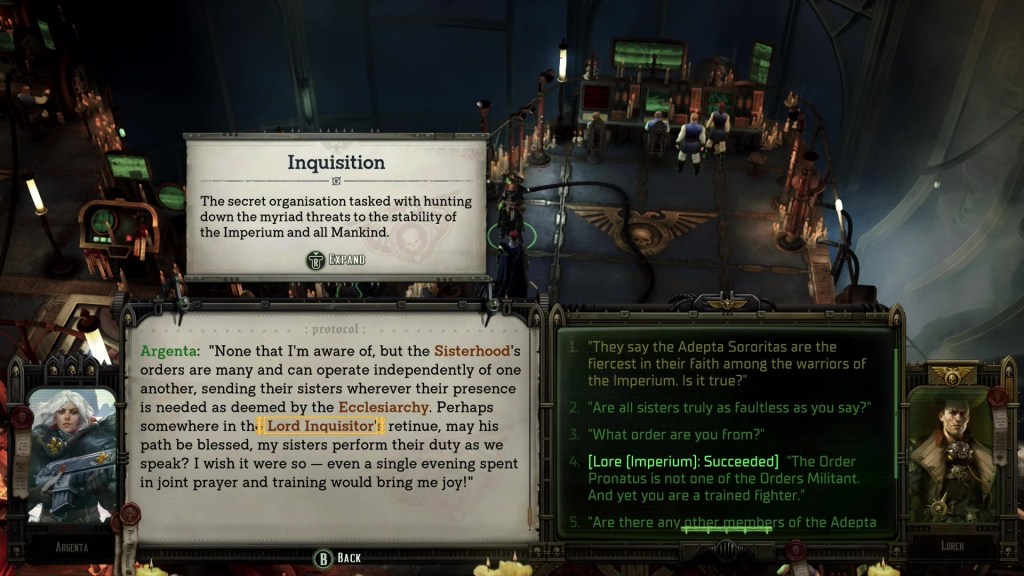
    Starting with the good, Warhammer 40,000: Rogue Trader on the Nintendo Switch 2 is feature-complete with no gameplay compromises (and it’s cheap). It is every bit as massive and engaging as the PC version or the other current-gen console ports (and the DLC expansions are arriving soon). The platform has no shortage of lengthy Nintendo first-party adventures and third-party JRPGs, but this is a rare western-styled CRPG for fans of the genre (the other options being literal classics, like Beamdog’s and Aspyr’s remastered D&D IP: Baldur’s Gate, Icewind Dale, and Neverwinter Nights). Isometric exploration, tactical turn-based based battles, dialogue choices with abundant skills checks, more exposition than anyone needs, and major choices that alter the later acts – it’s all accounted for.

    It took a post-launch patch or two, but Warhammer 40,000: Rogue Trader on the Nintendo Switch 2 runs as well, if not better than the PC version on the Steam Deck and original ROG Ally (my only other points of handheld comparison). On the handheld screen, enabling TAA produces a slightly softer but less noisy image, while the framerate sticks to the 30fps target outside of a few rapidly panning cutscenes with alpha effects. Coupled with a UI and controller scheme developed and refined for the current-gen consoles, it feels more than responsive enough for general exploration and the turn-based combat. Even the load times are respectable, albeit a little longer than on the other consoles.
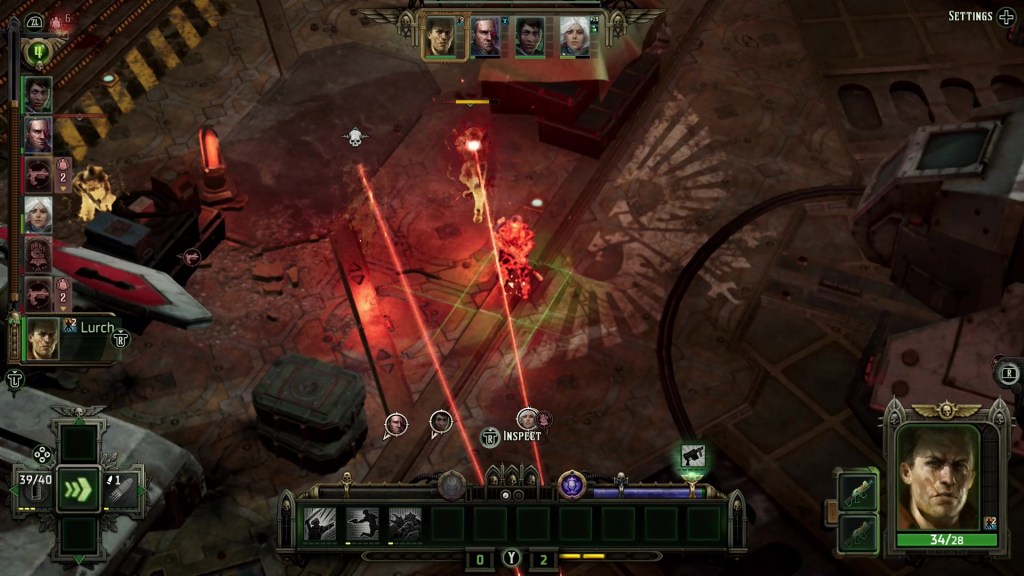
    The are, however, three issues of note – one subjective and two with gameplay implications. When docking the Nintendo Switch 2 and connecting to a 4K TV, you are getting a better experience than the Steam Deck or ROG Ally is capable of. However, the image is notably blurrier than when playing on even the budget Xbox Series S (especially when dynamic resolution scaling kicks in), and it appears to lack some post-processing effects that leave environments looking too bright and lacking depth. Of course, visual quality is subjective and the ability to easily suspend, resume, or continue your game away from the TV is a major perk.

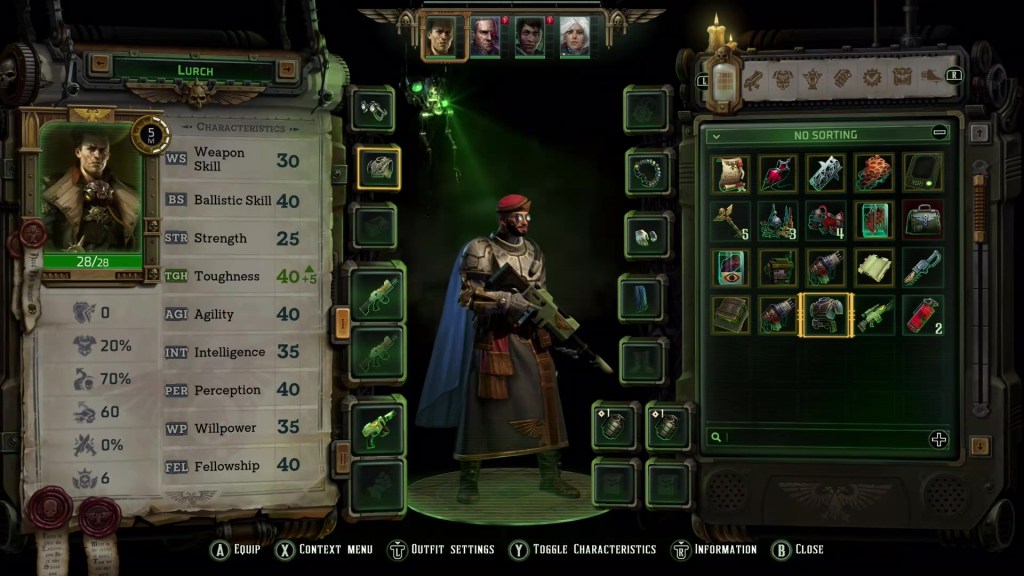
    More problematic are the awkwardly overlapping menus, tooltip boxes, and tiny text when playing in handheld mode. Navigating exposition-heavy dialogue menus, cycling between environmental text descriptions, and comparing items in the inventory is a core part of any CRPG and incredibly frustrating on a small display. One potential solution is using a Joy-Con 2 as a mouse, but the implementation is an all or nothing approach. The gamepad UI is replaced by icons around the screen and almost every aspect of the game is controlled by the mouse, slowing down the pace by making actions like simple camera control frustrating.
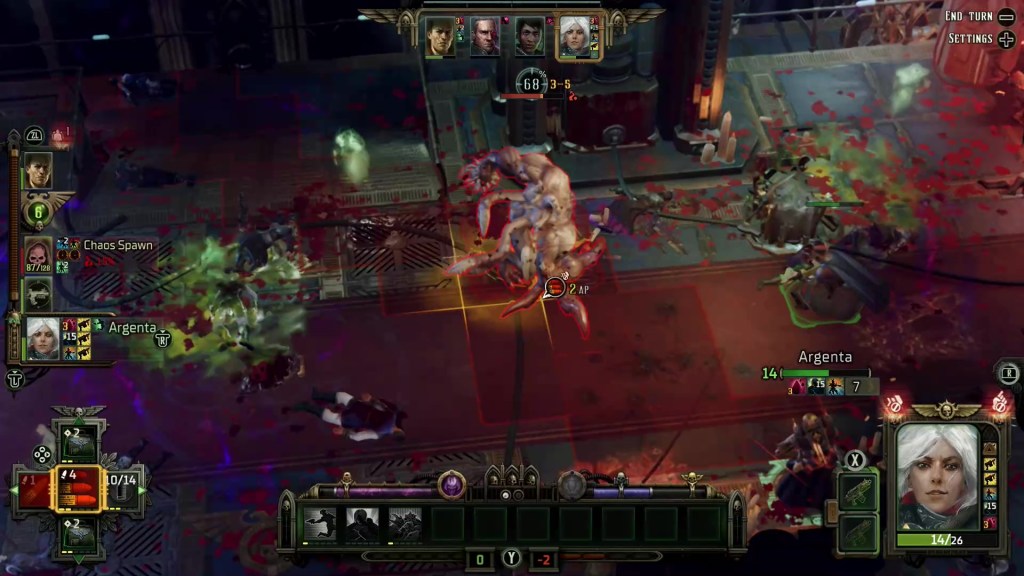
    Ultimately, you’ll need to consider how plan to play Warhammer 40,000: Rogue Trader on the Nintendo Switch 2. If you play mostly in portable mode, it is an impressive version that looks and performs better than all but the most high-powered handheld PCs. The text size and limited screen space is an issue, but the rest of the port is solid and it looks good on a small screen. If, on the other hand, you alternate between portable and docked play (or if your Nintendo Switch 2 lives under the TV most of the time), Warhammer 40,000: Rogue Trader looks rough in comparison to other current-gen console ports, and the mouse controls need more refining. All that said, if the Nintendo Switch 2 is your only console, CRPG fans should jump on the opportunity regardless.

    Warhammer 40,000: Rogue Trader was reviewed on Nintendo Switch 2 using a code provided to gameblur by the publisher. It is also available on PC, Xbox Series S|X, and PS5.
  • Retrospective Review: Warhammer 40,000: Dawn of War – Definitive Edition

    Retrospective Review: Warhammer 40,000: Dawn of War – Definitive Edition

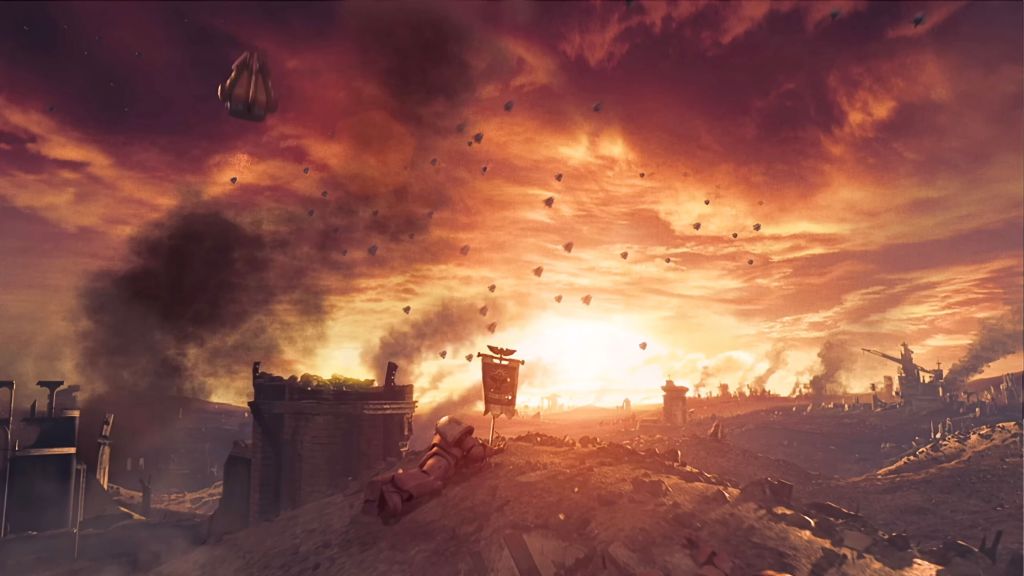
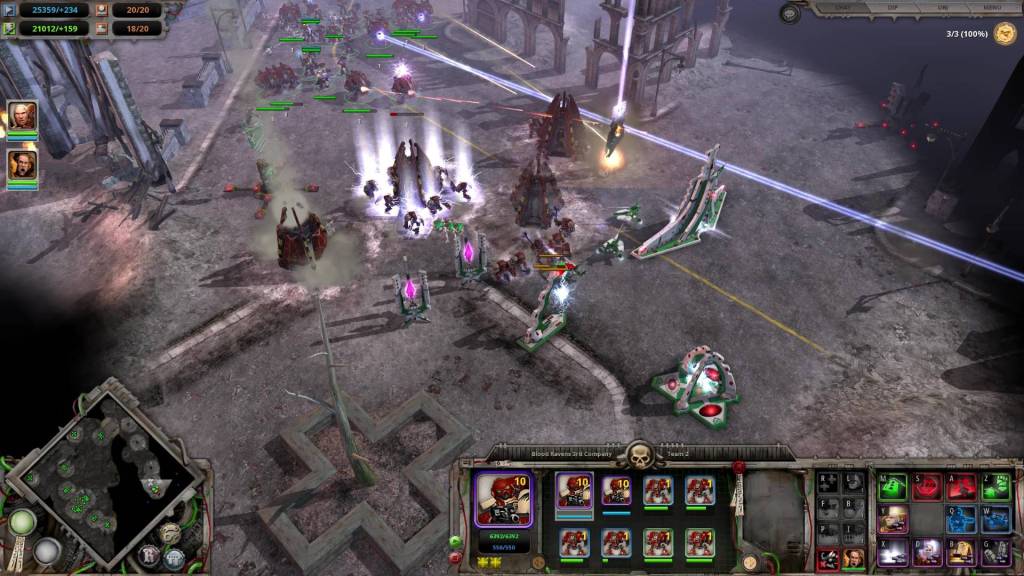
    If 1995’s Command & Conquer built upon early real-time strategy attempts to perfect the foundations of the genre, so too did 2004’s Warhammer 40,000: Dawn of War for the nascent squad-based RTS genre. Strategy games in which your ability to micromanage fewer squads and control territory is often more important than fortifying bases, tech-ing up, and overwhelming your opponent with a mass of units (which is not to say that can’t be done). Losing territory could swiftly strip you of resources and access to high-tier units, while losing entire squads and powerful leader units could turn the tide against you as you scramble to reinforce from scratch. Two decades on, even with real-time strategy reduced to a more niche market, the legacy of Relic’s Dawn of War is still visible in game design.

    Returning to it by way of the Warhammer 40,000: Dawn of War – Definitive Edition, I forgot how much it feels like a game of two halves – each half catering to a very different audience. If you share my fondness for fortifying every square inch of a map as you expand, upgrading every unit as far as possible, and using tactical retreats to preserve squads for a final push, the campaigns and lower difficulty AI skirmishes – either solo or coop – have you well catered for. If you prefer reactive, high-intensity, high-mobility battles to claim and hold territory, the PvP modes have you covered and, to a lesser extent, the Dark Crusade and Soulstorm campaigns on higher AI difficulties.

    If this remaster is your introduction to Dawn of War, it is one of those “easy to grasp, hard to master” games. The original campaign and Winter Assault expansion serve as lengthy, glorified tutorials that introduce basic mechanics and strategies, while providing all the narrative context and world-building you could ask for. You might think Space Marines killing aliens and demons in the God Emperor’s name has limited potential, but the Dawn of War campaign gets right what so many modern Warhammer 40,000 games gets wrong: the cast show some self-awareness of the absurd universe they inhabit, it focuses on the distinctly human flaws under a Space Marine’s superhuman physiology, and that humanity makes it easy to root for the protagonists. The Winter Assault campaigns lean more into the absurdity and hypocrisy of the universe, whereas the Dark Crusade and Soulstorm expansions only offer narrated flavour text to link together skirmishes.

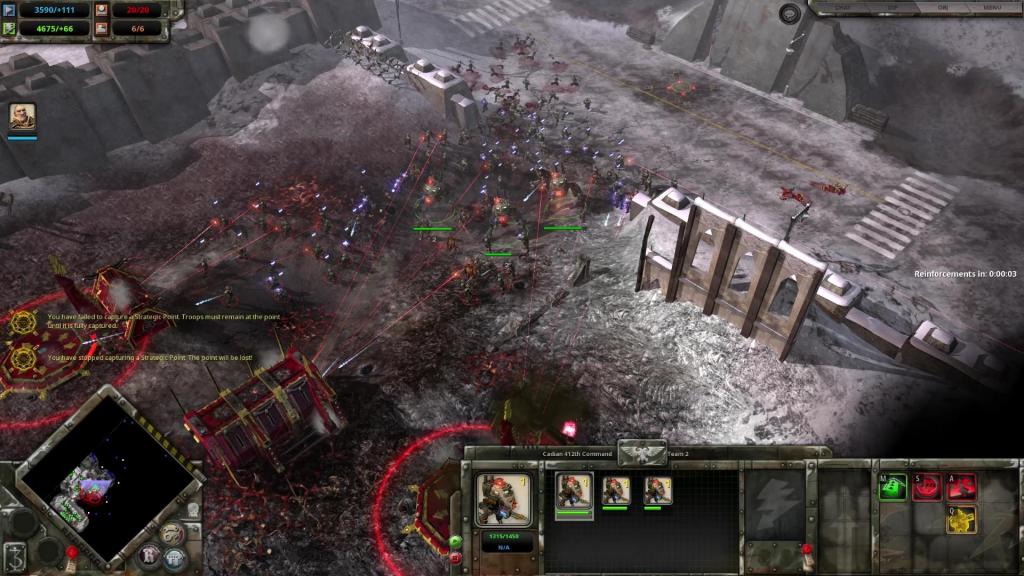
    Of course, the minute-to-minute gameplay is the draw of any RTS, and the Dawn of War – Definitive Edition offers up everything from exhilarating chaos to plodding grind, with no shortage of frustration that’ll have you cursing unit pathfinding and their lack of self-preservation. Befitting the squad-based focus, base-building is relatively simple with three resources to manage – requisition, power, whether you control a holy relic or not – and there are typically three tiers of global upgrades. Controlling units is standard RTS fare but in addition to global upgrades, you can personalise squad weapon loadouts; attach support units, define movement and engagement rules; use light and heavy cover to enhance infantry effectiveness; and exploit morale damage, negative cover, high ground, and line-of-sight to give your forces the edge.

    Irrespective of which of the nine factions you play as through the campaigns, skirmishes, or PvP modes, the basics are the same – even if the base-building and upgrade pathways may differ slightly. Control points need to be captured and fortified to generate requisition; generators or scattered plasma sources provide power; and rare holy relics must be captured and held to produce the most powerful units. Capturing points quickly requires spreading your infantry across the map; construction requires shepherding your weak builder units around; your defensive options are limited to one or two turret variants; and turtling is useless outside of scripted campaign missions that limit what enemy forces you face. There are units that can serve as base defence, but entrenched units and turrets are easily outranged. At best, defences can stall an enemy force while you move your army to intercept.

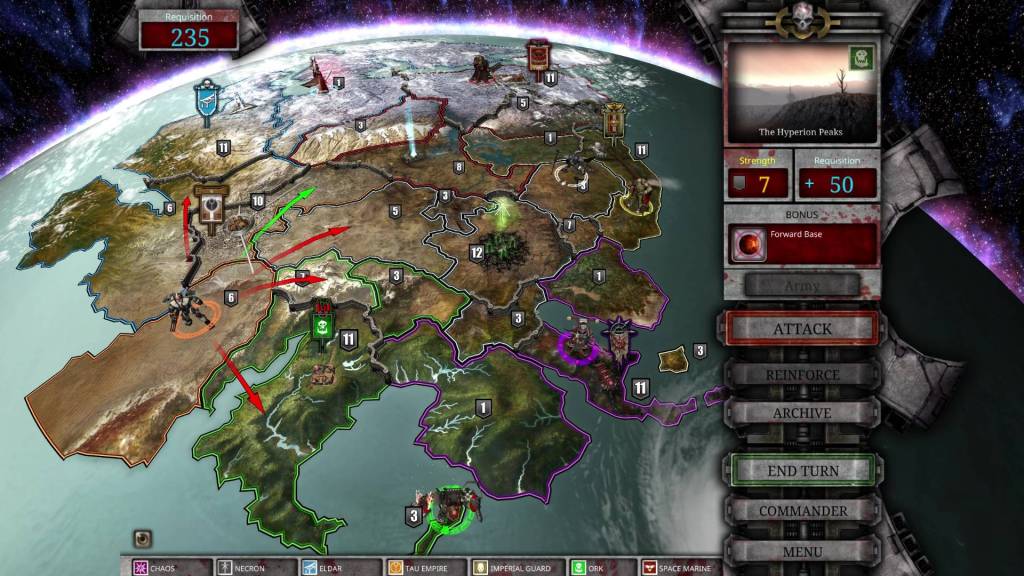
    In PvP matches, AI skirmishes, and much of the Dark Crusade and Soulstorm expansions – which offer turn-by-turn conquest maps to dominate – battles take place across broadly symmetrical maps and play out as dynamic cycles of attack and retreat, favouring those who can juggle expansion and micromanaging their army. Capturing and defending control points is beneficial (and essential for some victory conditions), but your limited defensive options mean a combined army can always steamroll a primary base if not intercepted. It makes for a stressful but thrilling back-and-forth. Even a player that has dominated territory could suddenly lose their key unit producing buildings or holy relic and find themselves with an abundance of resources they can spend on only basic squads.

    In contrast, the original campaign and the Winter Assault expansion are for those who prefer a scripted and more predictable experience. There are a few exceptions that impose time limits, but most missions allow you to slowly spread across a handcrafted map towards your objective. The methodical pacing and lower stakes might frustrate some, as even on the higher campaign difficulties the AI plays by the same rules. They may get free reinforcements at times, but as you claim control points and fortify chokepoints, they lose their ability to counterattack, and your growing force will inevitably steamroll the objective. There’s something about this predictable formula that I always enjoy, but after completing the original campaign and the Winter Assault expansion, I could understand why they wanted to change up the formula with Dark Crusade and Soulstorm.

    I’ve got this far without discussing the remastered elements of the Definitive Edition as it does a great job of presenting the game as you mis-remember it. Having a combined launcher, fully customisable controls, a pulled back camera, and proper widescreen support that doesn’t stretch HUD elements are simple but significant improvements. There are apparently pathfinding tweaks but these did little to alleviate the frustration of units shuffling around one anther instead of engaging enemies. There’s no hiding the limited geometric complexity, but the remastered 4K textures are a notable improvement that serve both the gameplay and rudimentary in-game cinematics well. It also ran at a mostly consistent 1440/60 at max settings on my 5-year-old gaming laptop with an underpowered i7 CPU and 8GB RTX3070 mobile GPU.

    Ultimately, I think the Warhammer 40,000: Dawn of War – Definitive Edition is a solid remaster – even if it’s not a particularly ambitious one. The core gameplay is still strong, even if the campaigns and PvP components can feel a world apart in how they play. Whether you’ve enjoyed structured RTS campaigns or chaotic PvP. there’s something for everyone. It should satisfy returning players looking for a nostalgia hit, and any fan of modern RTS games with a focus on managing fewer, more specialised units. If you’re someone that has spent last decade or two playing and modding the original, you might find the remastering effort too limited to justify the price – but there is the prospect of a revived and more robust multiplayer scene.

    Warhammer 40,000: Dawn of War – Definitive Edition was reviewed on PC using a code provided to gameblur by the publisher.