
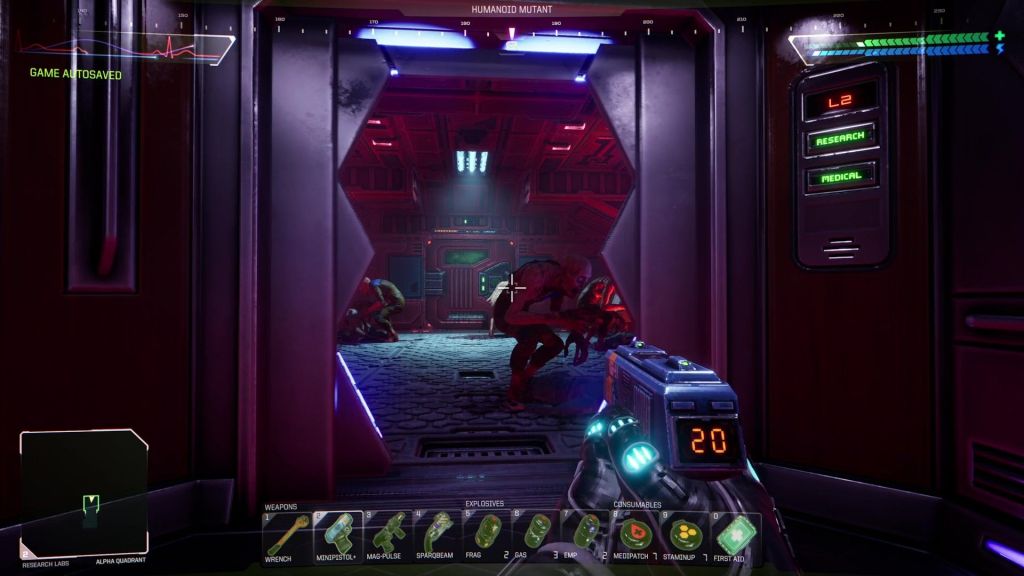
For those thinking of picking up System Shock for the first time on Nintendo Switch 2, Nightdive Studios’ 2023 remake transforms an iconic but dated immersive sim into a first-person survival/shooter hybrid that doesn’t feel out of place alongside modern games. What started as an unwieldy point-and-click/FPS hybrid now plays as a more traditional FPS and it works well enough with a controller. Given combat is so prevalent the change makes sense, and the shooting feels solid; however, navigating menus, inventory management, and interacting with switches or items in the environment can be finicky.
It is for this reason I would discourage anyone playing System Shock (2023) using a standard pair of Joy-Cons. Unless you’re a natural with gyro aiming, they feel far too imprecise in a game that offers no auto-aim assist that I can discern. That lack of precision can still frustrate when using a Pro controller, but the game plays smoothly enough (after patches) so that precision aiming and picking up objects in the environment is manageable. If you are stuck with a pair of Joy-Con 2s, you could try using one as a mouse on a lapboard or something serving the same purpose – though I could not find a sensitivity setting that ever felt as good as a proper PC mouse.
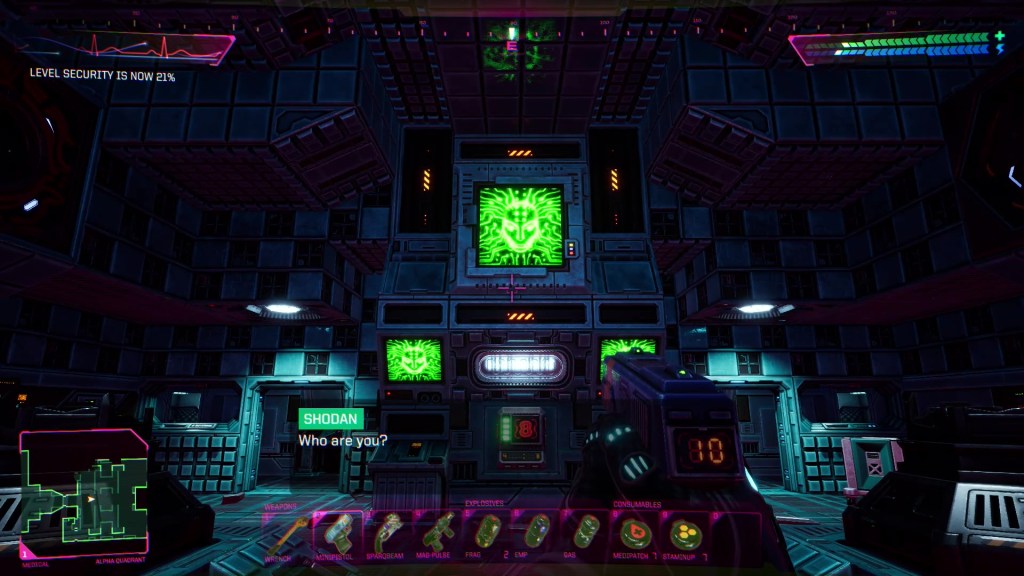
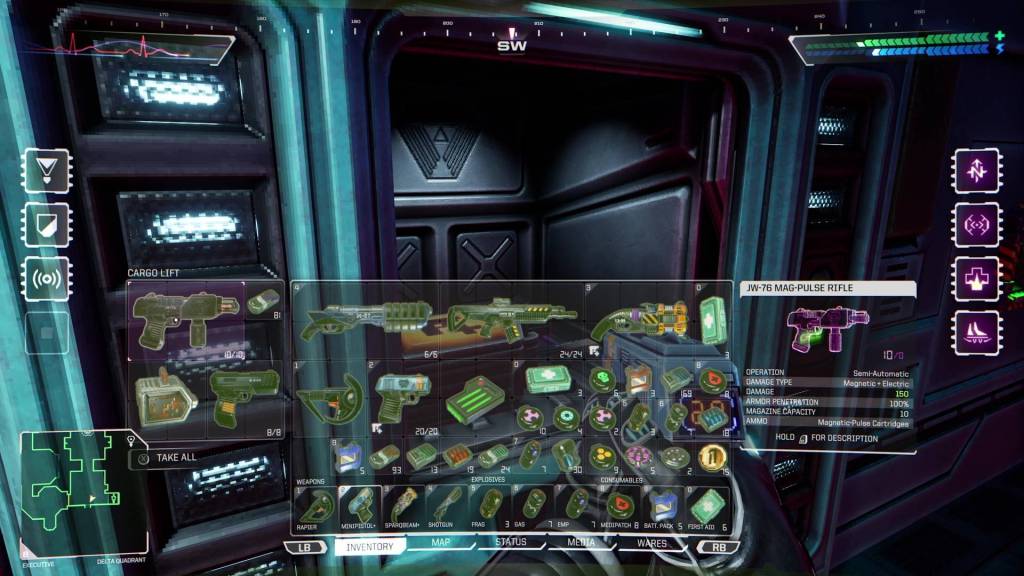
I’m highlighting this caveat early as System Shock (2023) has survival elements with resource and inventory management. Precision aiming is essential for conserving limited ammunition and minimising the damage you take. It’s only during cyberspace sequences and the end-game – when you have your hands on powerful weapons, weapon mods, and upgraded player augmentations – that System Shock (2023) can be played as a run-and-gun FPS with less concern for accuracy.
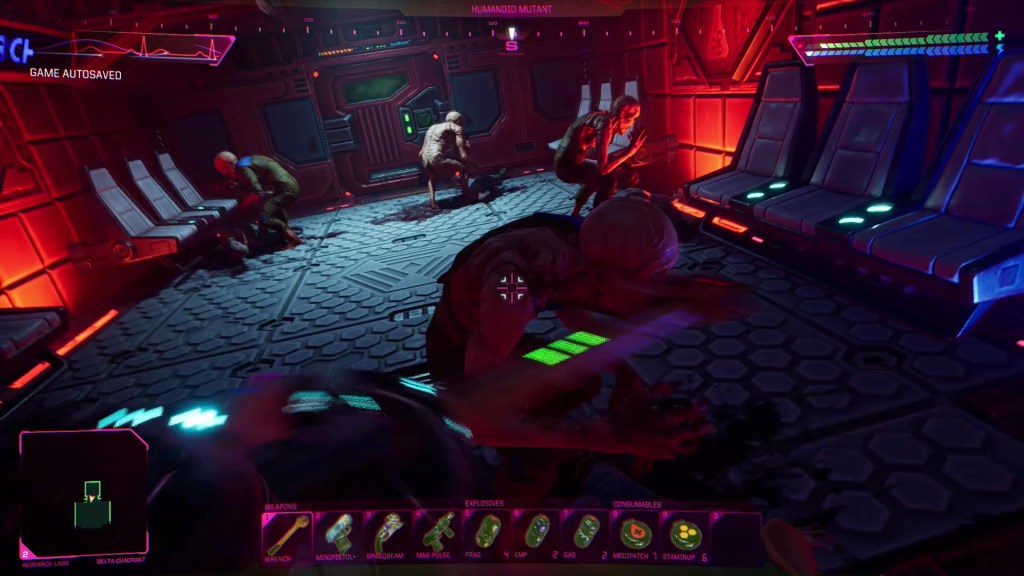
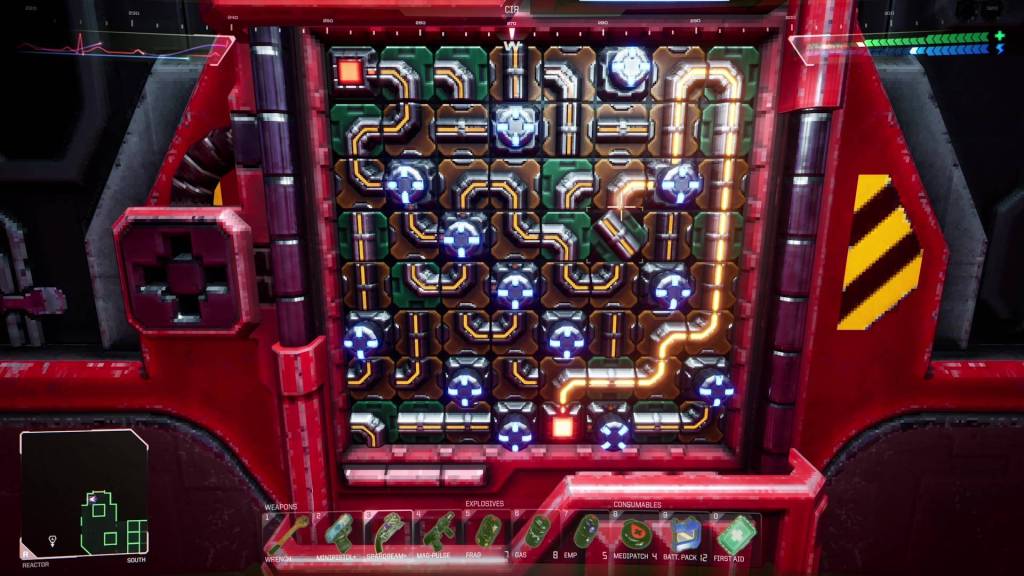
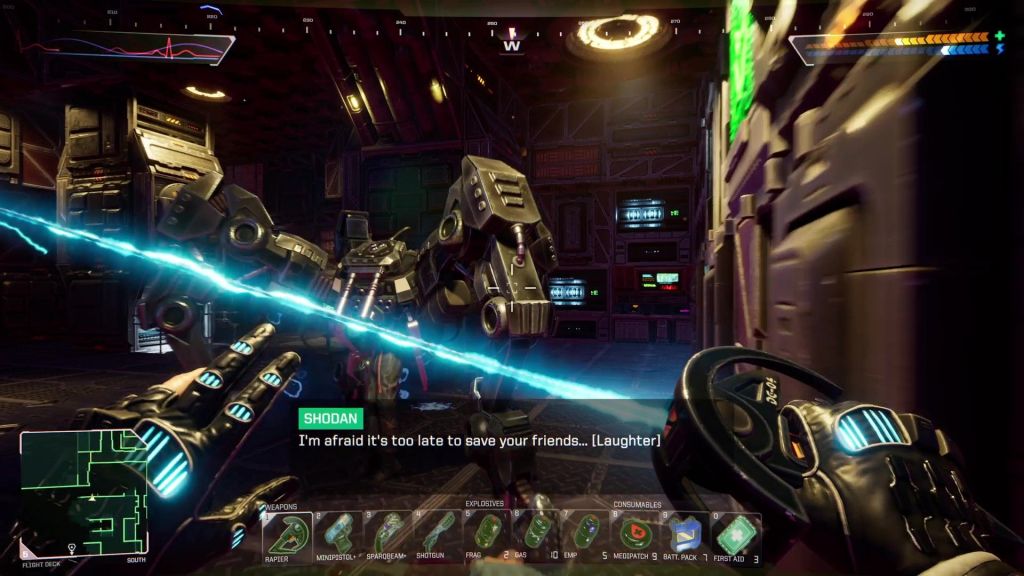
With a Pro controller and the Nintendo Switch 2 docked or propped up in tabletop mode, System Shock (2023) becomes every bit as compelling and immersive as on the other platforms – especially when you combine the stylised visuals with campy voice acting, creepy ambient audio, and an incredible synth-heavy soundtrack. It targets a high resolution with all visual features intact, and it sustains 60fps enough of the time that I rarely noticed any impact on responsiveness. It’s not perfect, however, and given the extensive post-processing effects and pixelation filter on objects near to the player, Nightdive Studios could drop the resolution further to focus on stable performance.
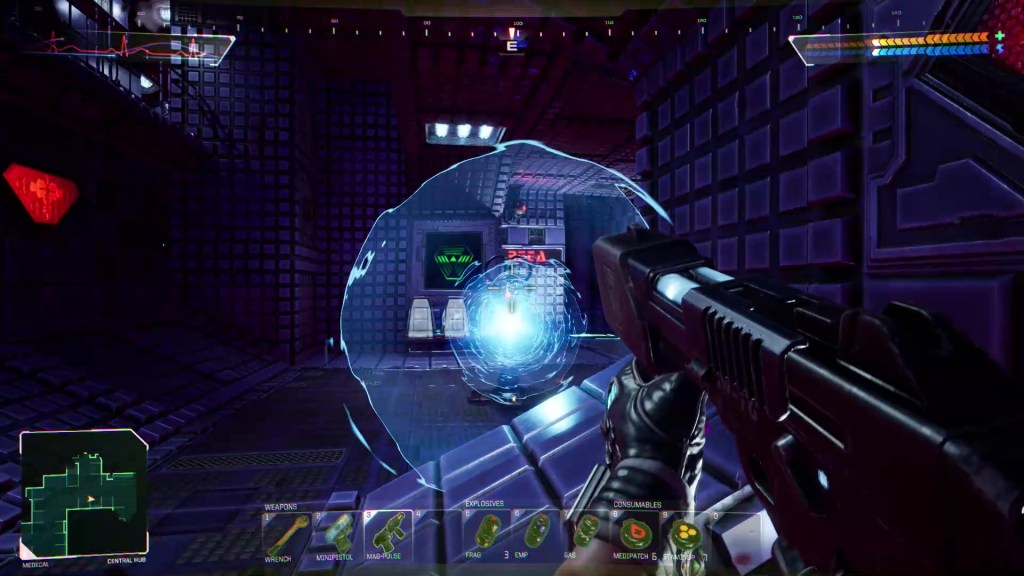
Considering just the game and not the hardware you play it on, System Shock (2023) is essential for those who enjoy more action-oriented immersive sims like Eidos Montreal’s recent Deus Ex games, or Arkane Studios’ Dishonored series and Prey (2017). It has little interest in providing the typical frictionless, heavily-guide experience of most modern games – even if you set each difficulty sliders to the lowest value. Thorough exploration, reading and listening to notes, and then following clues to key items is a core part of the experience. Even on the lowest mission difficulty, the objective icon only gives you a direction of travel, but getting anywhere in the labyrinthine Citadel Station is still a challenge.
System Shock (2023) is a game that rewards or punishes player agency as it should. If you explore cautiously, pick off isolated enemies, hack every door panel, hunt for secret stashes, and conserve resources, you’ll rarely be caught off guard; you’ll be able to minimise the effect of environmental hazards; and you’ll always have heavy firepower in reserve to trivialise a boss encounter or ambush. If you ignore your surroundings, charge into groups of enemies, and waste powerful ammunition, you’ll soon hit difficulty spikes that force you back to the last regeneration bay (or you’ll have to remember to make frequent manual saves).
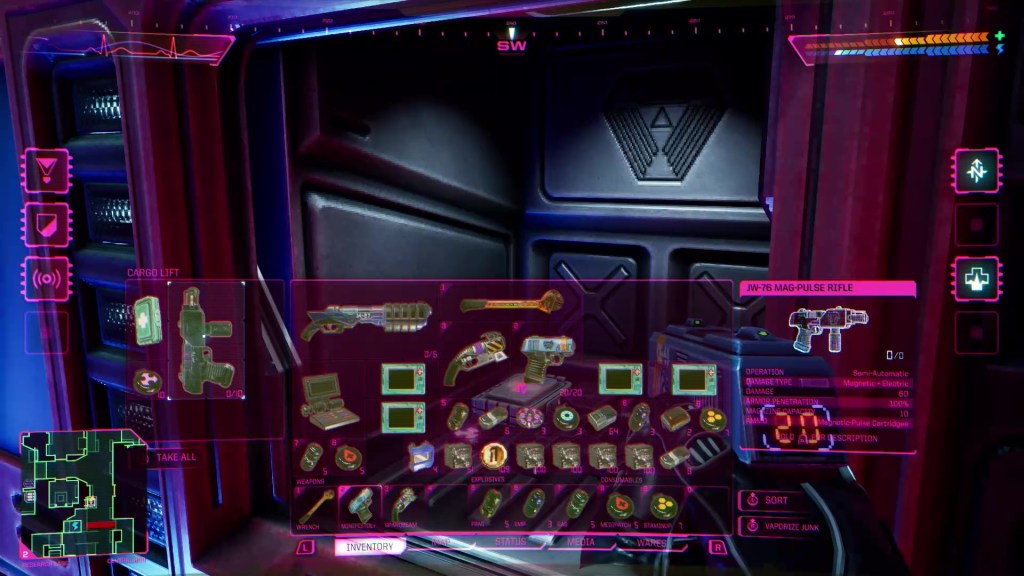
Despite the focus on player agency and freedom, the System Shock remake is still far more playable than its predecessor and closer in design to its well-regarded and equally influential sequel. There are mid-game requirements that might take you back and forth between levels of the station, but it opens up gradually and escalates smoothly towards the finale. For those who listen to audio logs, read notes, and pay attention to environmental details, it also has a wonderfully fleshed out setting and backstory you can piece together. If an audio log or note hints at an event, you can find evidence of it in the environment. Citadel Station provides a cohesive and believable sense of place despite the sci-fi trappings.
Wrapping up, I have now explored the remade Citadel Station across four different platforms. After early teething problems that a patch mostly resolved, the Nintendo Switch 2 port is yet another option easy to recommend to fans of the immersive sim genre looking for a portable option (especially important when you consider how few im-sim options there are on Nintendo hardware). The only caveat is that my recommendation only applies if you have a Pro controller, as the standard Joy-Con experience is predictably awful and the Joy-Con 2 mouse option is not as responsive as it should be.
Pros:
- Yet another opportunity to play the excellent System Shock remake
- It’s a rare immersive sim on Nintendo hardware
- Great visuals, campy voice work, and synth-heavy soundtrack
- Performance issues mostly resolved with post-launch patches
Cons:
- Nintendo Joy-Cons and first-person games are a terrible match
- Those who need a guided experience beware
Score: 8/10
System Shock (2023) was reviewed on Nintendo Switch 2 using a code provided to gameblur by the publisher. It is also available on PC, Xbox One/Series S|X, PS4/5, and Nintendo Switch 1.
 gameblur-v2.0