
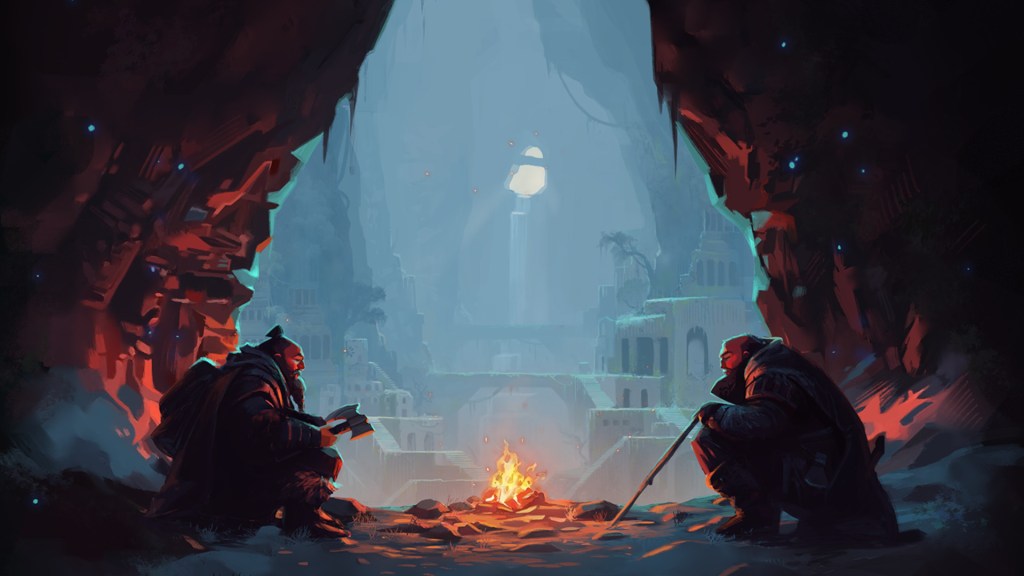
Regions of Ruin was a compelling mash-up of genres when it released on PC in 2018. It offered Kingdoms-style settlement-building with gorgeous pixel-art; bite-sized, side-scrolling action paired with surprisingly dense RPG mechanics; and indomitable dwarves fighting back against an overwhelming horde of savage goblins and orcs. It also had a great soundtrack (suspiciously similar to that of The Elder Scrolls V: Skyrim) that perfectly complemented the action as you carved a bloody path across the continent on a barely signposted quest to uncover a path to an ancient Dwarven sanctuary beneath the surface.
Eight years on, it now feels like an experimental, early-access version of Regions of Ruin: Runegate; a fully-fledged sequel that builds upon the scant narrative the first game offered, while delivering improved visuals, more varied combat with better balancing, quests with extensive narrative, expanded settlement-building, and refined RPG mechanics. You may prefer the classic visual style, but every other element of the game is hugely improved.
That said, the fundamentals stay the same. Regions of Ruin: Runegate is designed for short but more-ish play sessions that have you bouncing between diverse but compact 2D zones – very few of which will take more than five minutes to battle, puzzle, or platform through. You take on quests to aid locals and rescue dwarves; you cull greenskins and other threats that plague each realm; you smash through creates and loot chests for resources and gear; and you frequently return to Rivenbrook – a long-abandoned settlement connected to other realms by the titular Runegate. Unlike the first game, you have a more functional journal to track quests and there is a ton of narrative and world-building for those who want to know more about each realm and the history of the Dwarves.
It offers a satisfying gameplay loop in which you briefly visit settlements or outposts to chat to the diverse inhabitants and pick up quests, travel across a stylish world map as the day-night cycle rolls on, and enter hostile areas populated by man or beast – all waiting to taste your axe (or sword, spear, knife, crossbow, and firearm) in chaotic battles full of pixelated gore and gruesome sprite death animations. Unlike the first game, combat feels challenging but better balanced to support all weapon types. Going stealthy and flinging throwing axes at unaware enemies is no longer the only viable option when dealing with endgame hordes.
Battles on a 2D plane are inherently limited in complexity, but each weapon type – think one hand, two handed, knife, and ranged – has an ideal range, attack speed, crowd-control potential, and varied effectiveness against armoured foes. There’s a focus on managing a stamina bar that depletes as you accumulate wounds in battle, and you’ll want to rack up bonus damage by either hitting enemies from stealth, from behind, while they’re stunned, or knocked down. There is still plenty of jumping, dashing, and slashing during busy battles, but it feels more tactical once you’ve recruited and trained up some companions to draw attention away from you.
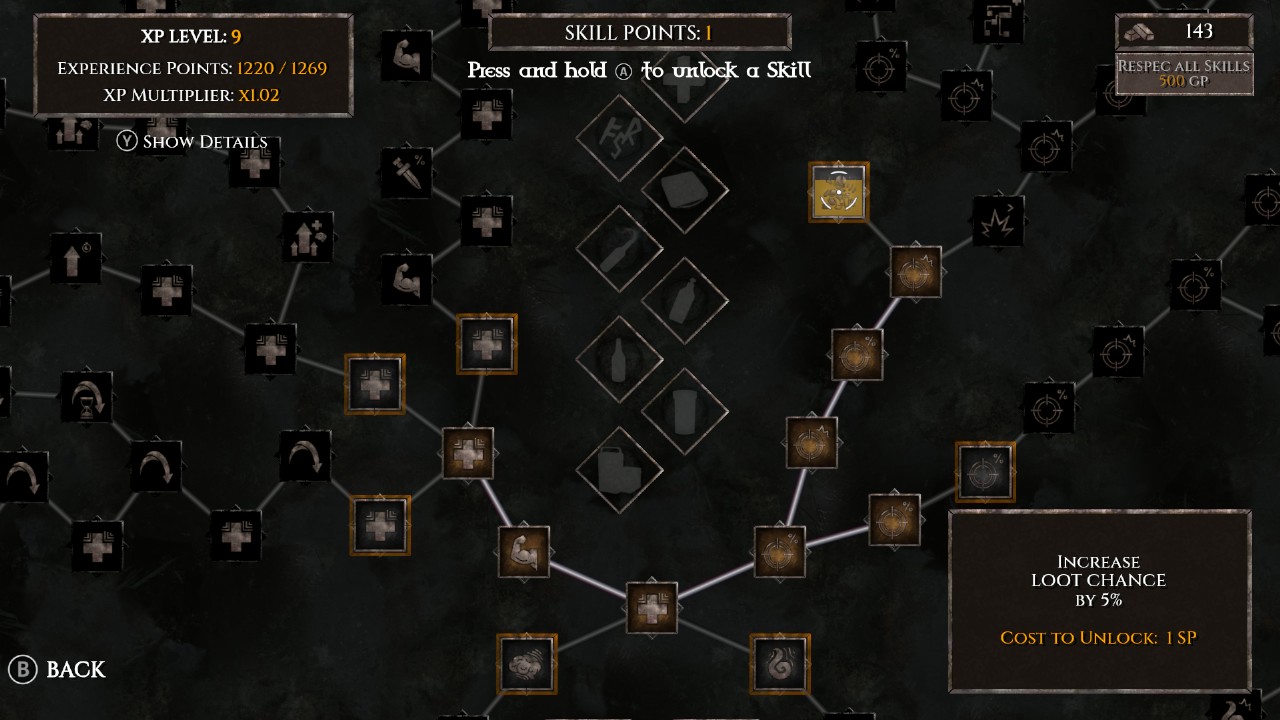
As an RPG, there’s still a strong of focus on character levelling, equipping powerful gear, and rebuilding the Rivenbrook settlement to generate resources and gold, attract shopkeepers and companions, and open up crafting and enchanting stations. Unlike the first game, in which survival in larger battles could feel random, Regions of Ruin: Runegate does a better job of balancing escalating difficulty with character progression. By default, those who don’t rush the main quest will have ample opportunity to fill out an expansive skill tree with essential perks and incremental upgrades, while also looting, buying, or crafting powerful gear to tailor their build. It is a game in which you always feel like you’re on a trajectory towards becoming overpowered and self-sufficient.
By the midpoint of my journey, tearing a path through the arid second realm, I had invested in restoring Rivenbrook’s fishing dock, lumber mill, and mine to ensure an infinite supply of basic materials for further upgrades, crafting, and enchanting. I invested broadly across the skill tree rather than hyperspecializing, with my focus on stacking every damage-over-time perk – poison and bleeding – with weapons that had a high chance to inflict burning status. I also spent a considerable amount of gold and a few skill points to level up my companions – ensuring they could tank some blows and even slowly self-revive while I led away enemies.
Those who tackle everything on offer will find the challenge gradually diminishes, but at least Regions of Ruin: Runegate never feels like it is wasting your time. Restoring and upgrading resource-generating buildings in Rivenbrook means less time spent juggling workers. Merchant stalls, an armoury, and forges means less reliance on loot drops. Companions draw aggro and allow you to tackle encounters with more aggression or creativity. It’s an adventure the feels like starting as a minor rockfall before escalating into an avalanche of Dwarven rage.
I played it exclusively on a Steam Deck and it was a fantastic fit for both the gameplay loop and visual style. The pixel-art looks great, especially when sunlight or moonlight filters through trees and rocky outcrops, and it hit 60fps most of the time (a fully upgraded Rivenbrook and battles with abundant fire effects dragging it down somewhat). It should run well on any more recent handheld PC and I hope a Nintendo Switch 2 port is next in line.
The only two caveats I can think of is there is a little too much text to read through at times (especially on a small screen), and binging Regions of Ruin: Runegate is the quickest way to highlight it’s limited depth and repetitive nature. So long as you’re treating it as a pick-up-and-play game when short on time or between other games, Regions of Ruin: Runegate offers a fantastic 2D action-RPG with few flaws. It moves at a brisk pace, never wastes your time, and turn you into an unstoppable force of Dwarven vengeance leaving bloodied chunks of your enemies scattered across the realms.
Pros:
- An actual narrative and better-defined quests.
- A brisk and immensely satisfying gameplay loop of escalating carnage.
- Settlement building is even more satisfying and allows you to become self-reliant.
- Improved pixel-art visuals, sprite animations, and another great soundtrack.
- A perfect fit for the Steam Deck and other handheld PCs.
Cons:
- Longer play sessions highlight its repetitive nature.
Score: 9/10
Regions of Ruin: Runegate was reviewed on PC (Steam Deck) using a code provided by the publisher.
 gameblur-v2.0