

Although I enjoyed my first experience with the Frostpunk IP on console, I had a feeling the port of Frostpunk 2 would prove more challenging. Despite sharing many core mechanics, Frostpunk 2 is far more menu-driven, with a focus on tweaking supply lines and juggling resource allocation across multiple Frostland sites, rather than restrictive city-building in one location. The result is an engrossing sequel with far greater scope and complexity, but it doesn’t always gel with a controller.
That said, Frostpunk 2 is still a great sequel so long as you’re not after more of the same. The campaign and sandbox-style missions begin with the familiar task of building up a settlement around a generator and exploiting local resources, but it takes less time to establish a logistics hub and dispatch Frostland teams to explore a sprawling over-world map. There are technology paths that focus on fortifying and sustaining a single mega-city by tapping into unlimited resource deposits, but the branching campaign chapters will still force you to explore the Frostlands to either settle or loot distant locations.
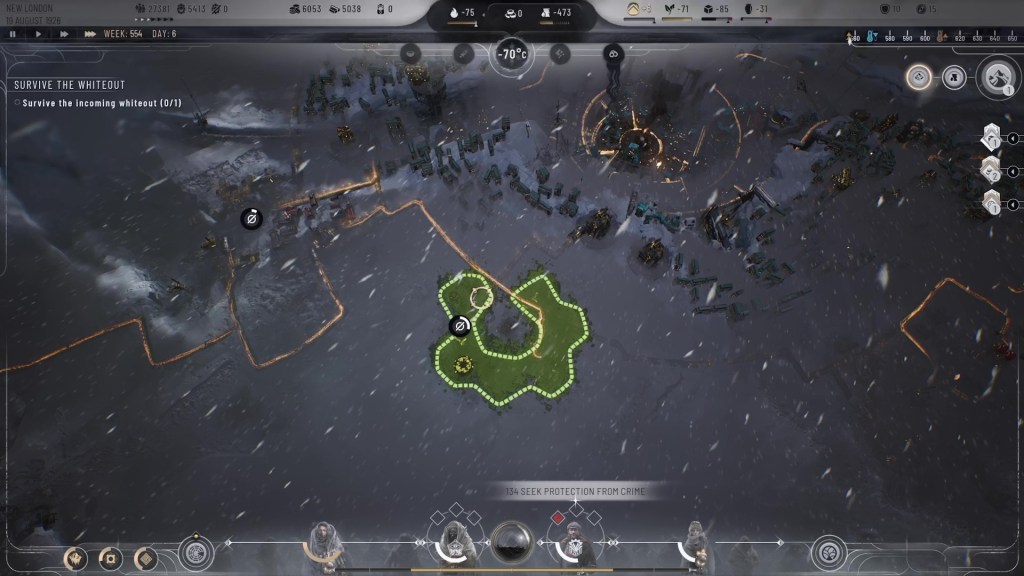
Frostpunk 2 feels considerably more epic in scope thanks to new mechanics and an accelerated timeframe. The in-game clock hurtles forward through days and weeks, so it plays out over years and decades, rather than the days and months of the original. The city-building elements – which now involve sprawling districts, hubs, and key buildings – feels less exacting. In contrast, menu-driven systems that control the flow of heat and workers across your city are vital, and so too are Frostland supply lines let you balance the flow of colonists, food, fuel, and goods between settlements and outposts.
Some may find the reduced focus on city-building disappointing, but there are new and expanded mechanics to keep you engaged. The most obvious is the new council and enhanced interplay of factions within your city. It starts with a simple vote to keep your player on as a steward (which can trigger an early game-over screen) but you’ll soon find yourself using these council sessions to vote on introducing new laws. These govern everything from education and social support, to policing and healthcare – all of which come with pros, cons, and faction preferences. If you play your cards right, there is even a path to entrench yourself as an autocratic leader who rules by edict.
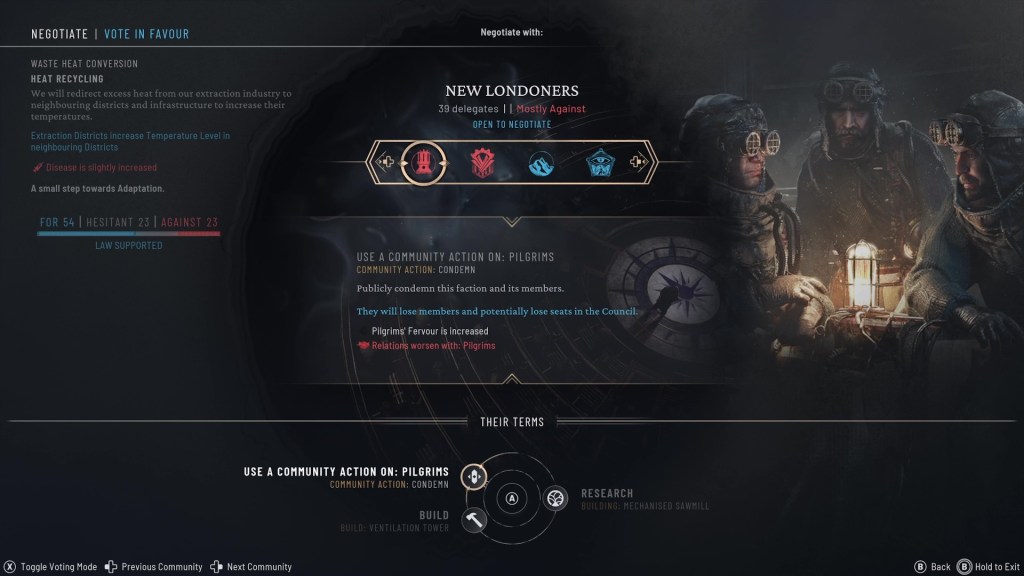
Factions can organically support your decisions, negotiate over future policy and research goals, or force you into a vote if you’ve ignored their requests for too long. If a faction gains dominance, they can start claiming housing districts, offer more support if you’re aligned with them, develop potentially problematic rituals, and even rebel against you – damaging structures and your economy. There is plenty of leniency on the lower difficulties, but a combination of social unrest, fanatics, sabotage, and the elements can conspire to destroy your settlement if problems are left to fester.
It is a complex and sometimes overwhelming interplay of systems, but it is incredibly satisfying to keep your city thriving on the edge of disaster – especially when you are reaping the rewards of an earlier narrative decision or newly researched technology. Gameplay can feel dry as you simply define development zones, flip between information overlays, and shift sliders, but the audiovisual elements are immersive. The city announcer, citizen comments, and short narrative vignettes convey the impact of your choices. Machines clear the ice, basic foundations grow into bustling districts, and well-lit paths and heat pipes connect them. Better still, you can zoom right out into the Frostlands view, zoom back into secondary settlements, or pan across the over-world map to track approaching Whiteout storms that still threaten your settlements from time to time and cut off distant outposts.
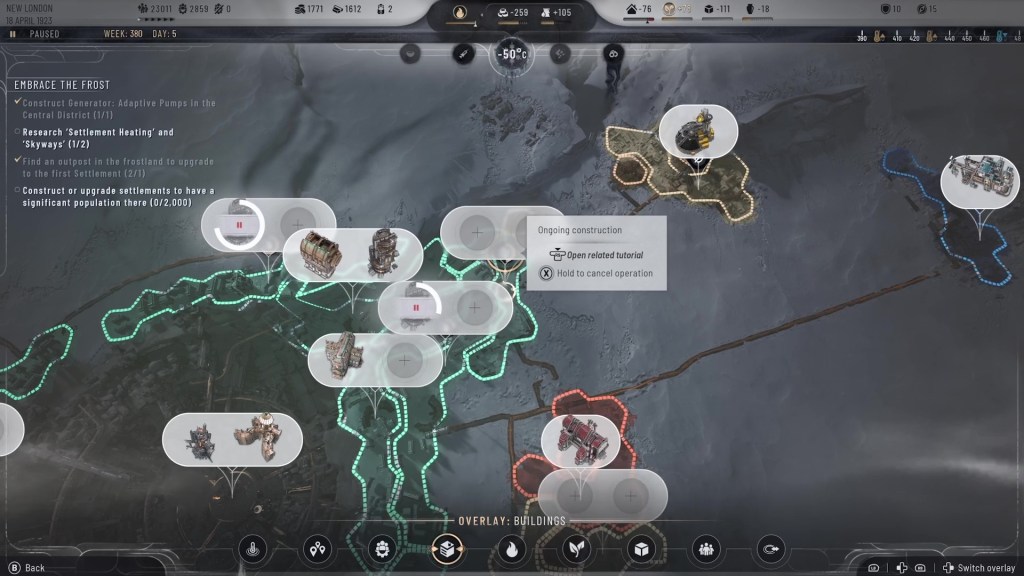
Unfortunately, all that complexity means playing Frostpunk 2 on console (or on PC using a gamepad) will have you fighting the controls just often enough to be frustrating. Selecting the wrong structure in a radial menu or placing a district in the wrong spot is annoying but manageable. Struggling to navigate the screen overlay icons or struggling to shift sliders in sensible increments is far more impactful as the game goes on. When you throw in other annoyances – like repeatedly zooming into a settlement while trying to connect Frostland supply lines, or tutorial pop-ups that won’t close – Frostpunk 2 can begin to grate. I just hope 11 bit Studios is still working on refining the control scheme as the rest of the package is an excellent choice for fans of the city-builders and management games with a survival twist.
Pros:
- It’s easier to establish interconnected cities and settlements
- Managing political factions is almost as stressful as managing resources and the elements
- The choice-driven campaign changes up how later chapters play out
- Generator cities, settlements, and the Frostlands all look and sound more beautiful than ever
Cons:
- The gamepad control scheme feels smartly designed but is awkward and sometimes frustrating in practice
- It can feel like a pure management game at times as you navigate menus, overlays, and maps
Score: 7/10
Frostpunk 2 was reviewed on Xbox Series S|X using a code provided to gameblur by the publisher. It is also available on PC and PS5.








 gameblur-v2.0