Syberia first released in 2002 as a point-and-click adventure with relatively unremarkable mechanics for the time. It was, however, elevated by Belgian comic artist Benoit Sokal’s striking designs, an evocative soundtrack, and a narrative that blended the relatable with the surreal. It was easy to play through the remaster for the story – the third time now if I count the awkward console ports of the PC original – and I’d argue Syberia – Remastered is now the most accessible way to play this uneven cult-classic. The updated visuals are beautiful yet faithful, the UI is cleaner, and a few puzzles have even been expanded or tweaked. That, old flaws remain and a few new bugs can frustrate.
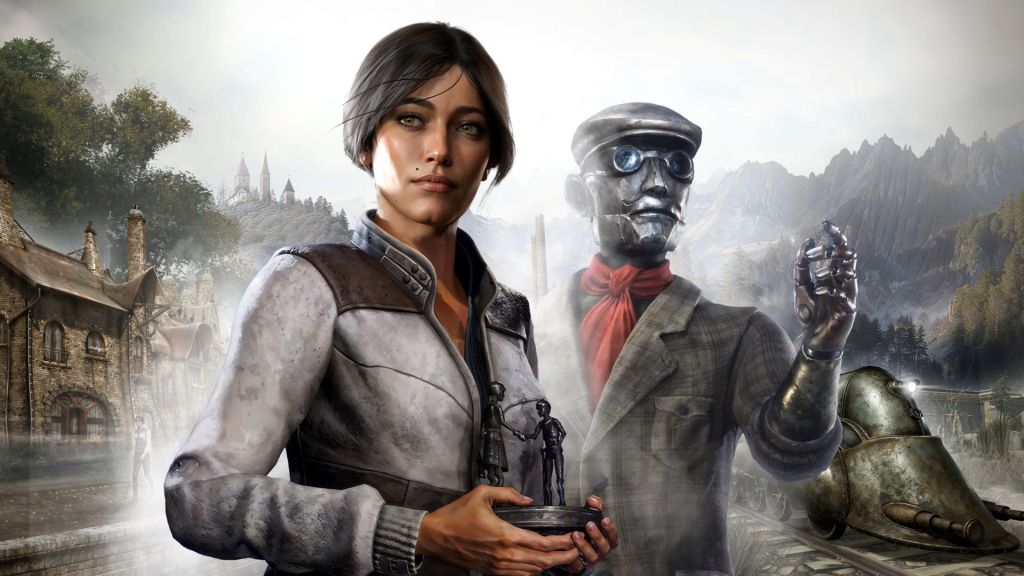
I think what I love most about Syberia is how it balances a growing sense of wonder with unease. You play as Kate Walker, a New York lawyer who looks and sounds like part of our world, but her journey eastward, from the French Alps towards Russian Siberia, feels increasingly detached from reality. Kate arrives in Valadilène to conclude the sale of the Voralberg family automaton business to an American company, only to find the owner has recently passed away and her short business trip is about to get complicated.
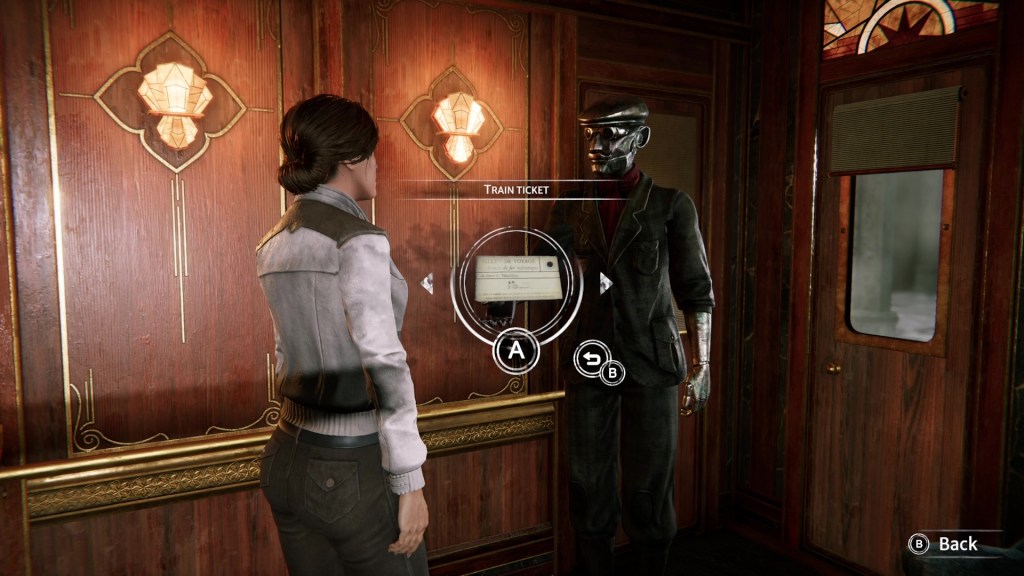
After learning of another heir, the reclusive Hans Voralburg who was long presumed dead, Kate kicks off a journey that will take her further and further away from her current life – her friends, her family, and everything she thought was important. She ends up travelling on a clockwork train, in the company of the weird but likeable automaton Oscar, following in the footsteps of Hans Voralberg decades later. She delves into the Voralburg’s tragic family history, explores seemingly forgotten corners of the world, and encounters an odd cast of those left behind with unfulfilled dreams.
It makes for a compelling but weirdly paced narrative that sometimes unfolds with no particular sense of direction (other than geographically). As someone who dislikes modern games with bloated runtimes that kill pacing, you’d think it would annoy me. However, given you can see the end of Syberia – Remastered in just 6-7 hours – puzzle-solving skills permitting – it feels more like deliberate and confident pacing. Kate’s journey is literally about going off the rails while on the rails, full of discoveries and revelations, about both her curious client and herself. It’s not always well written, the voice acting is variable, and it features some dated stereotypes, but it had emotional hits that many modern cinematic AAA games fail to generate.
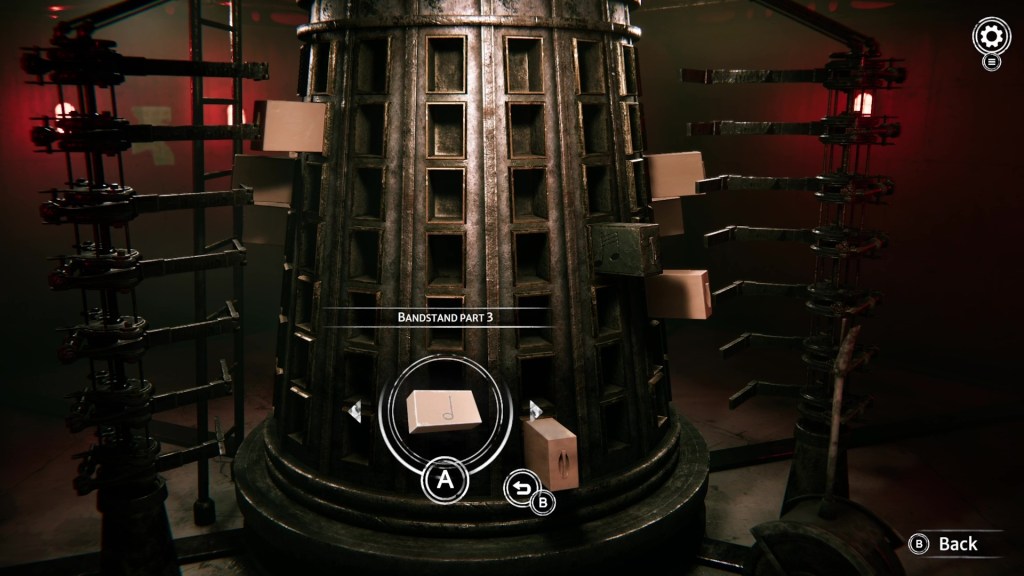
Gameplaywise, Syberia – Remastered has the same mechanical weaknesses as the original game – even with an updated journal and a handful of expanded puzzles to flesh out some locations. Unlike so many of its peers, Syberia was never about dense environments, pixel-hunting for interaction spots, or use-everything-on-everything experimentation. Instead, you explore large and beautiful zones, exhaust dialogue trees for plot triggers, find a handful key items, and tackle maybe two or three puzzles in each area. It feels more streamlined and logical than most point-and-click games from that era – but the size of the environments can make backtracking tedious.
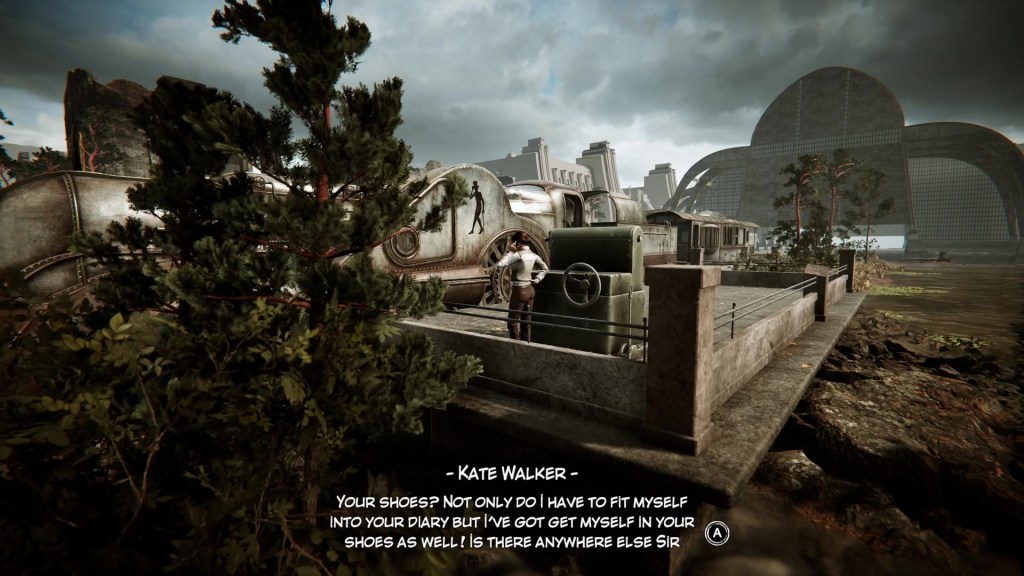
On the upside, Kate’s initial visit to each location feels suitably wondrous and surreal. She explores a declining alpine town with clockwork buildings and specialised automatons serving the ageing population. She travels to a quirky German university located alongside what look like a giant remnant of the Berlin wall, meeting the bizarre faculty members, exploring an incredible aviary, and learning about Hans’ fascination with Siberian Mammoths. She explores an abandoned Russian industrial city run by a deranged mayor; she visits a cosmodrome to help a drunken cosmonaut get airborne; and she finally help an ageing opera singer feel alive again – if only for a while.
Every step of the journey feels more surreal than the last and Kate’s fiancé, boss, friend, and mother – most of them self-interested and living shallow lives – frequently call and struggle to make sense of Kate’s trajectory from corporate ladder-climber to headstrong explorer willing to push ever further into the unknown. Again, Syberia is no masterpiece of videogame writing (and this remaster has some dubious subtitles and transcriptions), but it nails the atmosphere and Kate’s voice actor – Sharon Mann for the English dub – did an incredible job of capturing her emotions.
Of course, most cult classics like Syberia benefit from a mix of hyperbolic praise from fans and the resultant hype for this release. As one of those fans, and a fan of classic point-and-click adventures in general, Syberia – Remastered is a worthy effort at preserving a classic game and making it more accessible on multiple platforms. It stays faithful to the source material despite looking more modern, the expanded puzzles add a minor twist for returning players, and the new journal might prove essential for new player – but I still feel the diverse cast and timeless narrative are the main attraction.
Pros:
Experiencing Kate’s journey of self-discovery through a wondrous but surreal world
Beautiful, faithfully remade environments better fit the evocative soundtrack
Most puzzles are logical and streamlined
The expanded journal system makes the tougher puzzle less of a roadblock
Cons:
Backtracking through larger environments can get tedious
With a wildly successfully sequel and extensive modding support for the original release, The Elder Scrolls IV: Oblivion Remastered falls in an unfortunate middle ground.
I’m part of an audience of existing fans happy to purchase another Elder Scrolls game several times over, no doubt thanks to a heady dose of nostalgia for time when we had the time to “live another life, in another world”. However, there’s a reason they went with “remastered” in the title instead of “remake”, and I feel your history with the game – if any – could have a significant impact on your experience.
Honestly, I’d have preferred The Elder Scrolls III: Morrowind received this level of attention, but there’s no denying Oblivion was instrumental in popularising the IP on consoles and it laid the foundations for the success of The Elder Scrolls V: Skyrim. Still, after 25 hours spent following the primary questline with a few diversions, it’s easy enough to recommend this remaster if you’re after a mostly vanilla Oblivion experience in 2025 (assuming you have the hardware to run it).
For newcomers or those who loved Skyrim but missed Oblivion for whatever reason, it’ll scratch a lot of familiar itches – so long as you can accept its fledgling mechanics and systems can feel underdeveloped and even more janky at times. For returning fans, it’ll depend on your tolerance for Oblivion’s most notable failing.
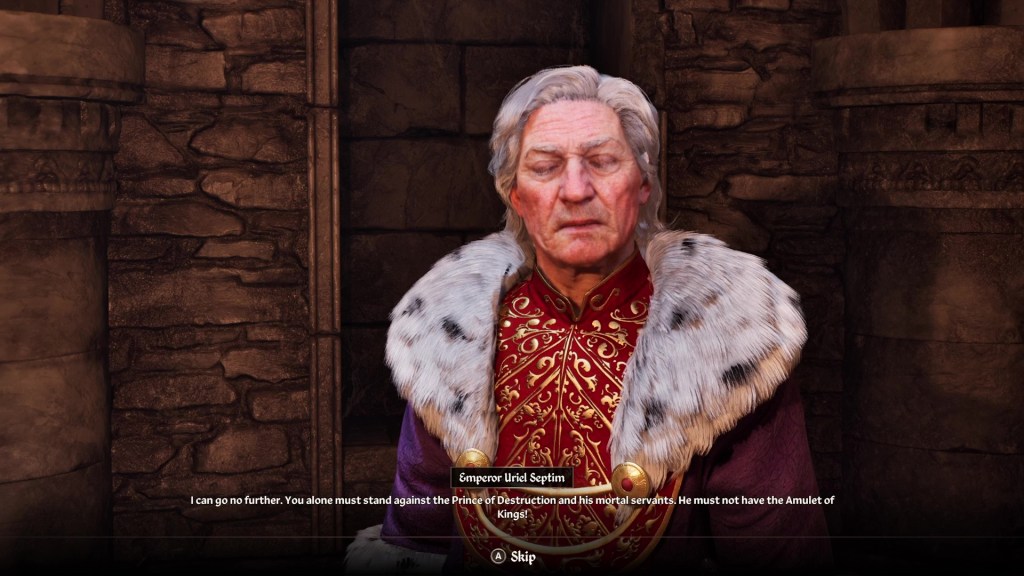
Sir Patrick Stewart only gets a handful of lines before his assassination. Remarkably, Sean Bean survives the entire game before meeting his fate.
For newcomers, The Elder Scrolls IV: Oblivion Remastered is, unsurprisingly, set during the “Oblivion Crisis” – an event often mentioned in Skyrim as the catalyst for the rise of the Third Aldmeri Dominion that would go on to fracture the Empire unified under the Septims.
Your protagonist is another prisoner who finds themselves swept up in events and during a bland cave- and sewer-based tutorial, they witness the assassination of the emperor; they’re tasked with finding a hidden heir to the throne; and told to help him “close shut the jaws of Oblivion”.
Of course, this is an Elder Scrolls game so you can pursue those instructions with vigour or just ignore them for hundreds of hours if you wish. Almost two decades on, Oblivion still excels at what Bethesda Game Studios have always done well: presenting the player with a massive world to explore, packed with things to see and do, and the flexibility to tackle it in any way you choose – in theory.
You craft your would-be hero using a horrific selection of cosmetic options somehow worse than the original; you wade through innumerable tutorial screens; pick your starting class, major skills, and star sign; and finally emerge into the high fantasy-inspired heartland of the Empire, Cyrodill.
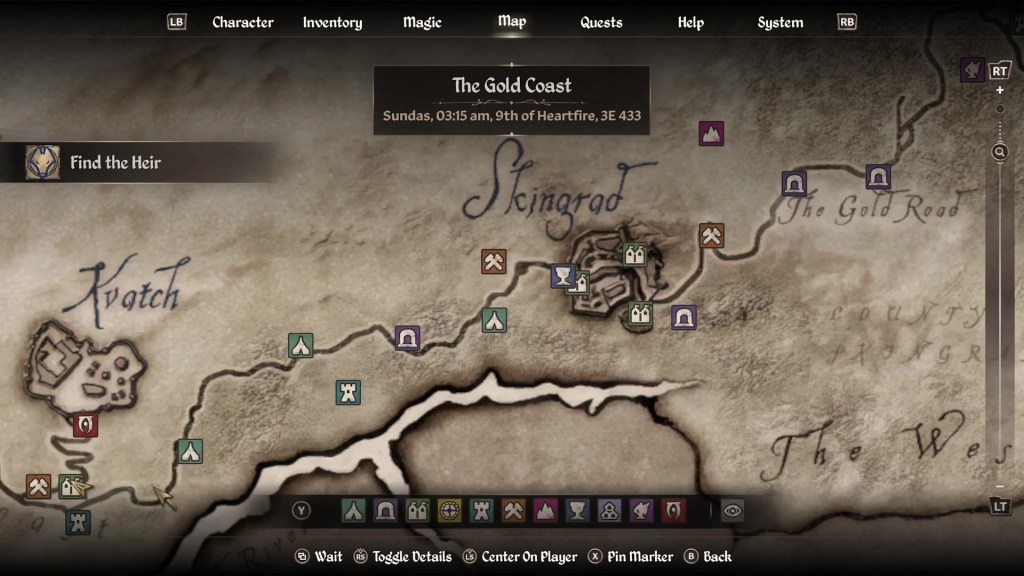
The primary quest points to a small priory to the north-west; the Imperial City looms over you; there’s a dank cave entrance or beautiful Ayleid ruin near at hand; and the map screen provides a half-dozen other cities you can instantly fast-travel to. It’s still a sensation as overwhelming as it is exhilarating even in 2025.
Even sticking to the critical story path, it’ll take you through all of the cities and past a ton dungeons to explore.
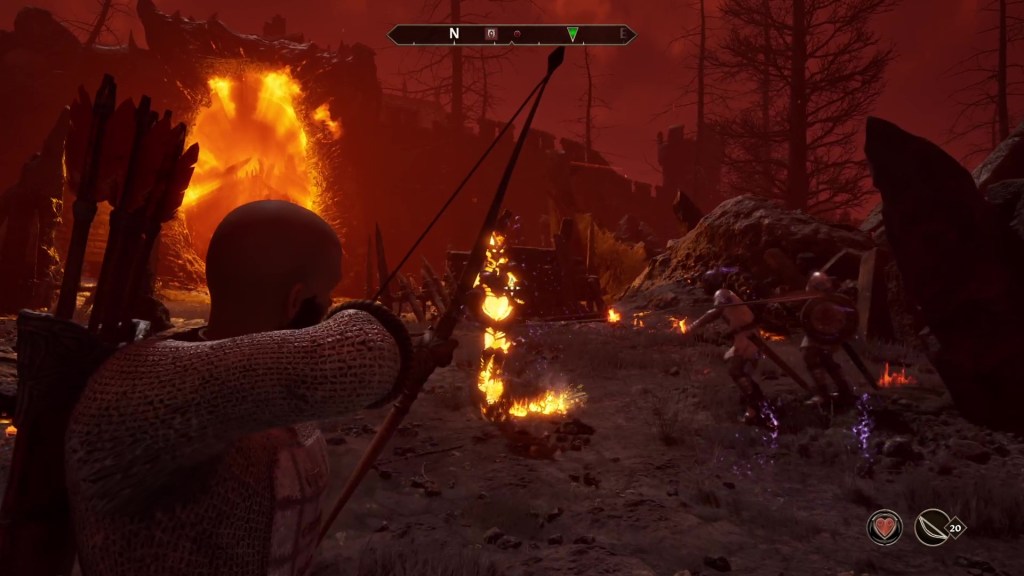
If you prioritise the primary quest, you’ll be knee-deep in cultists, Oblivion portals, and Daedra as you seek the last Septim heir and fight back against the schemes of Daedric Prince, Mehrunes Dagon. Alternatively, you can join and climb the ranks of the fighters, mage, or thieves guild – each dealing with nefarious plots to destabilise them from within and without.
You can seek out Daedric shrines to complete a mix of questionable and often hilarious quests to gain their favour and unique gear, or you can just travel from city to city, solving local problems that are sometimes exactly what they seem but often come with unexpected twists.
On paper, and for a dozen or so hours, Oblivion really sells that “live another life, in another world” premise. It’s also at its best when tackled organically. I’d neither recommend mainlining the primary quest, nor systematically clearing every location on the map. The end-of-the-world threat will happily wait on you and, attempting to do everything, everywhere, all at once, just highlights the AI routine limitations and dialogue inconsistencies.
If you just go with the flow – mixing up exploration and combat with persuasion challenges, thievery, and alchemy – it’s easy to get pleasantly side-tracked for hours at a time and better immerse yourself in a game world that, when studied too closely, is bizarrely dense yet underpopulated.
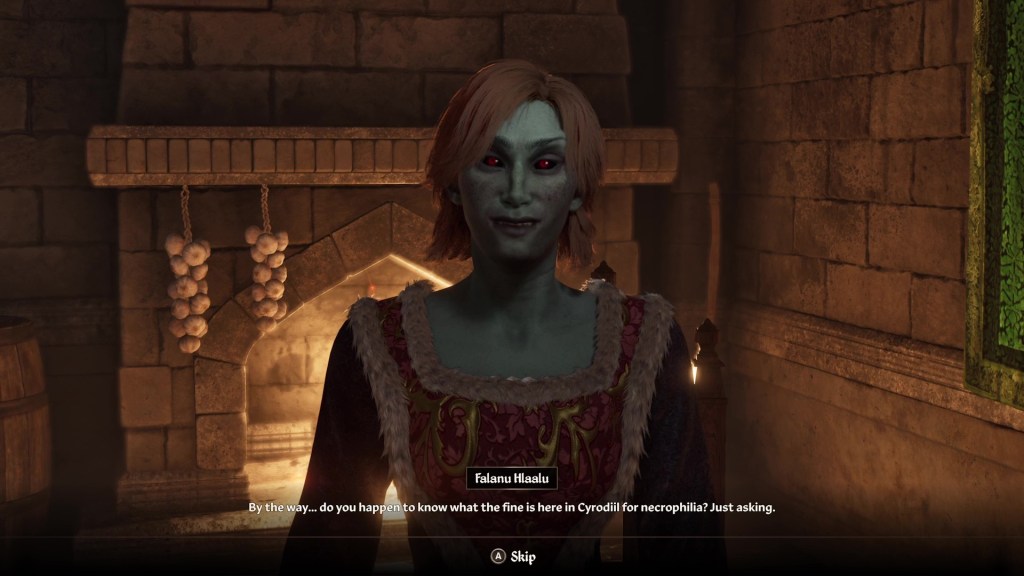
In retrospect, I don’t know what to make of The Elder Scrolls racial stereotypes but they certainly have some choice lines.
Of course, all open-world games face the same challenge: how do you keep players engaged while maintaining some semblance of pacing when you’re offering up a hundred hours’ worth of questing and dungeon-delving?
Oblivion’s answer was level-scaling. The idea being no matter what path you took, you’d face off against increasingly tough enemies with your upgraded skills, while looting higher-tier gear from their corpses or chests (with increasingly tough locks).
It was a noble but inherently flawed effort, and it remains an issue the remaster has lightly tweaked but not resolved. The obvious problem with this design is that level-scaling robs the player of any sense of meaningful progression for much of their playtime.
The need to balance player progression and the difficulty curve is always an issue in RPGs, but the modern approach is to reward over-levelled players with an easier time on the critical path, while still providing optional challenging content and the promise of greater rewards to keep them engaged.
In Oblivion, you’re constantly improving your skills through use, boosting attributes each time you level-up, and you’ll be looting or purchasing better gear and spells as you go; however, every combat encounter and dungeon-delve plays out much the same way for several dozen hours.
It’s a sensation compounded by the fact Oblivion is still more RPG than action game. You can stay mobile and block or dodge but combat ultimately boils down to hitting things with blades, arrows, or spells until they die. Progression is measured by how few hits it takes to kill something.
It’s only when you unlock the highest skill perks and access game-breaking enchantments – such as Chameleon-enchanted armour and paralysis-enchanted weapons – that it’ll satisfy the typical RPG power fantasy.
An epic battle alongside short-lived NPCs that sadly don’t benefit from the level-scaling system your enemies do.
It should also come as no surprise that level-scaling can play hell with quest design and what passes for rudimentary set-pieces.
Skyrim had its moments, but I feel most fans would agree the sense of exploration and the prospect of discovering something unique-ish was the main draw, not the quest design. Oblivion nails the first part, but you’ve got even simpler quest scripting, clunky set-pieces, and no traditional companions to liven things up
Quests are typically a variant of “go here”, “fetch this”, or “kill that”, with the most memorable boing those that offer multiple or unexpected outcomes. However, those are almost always standalone quests that will, at most, result in a different reward item or trigger a new generic line from townsfolk when you bring up the topic.
Oblivion is notable for introducing the “Radiant AI” system to give NPCs a simple daily routine that is significant to some quests, but it doesn’t take long to realise the bulk of scripting boils down to whether an NPC is in possession of an item, at a location, or flagged as dead.
Many of these basic quests are elevated by hilarious writing, goofy voice work, and plenty of animation jank, but the bulk of your time is spent away from settlements, scouring overlong, multi-zoned dungeons or Oblivion planes on your own.
Expendable NPC companions that feature if a handful of quests don’t benefit from level-scaling and die almost instantly if you’ve out-levelled them – either in battle or through sheer stupidity – leaving you alone once again to slog through hordes of enemies.
The only way to circumvent this is to exploit invulnerable plot-critical NPCs, dragging them along as silent but useful damage sponges without completing their respective quests.
Never waste the opportunity to drag plot-critical and immortal NPCs along as unofficial companions.
Although The Elder Scrolls IV: Oblivion Remastered does little to address the game’s fundamental flaw, it does include some significant gameplay tweaks to go along with the gorgeous Unreal Engine 5-powered visual overlay.
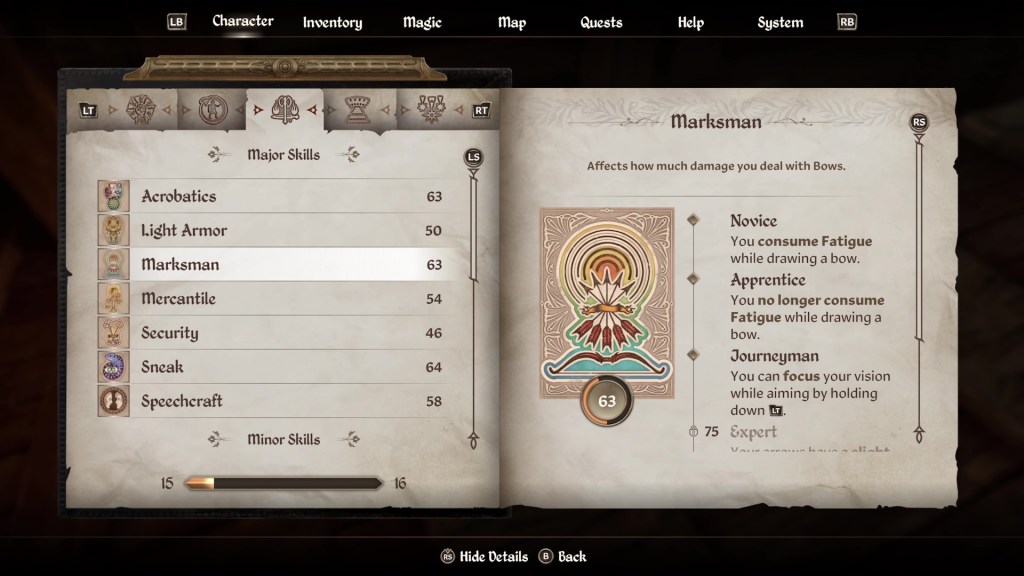
The most impactful changes are how both major and minor skill gains now contribute towards the player level, and which skills you improve no longer influence how many points you can boost attributes. You simply earn 12 “virtue points” each level, which you can invest across three attributes of your choice. You can still make your own bad levelling decisions, but as you retroactively gain health for strength and endurance boosts, it removes the likelihood of non-combat classes being one-shot at higher levels.
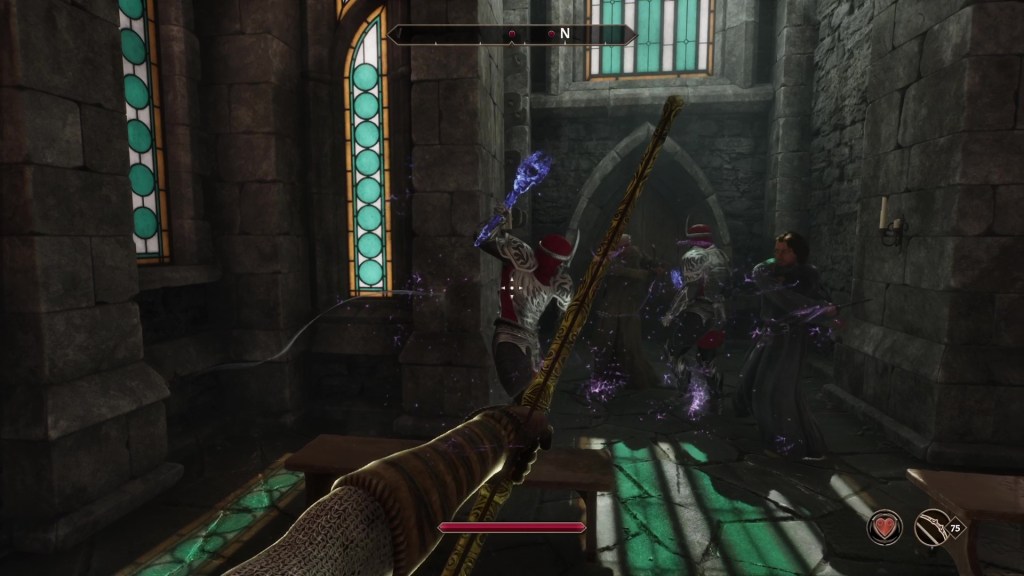
There is also a range of smaller but welcome changes, like more responsive menu-ing, increased movement speed and sprinting, health regeneration outside of combat, more reliable stagger animations based on where you aim, no fatigue penalty to attack damage, reliably recoverable arrows that both fly faster and hit harder, and tweaks to skill perk tiers – some new, some adjusted, and some just rearranged so you gain access to more useful ones earlier.
Despite these changes, old problems return when trying to boost combat-related skills if you realise you need a melee/ranged fallback, or maybe some elemental damage spells for resistant enemy types. The only sensible approach is to find and pay trainers, as low-level weapon skills and damage-dealing spells become laughably ineffective against higher level foes.
It’s been a long time since I’ve played the vanilla version of Oblivion, but tweaks to the levelling system do not feel like they drastically alter the experience.
I’ve got this far without praising the audiovisual enhancements and, for returning players, it’s an impressive overhaul that turns Oblivion’s distinctive but barren landscapes and interiors into something akin to a modern release.
Geometric complexity, textures, vegetation, water, weather, environmental details, character models, movement and attack animations, lip-syncing and facial expressions – they all take a generational leap in quality, albeit not always a consistent leap.
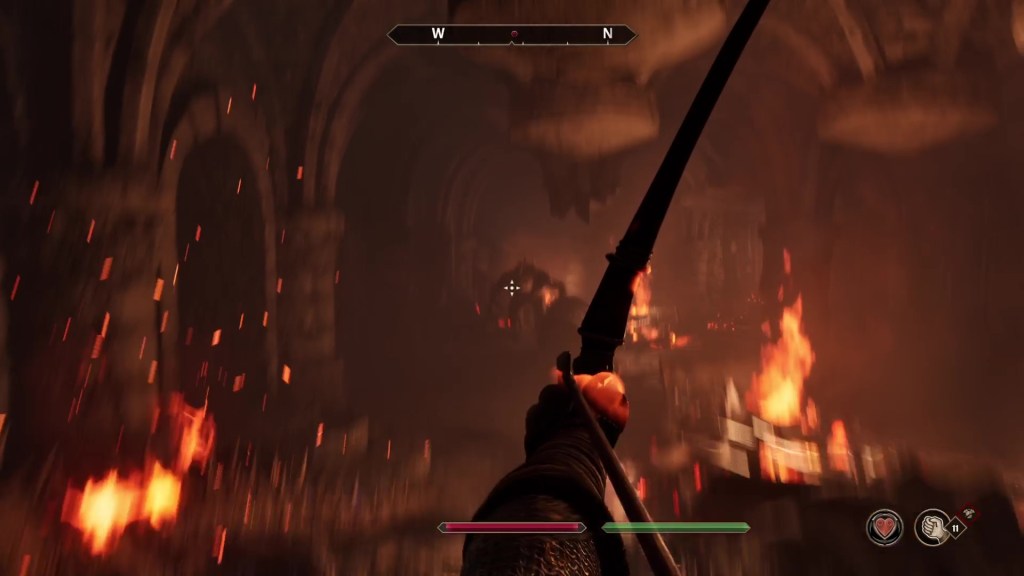
I’d argue the global illumination system for the sun, moon, and other light sources feels most transformative, bathing the world in more realistic and atmospheric shades of light and dark. Oblivion always did creepy interiors well, and they feel even more terrifying this time round.
The Elder Scrolls IV: Oblivion Remastered touches up the voice work without changing the weird, wild, and openly prejudiced (in-universe) dialogue, something most notable during hilarious NPC interactions driven by the Radiant AI system. These exchanges rarely have logical replies or a consistent tone, yet the system excels at antagonistic conversations between NPCs of difference races and class (in the socioeconomic sense). There’s also limited new voice acting to better differentiate Tamriel’s many races, while some NPCs that previously had multiple voice actor lines assigned to them have been fixed.
Combat audio effects and ambience have been added to improve combat and exploration respectively, though volume levels can feel off compared to the original. In contrast, the soundtrack needed no tweaking as it still holds up brilliantly, providing memorable orchestral themes for any scenario.
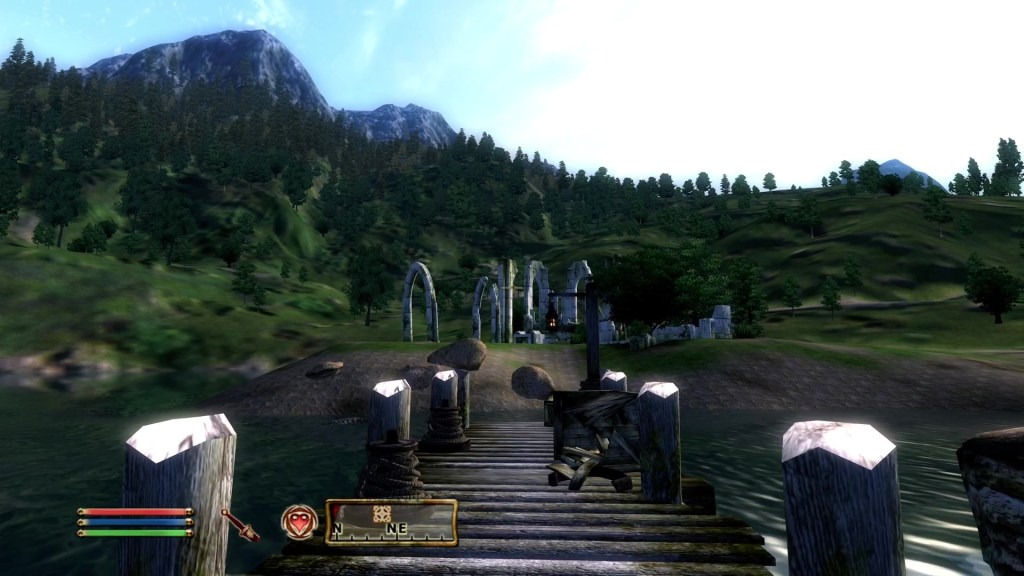
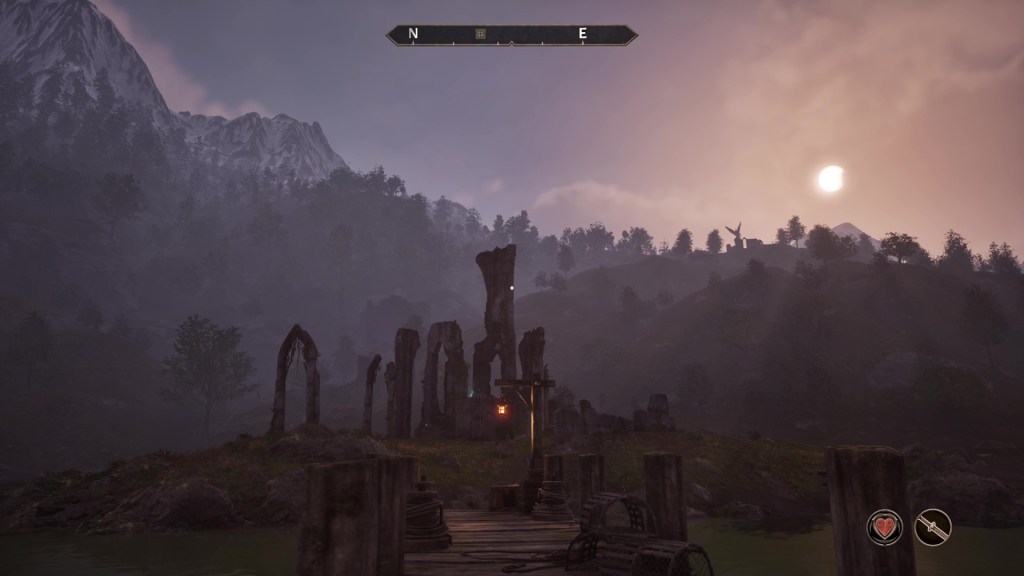
Emerging from the tutorial sewers in the backwards-compatible Xbox 360 version of Oblivion (which at least holds 60fps).Emerging from the tutorial sewers in Oblivion Remastered played on an Xbox Series X.
All that said, the gameplay tweaks and audiovisual updates can only do so much when the aged Gamebryo engine is presumably chugging away just below the surface.
The increasingly repetitive nature of Cyrodiil’s overworld and dungeons is hardest to disguise, particularly when maybe two dozen quest-related locations feel truly unique in appearance or design (and The Shivering Isles expansion accounts for much of this).
Every asset used to build the world has clearly been overhauled in The Elder Scrolls IV: Oblivion Remastered, but it’s not clear if any new assets were created. The bulk of Cyrodiil is still rolling, forested hills, while the “dungeons” are crafted using just a handful of tile-sets – think cave, mine, ruin, fort, city, and Oblivion plane – each with a limited number of building blocks. The world also retains its segmented nature, with dungeons, cities, the structures within them, and even each floor of some structures connected by loading screens.
You could argue Oblivion’s dungeons are typically larger and more elaborate than Skyrim’s convenient loops, but very few have memorable puzzle rooms, unique vistas, or anything close to the epic scope of the Blackreach Cavern. It becomes a serious problem when there are well over 200 dungeons to explore and, depending on your approach to the tackling the main quest, up to 50 Oblivion portals that can spawn.
Is all this content mandatory? No, but even sticking to the primary questline left me frustrated with the degree of repetition in this replay.
Many interior locations now look stunning thanks to the overhauled visuals and lighting – though it doesn’t take long ot recognise the same rooms and hallways.
Returning to my opening line, it leaves The Elder Scrolls IV: Oblivion Remastered in a weird place. Given the response, it feels like a project targeting fans of the original – yet it retains many flaws that’ll quickly frustrate those fans. The visual overhaul and gameplay tweaks are an improvement – and there’s no denying the power of nostalgia – but it’s unlikely these remastering efforts would push me to complete it again over a modded version of the original.
With that said, I feel it’s newcomers to the IP or curious Skyrim fans that might benefit the most from this release, as they’ll find it easier to look past Oblivion’s flaws as they experience the wonder of simply exploring Cyrodiil’s cities, countryside, and dungeons for the first time.
There are few games as deserving of preservation as the original Tomb Raider. Not because it’s some timeless masterpiece that holds up today, but as a reminder of where we’ve come from, and how far we’ve come. If you’re a fan of games set 3D environments and played from a third-person perspective – the vast majority of blockbuster titles – you could trace at least some part of their ancestry back to 1996’s Tomb Raider.
Replaying it in 2024, in its freshly remastered form, has been unexpectedly compelling – albeit with a mix of highs and lows I expected. There was raw nostalgia for my 11-year-old self, sitting in front of a small CRT screen, playing it on a SEGA Saturn rented from the local video store – my first experience exploring a truly 3D world after growing up with a NES that was as old as I was, and infrequent visits to arcades to play on-the-rail light-gun games. It was a pivotal moment that ensured video games would became a lifelong hobby – with my very own PSOne and a copy of Tomb Raider II the following year cementing my love of the character and IP.
If you only have experience with the Crystal Dynamics trilogies – 2006’s Legends or 2013’s soft reboot – Lara Croft in 1996 was a rare example of a female protagonist, at least outside of RPGs with character creation, and, rarer still, possessed a physicality typically reserved for male leads. She was an acrobatic heroine with calves, quads, and glutes so strong she could lunge-jump her own height and was strong enough to push and drag around 8 cubic-metre blocks of stone. The first Tomb Raider would pit her against an equally capable villainess and give her the chance to save the world at the expense of power and fame. I doubt representation was Core Designs’ original intent, but Lara nonetheless proved instrumental in drawing more female gamers into a hobby that all too often felt like young to middle-aged men developing games for young to middle-aged men.
Of course, nostalgia can only take you so far and it was impossible to enjoy the remaster without looking at it through the lens of 28-years of gaming advances. Revolutionary for the time – and possessing an impressive sense of scale and verticality that early 3D FPS and dungeon crawlers lacked – Tomb Raider now offers a purity of design, so uncluttered by secondary mechanics it almost feels novel. The bulk of the experience is simply observing, planning, and traversing blocky 3D environments using Lara’s equally rigid, grid-based move-set. The goal? Rarely more complex than finding key items or switches within a level to open the exit to the next, before a crude in-game cutscene or flashier CG variant pushed the story forward.
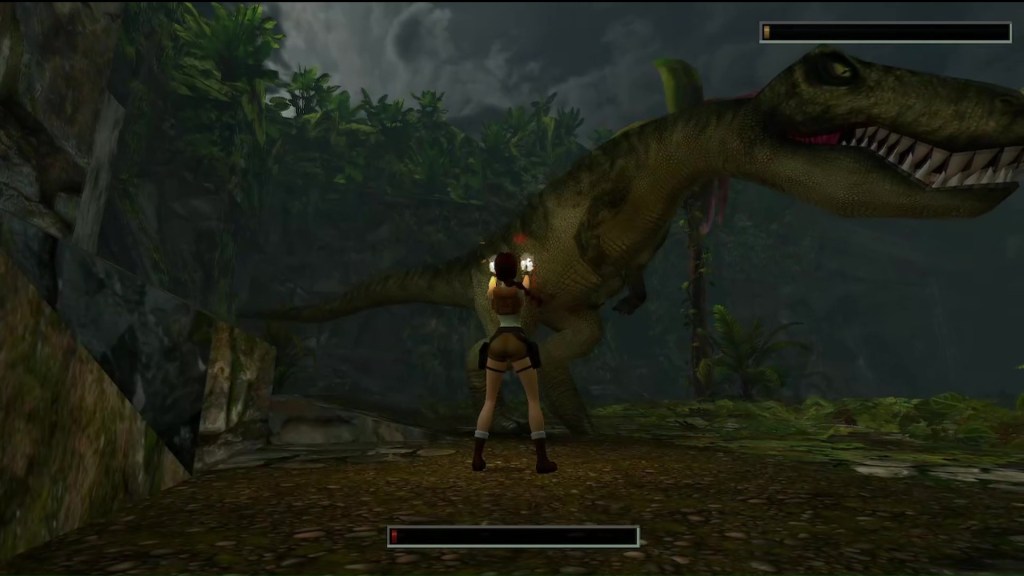
To spice things up, Lara will sometimes need to solve basic spatial puzzles that typically involve slowly pushing or pulling blocks; while other times she’ll need to draw her weapons to slay a shameful number of endangered species, a few that should’ve stayed extinct, tough mythical creatures, and a handful of human bosses that are an unfortunate reflection of cultural and racial stereotypes in the 1990s. Much like the platforming, combat is all about using Lara’s rigid move-set to avoid enemies that follow far less predictable patterns – often in tight spaces with perilous drops. Combat never feels more than functional, but many encounters can be rendered trivial if you horde powerful ammunition or find high-ground to exploit the limited AI pathfinding. Just don’t stop to ponder who left modern ammunition and health kits in ancient ruins supposedly unexplored in centuries.
By far the greatest challenge comes from mastering the original controls, especially as the alternative controls offered in this remaster are a twitchy abomination not worth considering. It’s a rough transition from modern games – games that strive to make you not think about the complexity of traversal – however, once you’ve get to grips with Lara’s move-set, they feels perfectly suited to the blocky but carefully crafted environments. It’s a game that requires patience, with a strong focus on planning a sequence of moves and lining up jumps, rather than being reactive, and you’ll want to save regularly if you don’t enjoy hearing Lara’s scream followed by a sickening crunch. The obvious caveat to this design is how clumsy and frustrating simple tasks end up feeling – such as lining Lara up to interact with a switch or pick-up, and how long it can take to trek back to the start of a jumping sequence if you mess up.
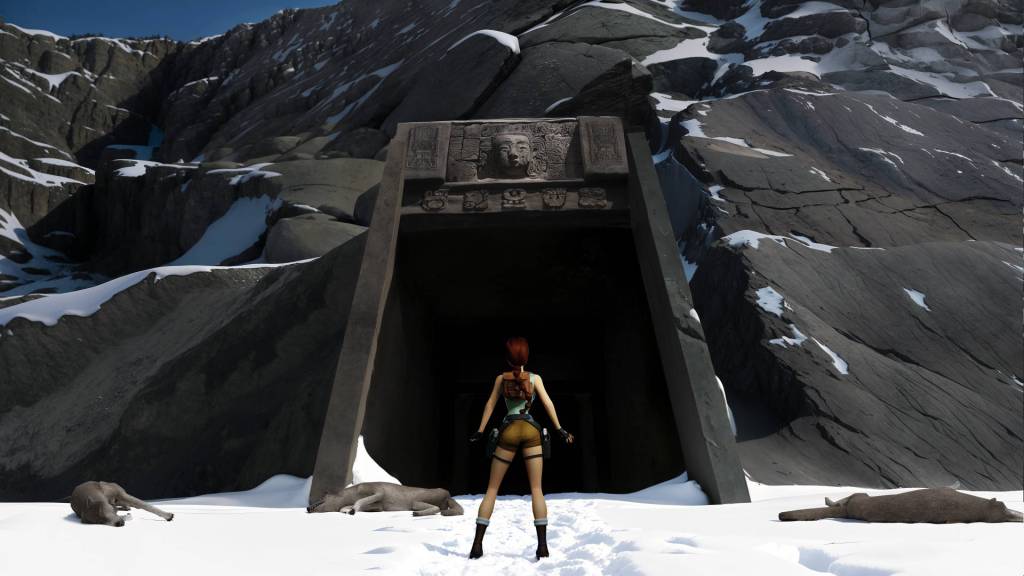
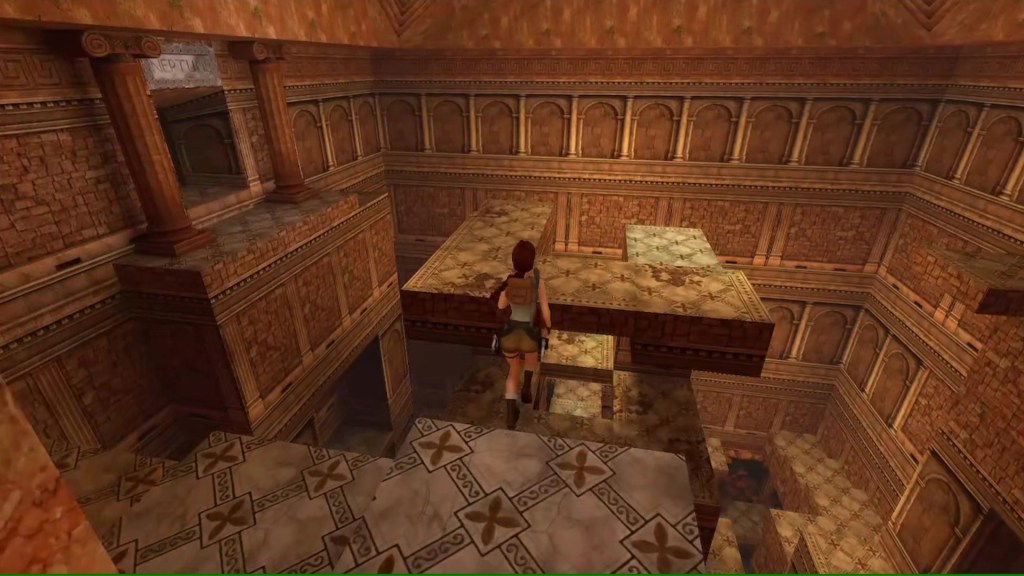
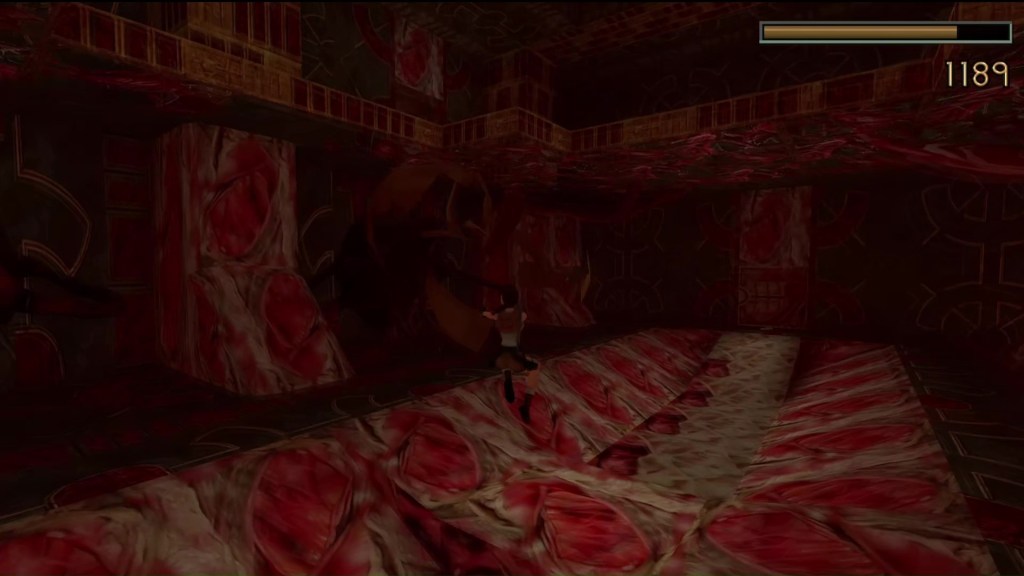
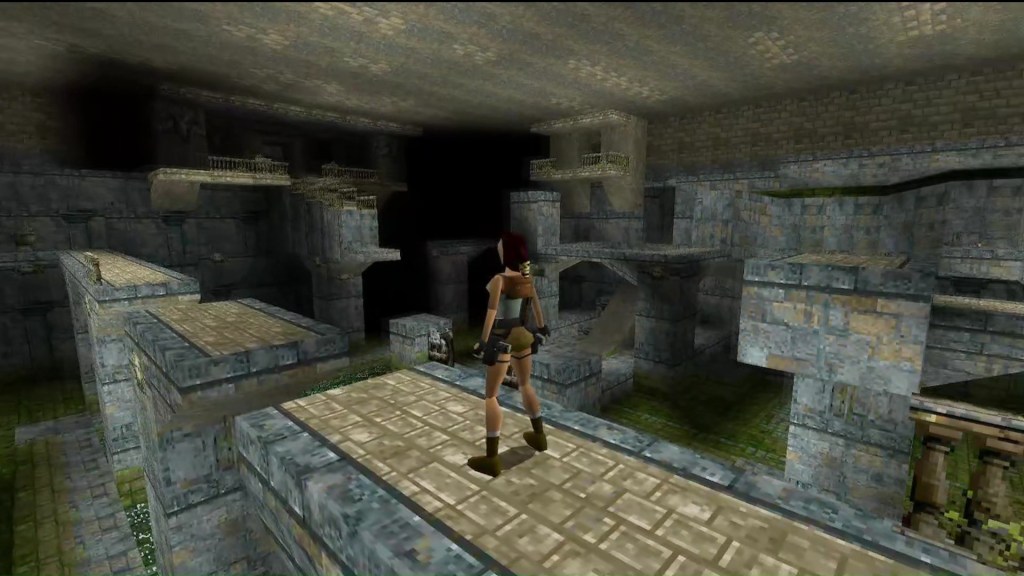
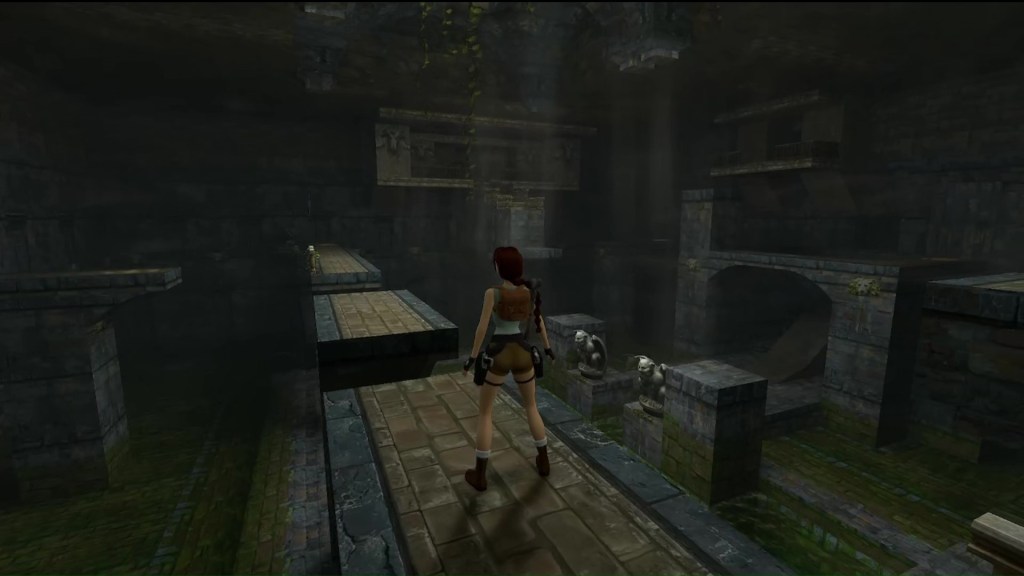
Moving on to the remastering effort itself – Tomb Raider I Remastered feels smartly touched up and respectful of the original vision, while the only major gripe I have is aforementioned and entirely optional alternate controls. Texture work, character models, and lighting have been overhauled – with the addition of more props where appropriate, and minor geometry changes to introduce new light sources like open ceilings. The world itself is still blocky, and the seams between textures are still obvious, but they feel suitably detailed for modern TVs, those representing water surfaces or lava are better animated, and some even have an impressive parallax effect to simulate depth.
All character models retain their somewhat angular designs and jerky motion, but they look much more detailed and have been embellished with plenty of added detail – including updated faces and basic lip-syncing for in-game cutscenes. Pixelated 2D sprites for pick-ups and props have been replaced with 3D models, and you can enable an interaction icon to make them easier to find – along with switches and key holes. The new lighting model – especially in rare locations that use beautiful new sky-boxes – looks great, adds to the immersion, and even simulates taking on the colour of the environment. There are more atmospheric effects like dust and mist, while a few locations even have puddles with reflections!
Talking of atmosphere, Tomb Raider I Remastered still relies primarily on ambient audio to capture that feeling of isolation you’d expect exploring long lost tombs – but it feels like they’ve added a few more music triggers and possibly repurposed a few tracks from the later games. In short, this remaster excels at presenting Tomb Raider as you might remember it. There are oddities, like how some areas feel too dark and the new 3D models for key items too small, but you can always swap back and forth between the remastered and classic visual mode – though you then have to deal with a stuttering 30fps cap that feels awful compared to the remasters 60fps achieved through frame interpolation.
All of which brings me to who I’d recommend Tomb Raider I Remastered to. From a pure preservation angle and for those interested in the history of video games, it’s an essential remaster. For those just considering the entertainment potential – this is more for fans of the original, especially those without the patience to deal with DOSBOX settings on PC, or console players that once had to deal with a frustratingly restrictive save crystal mechanic. As a long-time fan, the first three acts in Peru, Greece, and Egypt remain the highlight – and levels like The Lost Valley, St. Francis’ Folly, Temple Midas, Obelisk of Khamoon, and Sanctuary of the Scion have not diminished with age. If anything, they finally have a degree of visual spectacle to complement their impressive scope.
For everyone else still curious in Lara’s original outing, I’d rather suggest Crystal Dynamic’s excellent 2006 reboot, Tomb Raider: Anniversary, which can still serve as an excellent stand-alone experience.


 gameblur-v2.0