Returning to the The Riftbreaker for the fourth time, I’m forever impressed at how EXOR Studios has continued to expand and refine its hybrid base-building, supply-line managing, research- and loot-driven, isometric hack-and-slash, twin-stick shooter. If you critique each element in isolation, they’re not as developed or balanced as the games they draw inspiration from, but The Riftbreaker’s priority is always giving you the tools you need to have fun – something far too many developers seem to actively discourage these days.
My excuse for investing another 20 hours into The Riftbreaker was the recently released Heart of the Swamp expansion (which arrived on console at few months after PC), with a ton of free content for the base game including a new swamp biome, new creatures, new research options, new structures to manage waterlogged environments, and massive new defensive towers and base-shields that’ll be put to good use before the end of the new story campaign. That said, The Riftbreaker is nothing if not formulaic when it comes to mission design and progression, so you’re primarily getting more tools to overcome a few new challenges, to complete a familiar job – assess and defeat a new threat to the Galatea 37 mission.
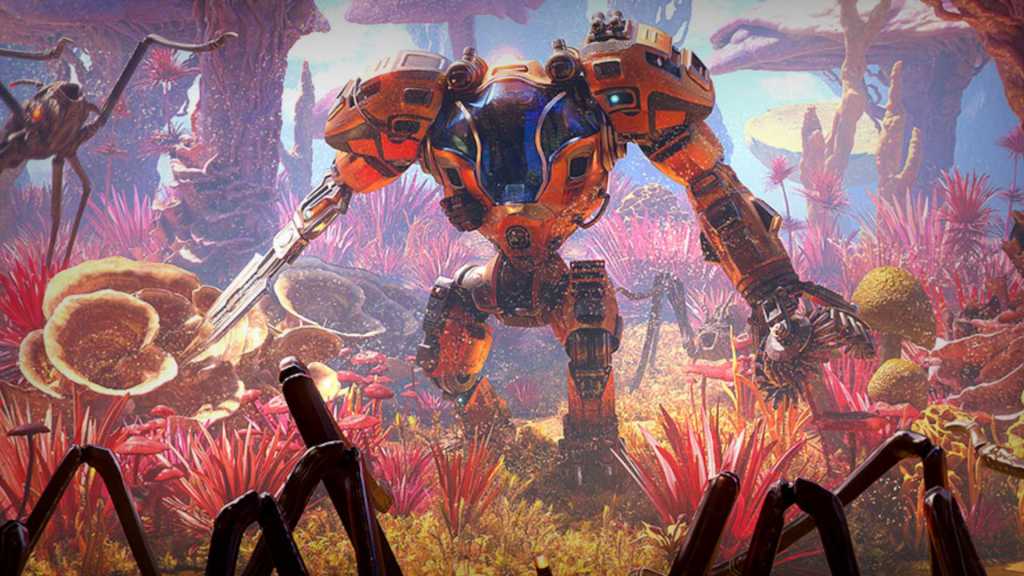
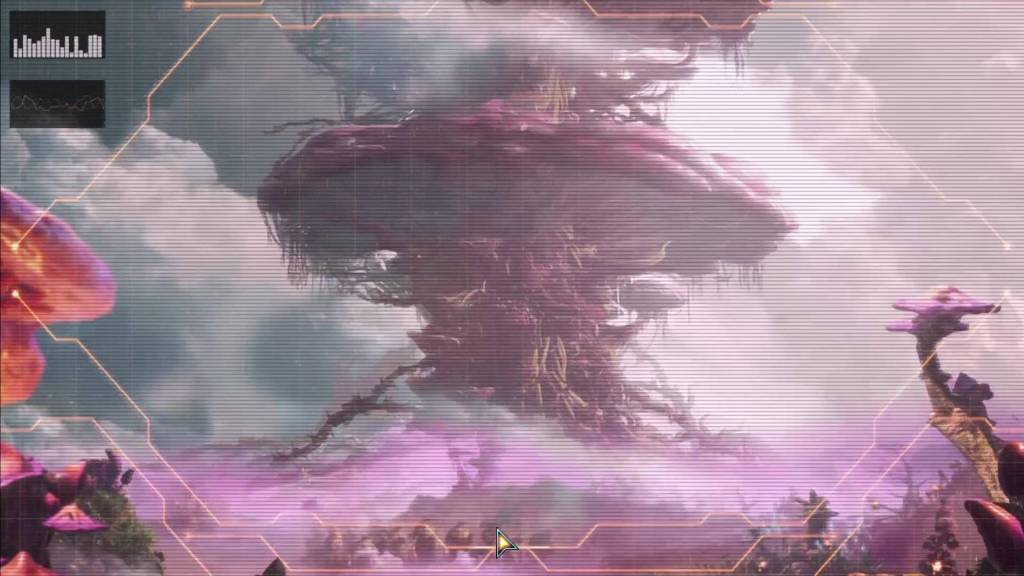
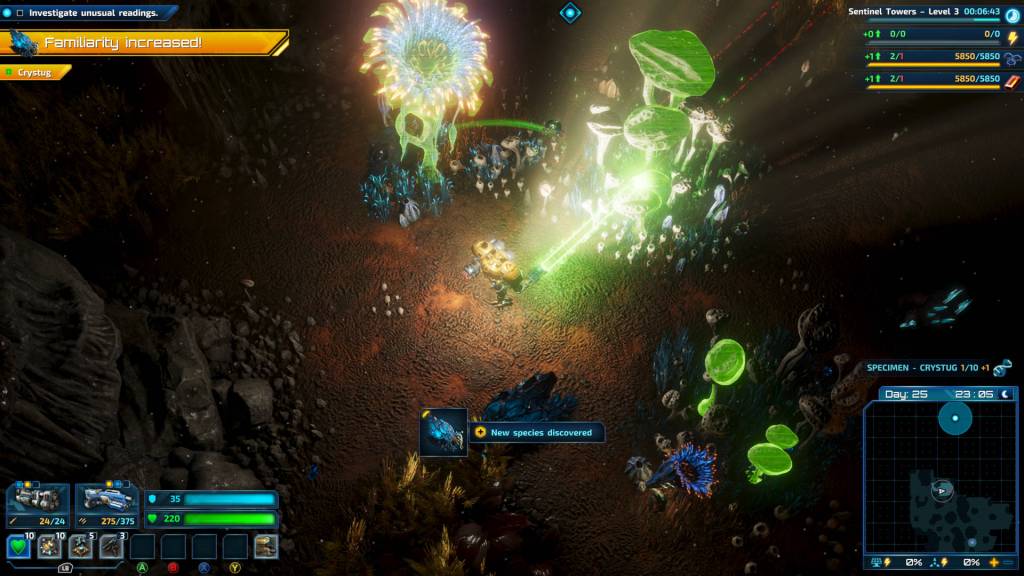
The Heart of the Swamp expansion kicks off only once you’ve investigated potential Titanium, Uranium, and Palladium deposits to begin constructing the Rift Station back to Earth, with yet another mysterious meteorite crashing in the headquarter region. This time it’s giant mushroom spores, which leads Ashley and Mr Riggs to a massive flowering mushroom “tree”, invaded by a myriad of parasitic creatures and thorn vines draining its remarkable sap. Despite the new setting, events follow a familiar rhythm: investigate the organism while defending your outposts from waves of enemies, travel to the source of the threat to try wipe it out, then engage in a chaotic hold-out finale.
The biggest challenge introduced in the Heart of the Swamp expansion – if you accept insanely hostile plant life and rapidly regrowing thorn thickets are typical of Galatea 37 – is establishing and sustaining several outposts on isolated patches of solid ground around the base of the giant mushroom. The saturated air makes renewable power generation difficult, while natural gas vents, Carbonium, and Ironium deposits are also scattered across small islands. The swarms of parasites you fend off come in waves, with self-replicating horrors emerging later, and that lack of space is a serious impediment to a solid defence. Of course, The Riftbreaker excels at giving you a myriad of tools for the job and, even if some are clearly optimal, you can hack together your own solution to just about any problem – be that through quantity or quality.
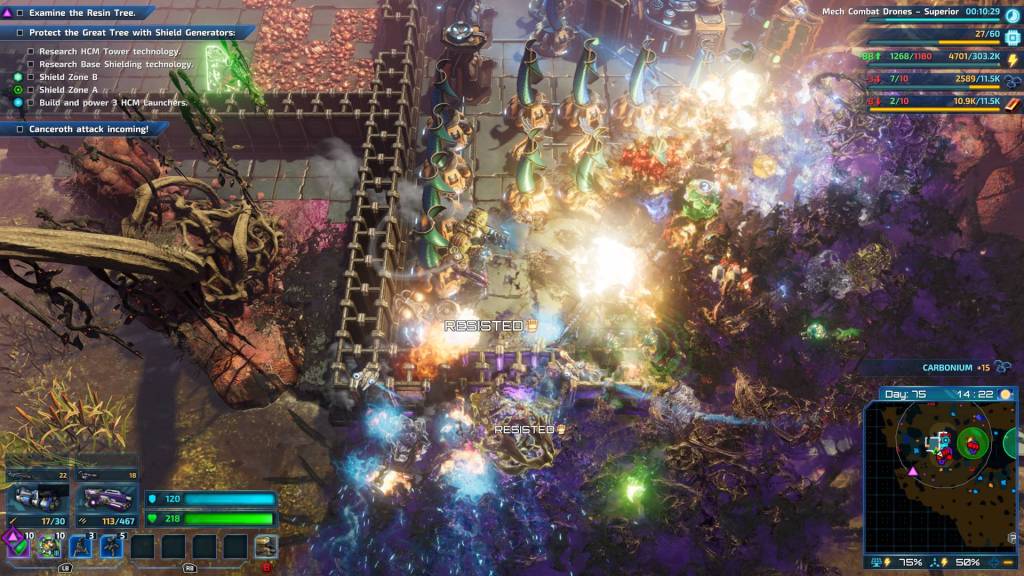
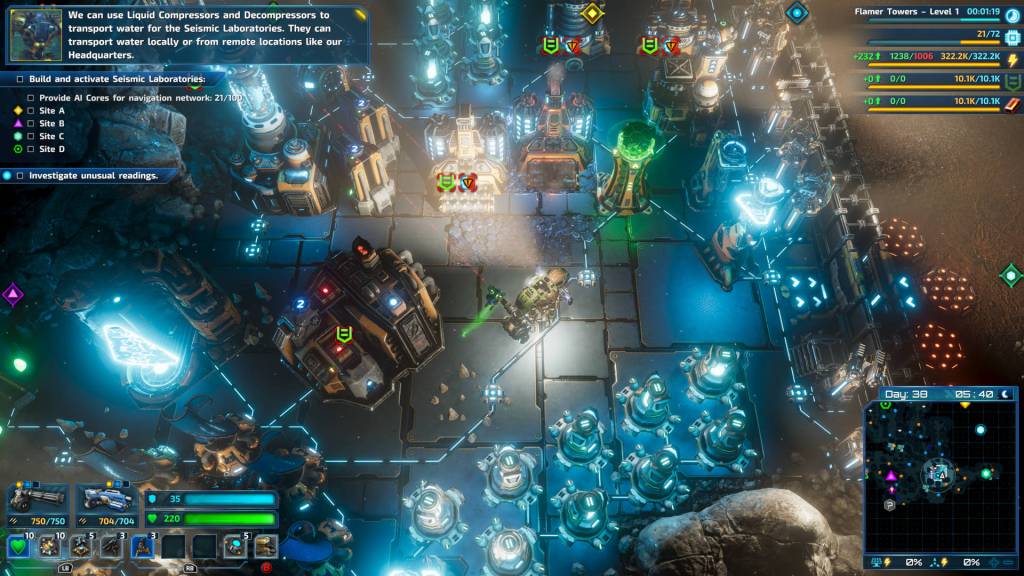
I’d recommend anyone starting this expansion ensure they have large Carbonium and Ironium outposts set up to cover basic construction costs remotely, but you can establish mines alongside research outposts with some planning. In addition to utilising existing structures like Energy Pylons to transmit power between outposts, there’s a fresh selection of land-based, floating, and pipe-mounted defensive towers – including massive piercing towers and cluster munition towers – that allow you to build defensive lines in the swampy water. If you explore thoroughly early on, you’ll also discover a source of sap that can be converted in plasma; a novel solution to construct advanced buildings and base shields, buying you much needed time to destroy the massive swarms in the finale that shredded my base and framerate in equal measure.
It’s admittedly familiar fare at this point, three years and two expansions since launch, but Heart of the Swamp is another solid addition to The Riftbreaker. It offers another excuse to explore more of Galatea 37’s hostile biomes; expand and upgrade my existing outposts; research more of the sprawling tech tree for new buildings and higher-tier gear crafting; and engage in more visually spectacular base-defence events. It’s a fantastic hybrid of genres that deserves to be more successful than it is, and I strongly recommend you pick it up if any of this looks exciting. With the “Complete Edition” on storefronts, this looks to be the last paid expansion, but there’ still the promise of online co-op in the future that could make a great game an incredible one.
Survival games usually frustrate me, as I find many mechanically dull, to the point they’re incapable of obscuring their busywork structure. When it comes to The Riftbreaker, I’m always happy to sink another dozen hours into its satisfying hybrid gameplay loop. The new “Into the Dark” DLC is my latest excuse to return, and it provides more of that one-more-mission/building/upgrade loop – albeit with a few new challenges and some familiar technical issues.
Their budget for writing and voice acting must be huge
If you played through the base game or the Metal Terror DLC, the basic structure of this expansion won’t come as much of a surprise. A massive earthquake followed by a powerful neutrino emission rocks your primary HQ region, which sets Ashley and Mr Riggs on another multi-stage adventure to discover the source of a not-so-new threat to Galatea 37.
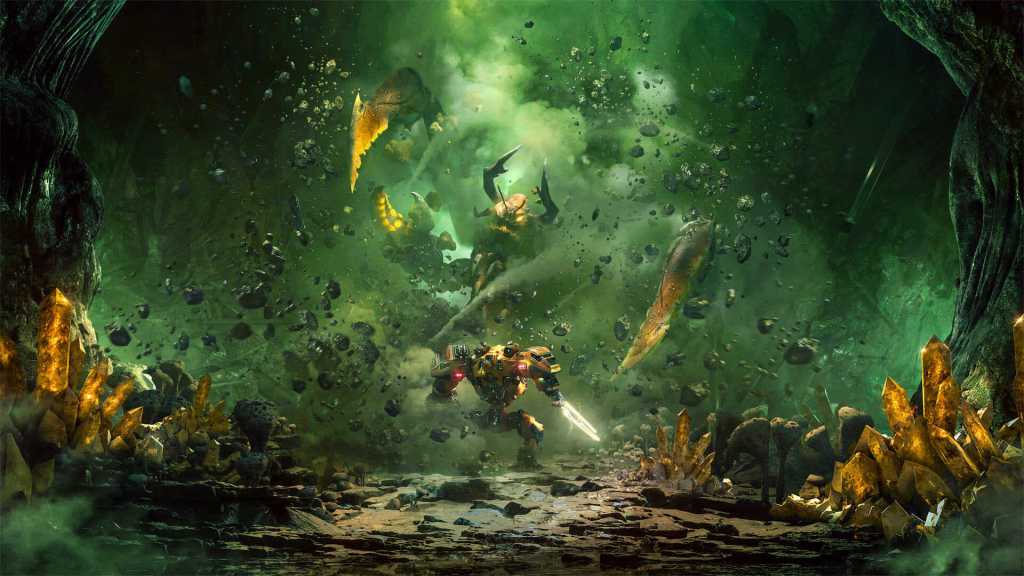
They’ll discover anomalous growths guarded by crystal-infused wildlife and lumbering bipeds capable of summoning new forces; they’ll explore a surface region to triangulate the position of a massive underground creature; they’ll research new technology to breach, explore, and survive in a massive crystalline cavern system below the surface; and they’ll fend off waves of creatures so large and so frequently, the reproduction and maturation rate of Galatea 37’s wildlife is probably the least believable sci-fi concept.
While The Riftbreaker is ultimately a mechanics- and systems-focused game, Into the Dark uses its narrative elements to delve into Ashley’s failed Orion expedition she references in the base game. The “new” threat appears to be a familiar one and, once again, Ashley and Mr Riggs spend an inordinate amount of time discussing what they’ve observed, generating wild hypotheses, and experiencing several “eureka” moments that feel utterly detached from the player’s actions.
They’re still a likeable pair of protagonists but I’m forever amazed at the amount of recorded dialogue in this game and the constant disconnect between Ashley’s intentions to preserve the planet’s ecosystem, while periodically murdering thousands of its denizens to pave the way for human colonisation.
A slow start leads to a chaotic finish
Ignoring the narrative dissonance, The Riftbreaker remains as mechanically engaging and complex as ever – even if Into the Dark feels more about adapting existing tools to a new biome, rather than managing an entirely new resource and dependent technologies we got in the Metal Terror DLC.
The opening missions above ground and within a maze of canyons feel unremarkable. The introduction of summoner-type creatures and mobs with a limited self-revive ability complicates combat and pushes out beyond your walls, but you’ll still be going through that familiar loop of exploring, scanning objects of interest, establishing outposts, and fortifying them against waves of enemies.
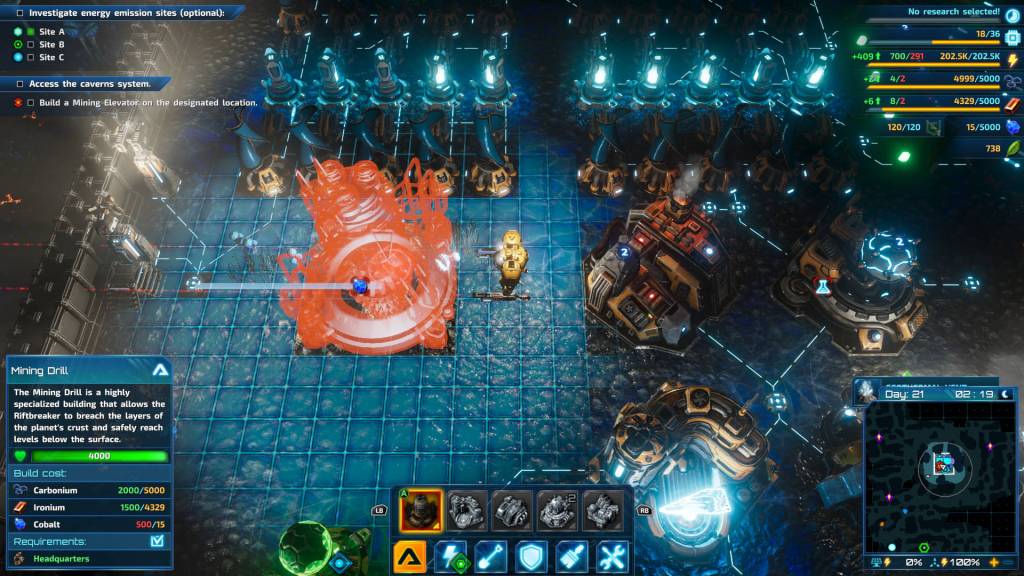
Things get interesting about a third of the way through the new campaign when you finally construct a drilling craft and descend into the unexpectedly vibrant and colourful caverns below. The caverns offer a mix of solid formations and soft limestone you can drill through, so below ground, base building and combat take on a new spatial dimension, especially when objectives force you to build and hold several distant outposts.
The caverns offer abundant construction resources that you’ll have to drill to uncover, but extremely limited wind and sunlight complicate power generation if you’ve been investing in green energy and storage solutions, while a lack of standing water and fluids requires workarounds for advanced base structures.
I found myself scrambling to make use of carbonium power plants and abundant plant and animal biomass, while investing in new regenerating defensive structures, automated resource gatherers, and, most significantly, technologies that allowed for the direct transmission of power and other resources to distant outposts without laying vulnerable cable or pipe networks.
When it comes to base defence and combat, careful drilling and planning your perimeter around solid rock pillars can make defence feel easier at first, but several powerful towers are unavailable below ground and periodic earthquakes can damage multiple structures simultaneously (though at least you can rebuild from ruins now). There are a few massive creatures that’ll bore through soft limestone and beeline towards your base, but kiting is much easier for common mobs. The downside – or maybe the upside if you enjoy combat – is that Into the Dark throws a lot of enemies at you from the get-go.
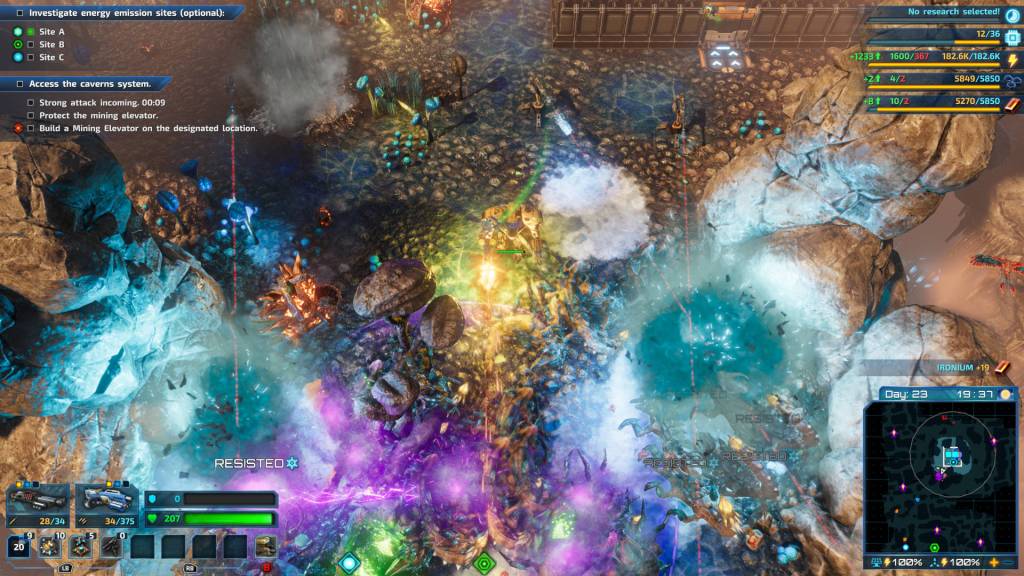
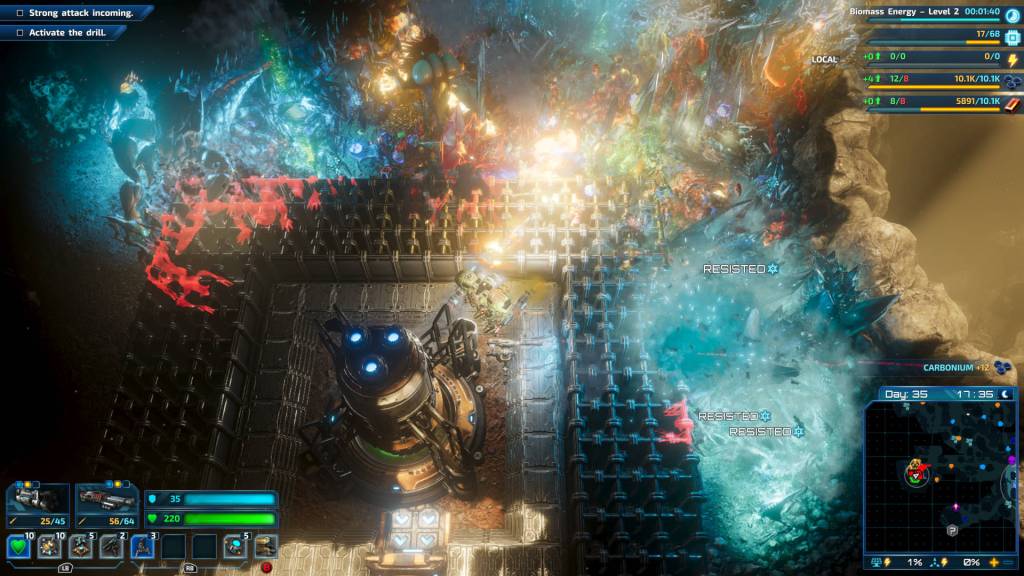
Circle-strafing and dodging around enemies are rarely viable tactics underground, so backing up into a dead end while exploring is usually fatal. When hunkered behind your walls, massive hordes are often forced to converge and throw themselves at your defences for what feels like minutes at a time. Deeper, smartly-designed, multi-layered defences are essential – especially when protecting distant outposts operating on a local grid – and I finally came to appreciate the incredible combination of repair towers with minefields and new traps.
If you’re partial to twin-stick combat, there’s no shortage of it. Into the Dark feels relentless from the start, with bigger hordes crammed into smaller spaces, and fewer chances to intercept them before they hit your defensive lines. To help you survive the increased challenge and two arcade-like boss fights, there are, of course, new elementally-themed towers, traps, and weapon technologies to research.
They’re coming outta the goddamn walls!
The Into the Dark DLC easily consumed another dozen hours and is just as expansive and feature-rich as the Metal Terror DLC, offering a ton of new or reworked content at a low price.
Some elements – like the incessant, lengthy conversations and revelations about Ashley’s past mission – can feel underwhelming, while the opening missions above ground are familiar fare. However, once you finally head below ground, you’ll quickly come to appreciate the unique base-building, defence, and energy-generating challenges, and experience the thrill of overcoming them with new technologies and smart planning.
When I returned to The Riftbreaker to tackle the new Metal Terror DLC, the experience was both familiar and refreshing. I enjoyed the initial release on console, though the gamepad support needed work and the campaign felt padded out by lengthy research times.
Thankfully, Metal Terror is a more compact and cohesive experience that entertained me but also reminded me why I stopped playing. An hour each night between other games quickly turned into nightly sessions, and then entire weekend mornings disappeared. The Riftbreaker’s compelling blend of base-building, juggling resource allocation, tower defence elements, and twin-stick combat make for a more-ish experience.
A competing coloniser?
The Metal Terror DLC can be accessed fairly early in the campaign after you’ve built a few core structures – namely the Rift Station Foundation, Orbital Scanner, and Alien Research Lab – and undertaken at least two reconnaissance missions.
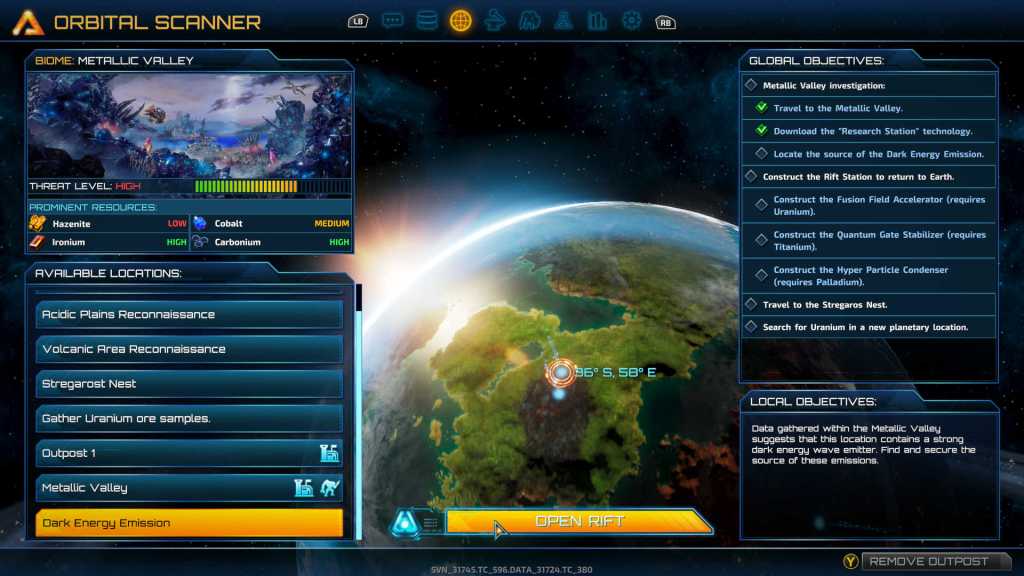
A meteor comes hurtling past your HQ – a common enough sight in the game – but this time Mr Riggs informs Ashley it was not following a natural trajectory from the nearby asteroid belt. After studying the unusual metallic composition of the debris, a scan for similar deposits reveal a new region on Galatea 37 that looks nothing like you’ve seen before.
Now while The Riftbreaker has an interesting premise, tons of dialogue between Ashley and Mr Riggs, and a never-ending codex, storytelling was never a strong point. The same holds true for the Metal Terror DLC, but the shorter, focused string of missions, with several instantaneous research rewards, make for much better pacing.
An early encounter with biomechanical lifeforms and the ruins of an alien starship kicks off a back-and-forth quest to discover the fate of another colonisation gone awry. At first, it seems you may just be dealing with the remnants of an expedition but it soon becomes apparent they may still have a presence in orbit and control over parts of the planet. The mini-narrative does its job of bouncing you between locations and escalating sieges, but also fits nicely with the existing themes of reckless colonisation.
Less waiting about and better base locations
For returning players, you can consider the Metal Terror DLC a chance to unlock some situationally useful new structures, a few new weapons and gear, and a new branch on the Alien research tree. For newcomers, or those starting a new run for the DLC, it’s compact enough that it doesn’t interfere with the flow of the main campaign. It also gives you something more interesting to do while waiting on major research projects.
The mission flow is similar to that of the core game: you arrive in a new location, scout the terrain, investigate an important location, and typically establish a fortified outpost to hold out against a new roster of particularly dangerous foes – dubbed “exo-morphs”. The exo-morphs fill the same basic functions as Galatea 37’s insane flora and fauna, but there are new complications that make outpost defence more challenging and force you to rethink your layout.
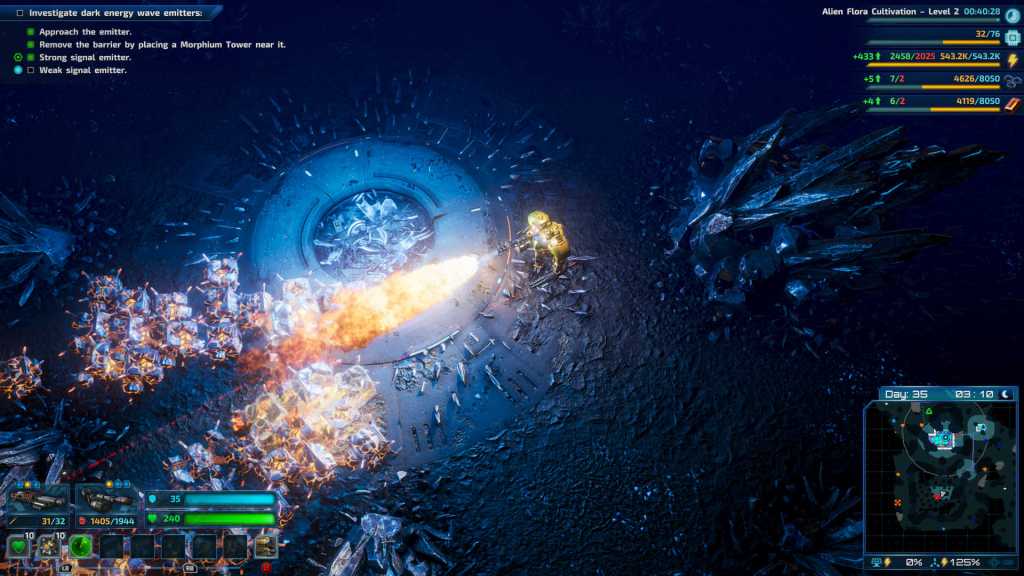
As an example, swarms of metallic dragonflies function as basic rushers, but they can fly over terrain and attack from any angle. Rolling cube-like forms are easy to kite and destroy on foot but they explode on contact with walls, making it essential to have multiple layers of defence to avoid a sudden breach. The biggest foes are lumbering bipedal mechs that combine devastating close-range attacks with an artillery-like plasma launcher. Of course, there are some new and weird, non-hostile flora and fauna to encounter.
To make matter worse, events escalate quickly across the Metal-Terror mini-campaign so you’ll be fighting large hordes early on. The upside is that most locations you need to secure are far more forgiving in their layout, with more natural chokepoints and a higher density of basic resources – think carbonium, ironiom, and cobalt – within a defensible perimeter. Sure, it’s beneficial to have invested some research into defensive structures but sieges are never impossible, especially as the mission research rewards are primarily focused on defence and power generation.
The power of Morphium
Introduced quickly in the first new region you visit, “Morphium” liquid is found in pools around the metallic biome and is used to power unique structures. In the opening missions, you’ll first run pipes to existing Morphium towers to clear a path into alien ruins, but those soon become a part of your arsenal. These provide an effective area-of-denial tower that modifies the surrounding terrain – exceptional against the aforementioned rolling cubes – and they only require piped Morphium to function. Similarly, the Morphium powerplant, especially once upgraded to level-3, is highly efficient given the low construction cost and minimal Morphium consumption cost.
These structures are particularly useful when quickly establishing, powering, and defending an outpost in the metallic biome, as all you need to find is a pool of Morphium. That said, there are new layout challenges as the aboveground piping system is far less efficient than simply dropping energy nodes everywhere (which can connect beneath structures).
More of the same but still compelling
If you’ve been playing The Riftbreaker frequently since launch, the Metal Terror DLC might feel a little light on new structures, gear, or game-changing technologies. The narrative detour is entertaining enough and expands on the universe (possibly providing a sequel hook), and slightly alters the existing end-game scenario depending on your final choice. For new players, it’s smartly integrated and feels like a natural part of the overarching questline.
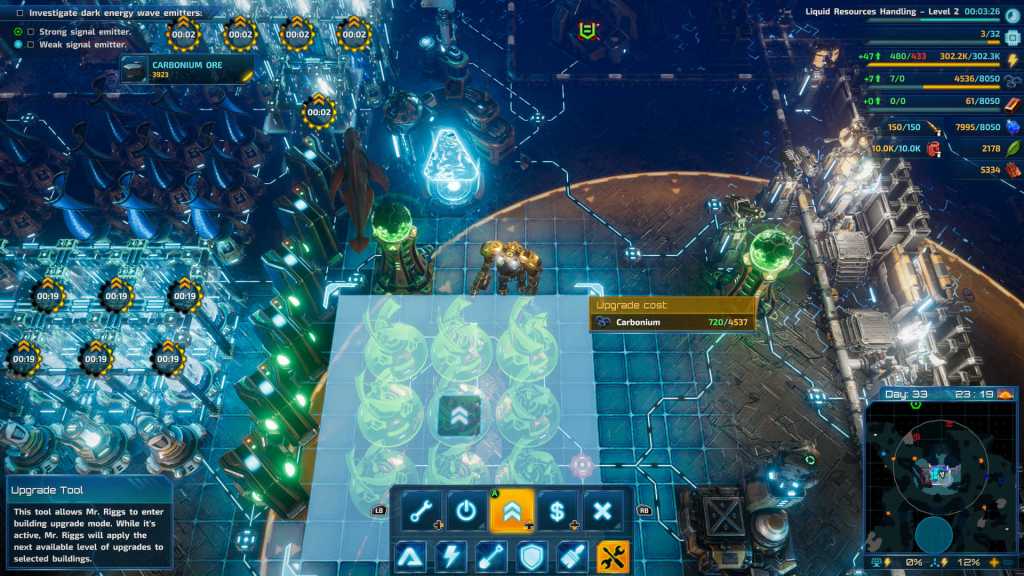
What I appreciated just as much – and this is a free update for all players now – is the ongoing quality-of-life updates. Make no mistake, building defences and running power nodes while under pressure is still tough on a gamepad, but it’s easier now with smarter automatic placement and default behaviours. There are also updates like placing new turrets on top of your existing defence structures (with an automatic refund for the original structure), and the ability to toggle the selection box size for quick repairs or mass upgrades.
If you’ve not returned to The Riftbreaker in a while, the Metal Terror DLC is a cheap and entertaining excuse to lose a few more weeks to its compelling gameplay loop. If you’ve never tried The Riftbreaker, consider this a reminder it’s a lot of fun, well-priced, and still part of the Xbox Game Pass service on both PC and Xbox Series consoles.
At first glance, you might think The Riftbreaker – developed and published by EXOR Studios – is a simple hybrid of twin-stick shooter and base-building/tower-defence game. To an extent, that’s true, and a skilled player could always draw aggro away from their base and limit the need for extensive defensive structures. However, The Riftbreaker also packs unexpected depth, with hundreds of research options, dozens of building and player upgrades, and the ever-present need to expand and protect resource-generating operations. The Riftbreaker provides plenty of entertainment in short-bursts but can also feel unforgiving and tedious when you mess up and need to recover.
Story
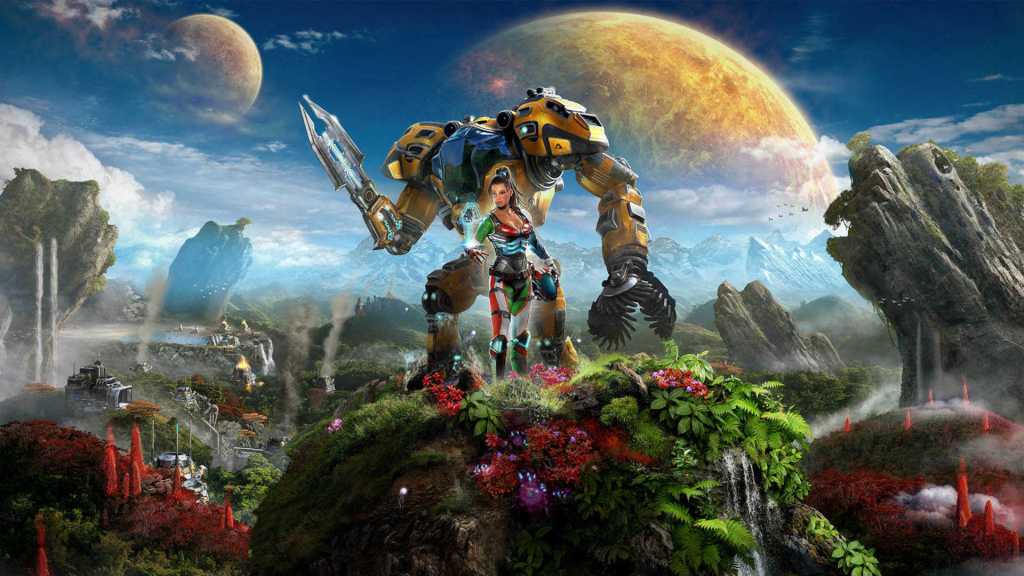
The narrative, outside of a flashy opening cutscene, is minimal and stretched thinly over hours of playtime. You take control of captain Ashley Nowak, a “Riftbreaker” – think scientist/commando hybrid – in an AI-powered mecha-Suit called “Mr. Riggs” as they emerge from a one-way jump to the lush world of Galatea 37. Earth is barely liveable, and humans are rift-jumping to distant planets to find resources and establish new colonies. She’s tasked with securing a foothold and building a massive “Rift Station” that will allow two-way travel between Earth and Galatea 37. Of course, things are never easy, and the native species are not happy with the intrusion. Aside from infrequent banter between Ashley and Mr. Riggs, which fleshes out Ashley’s ideologies and past a little more, this overarching objective and the need for rare resources to construct the Rift Station is all the context you’ll get to push forward.
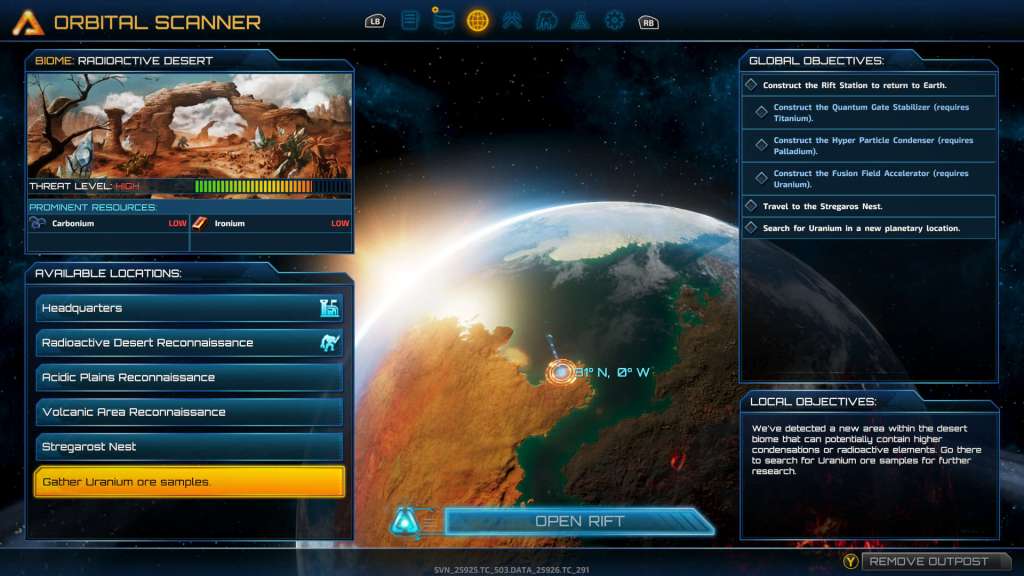
Galatea 37 is a massive, procedurally-generated world full of potential resources and danger – from both the environment and local lifeforms. Early on, you’ll gain the ability to perform short-range jumps to scout and set up new outposts, but you always need to maintain your starting HQ.
Gameplay
Controlling Ashley in her mecha-suit is a breeze, with a familiar twin-stick movement and aiming setup. This makes early exploration an enjoyable foray into the unknown, but you’ll eventually have to decide on the location of your HQ and engage with the base-building, resource-generation, and horde-defence mechanics. The world is filled with finite resource pockets – some immediately apparent, several uncovered through research and scanning – and the continuous generation of these resources is essential to making progress. Carbonium is your basic building material used to craft new structures and gear. Ironium is needed for defensive structures and, most importantly, ammunition production. Cobalt, Palladium, Titanium, and Uranium are rare resources needed for advanced structures, crafting designs, and – in huge amounts – your ultimate goal, the Rift Station. Liquid resources, like water and magma, are essential to the functioning of advanced structures, which can, in turn, produce artificial resources, like coolant and plasma, for even more advanced structures.
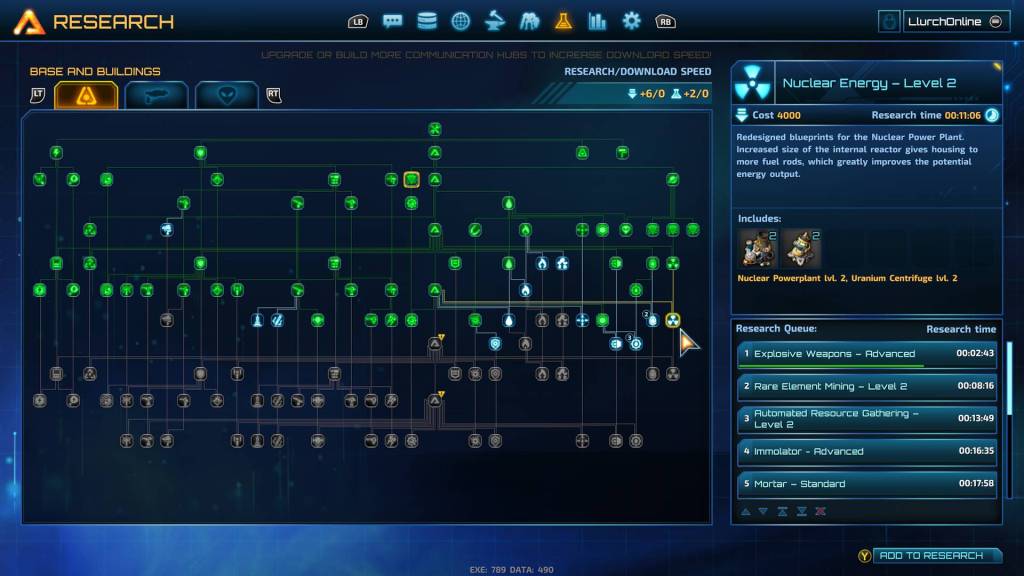
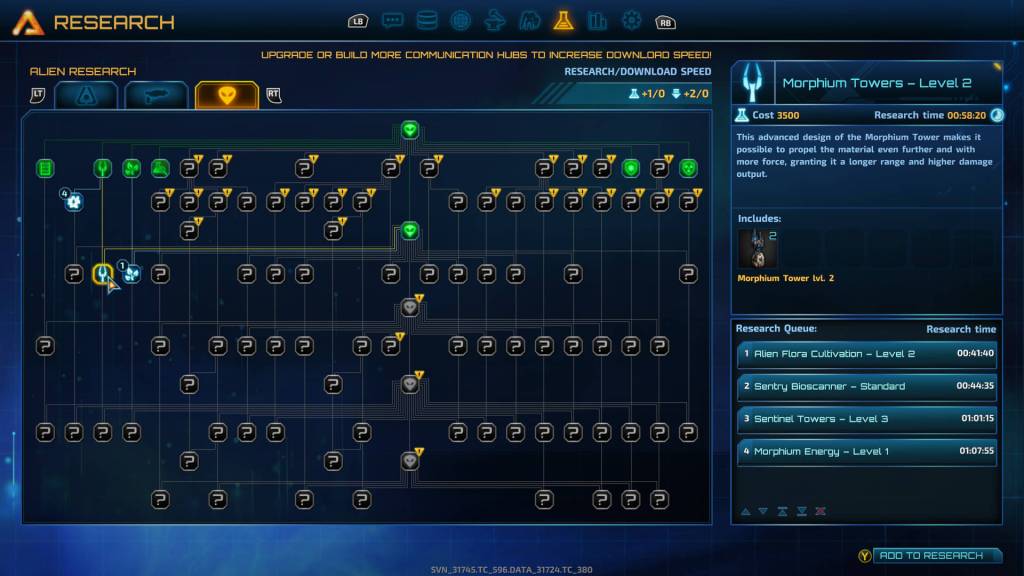
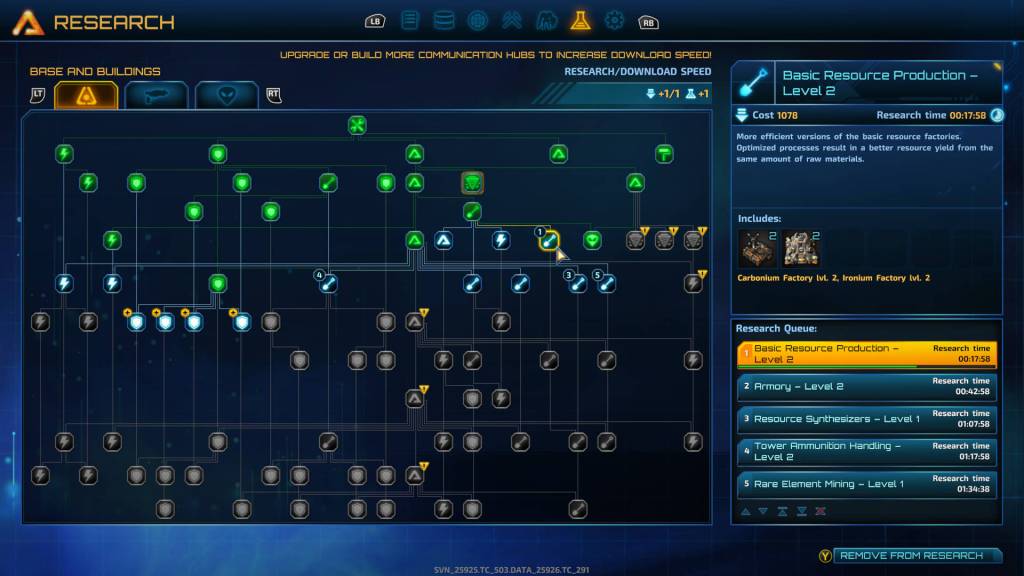
All the basic, advanced, and defensive structures you can build require considerable power, which can be produced using solar panels and wind turbines (susceptible to environmental conditions), Carbonium powerplants, biomass generators, geothermal power, and even nuclear reactors. Of course, the ability to build advanced base structures, upgrade them for greater efficiency, or craft and equip the multitude of weapon and mech-suit upgrades, requires researching your way through three massive, multi-tier technology trees. Research speed becomes a major obstacle to progress and can feel painfully slow at times – unless you can support multiple power-guzzling Communication Hubs. Naturally, all these structures require space, and making more space means your walls and defensive network is spread thinner (an HQ location with some natural barriers is a must). You’ll quickly discover the need to run power nodes to distant resource-producing outposts, which are then more vulnerable to horde attacks. You could surround them with walls and powerful, specialised turrets but that means more power, AI cores, and resource-hungry ammunition factories.
So many structures and so little space! Thankfully, most structures can be upgraded to make them more efficient, but you’ll still need a sizeable base, with a strong defensive perimeter, packing dozens of power-producing structures, refining and beneficiating resources for advanced structures to complete the Rift Station.
If this is all starting to sound overwhelming, it can be. Although not as granular or deep as games like Factorio or Satisfactory, I can’t help but feel The Riftbreaker has been untruthful in its marketing campaign. Resource production and beneficiation, coupled with power generation, underpin everything you do. As a result, it’s possible to get it very wrong and find yourself struggling to recover. As an example, an early push for automated Repair Towers seemed like a great idea, until I realised they were chewing through my resources faster than I could replace destroyed structures and defences, forcing me to run about manually disabling them. This frequent need to repair and upgrade structures also highlighted the variable gamepad support. Exploration, combat, and menu navigation are solid with a gamepad, but the precision placement of structures or trying to mass select them for upgrades is problematic (and nigh-impossible under pressure). The base building feels more intuitive using a mouse and keyboard, and this is an option for console players if they have the hardware.
Having hopefully conveyed the complexity of resource production, construction, and research, you’ll be relieved to know exploration and twin-stick combat is far simpler and instantly gratifying. Movement and shooting feel great, making it easy to kite hordes, dash out the way of larger creatures, and thin the alien ranks before they break upon your walls. The mecha-suit can handle three swappable weapons per arm – ranging from swords to chain guns, flamethrowers to rocket launchers – which can be upgraded to higher tiers or modded for extra elemental damage. There are passive equipment slots and active abilities to enhance your combat skills and survivability, all of which can be crafted with the right research and sufficient resources. If you’re after a more hands-on approach to base defence, you can prioritise the weapon technology tree and create a walking tank. Many of the upgrades in the alien technology tree become essential once you’ve constructed the Orbital Scanner and begin away-missions to secure rare resources in hostile environments (think heat, radiation, volcanism, and corrosive clouds). Given the ceaseless demands of your primary base, these away-missions to explore and establish distant outposts are paradoxically stressful and relaxing.
So many things to research, so few communication Hubs, and constant power shortages… Waiting on research feels like an excuse to go out and explore more, but there’s only so much entertainment to be gleaned from clearing respawning alien mobs from the local area for upwards of 15-minutes at a time.
When the environment isn’t trying to kill you – and there is an inordinate number of natural phenomena on Galatea 37, from calm moon phases to damaging hailstorms – it’s the myriad of alien species. These range from basic Zerg-style cannon fodder to lumbering organic artillery and – sticking with the StarCraft analogies – seemingly advanced, cloaked and bladed warriors. Each environment – lush jungle, scorched desert, icy tundra, or volcanic waste – has several unique lifeforms (not all hostile) but they fill similar roles when it comes to assaulting you or your base. Despite Ashley’s apparent desire to study and conserve Galatea 37’s original environment, frequent hordes and respawning alien clusters ensure she butchers hundreds of them on any given day. Combat is less stressful than resource production and base management to be sure, but it’s frequent enough that you’re rarely able to explore for more than a minute without shooting something. On the upside, it’s a great way to hoover up biomass, uncover hidden resources using a scanner, find new species for the alien technology tree, and several unique power or gear designs.
Presentation
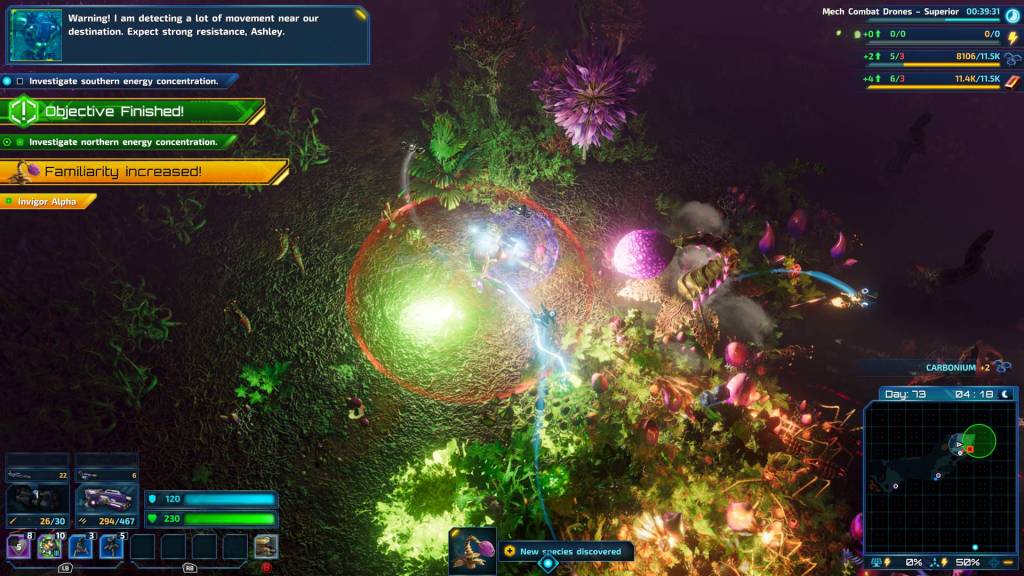
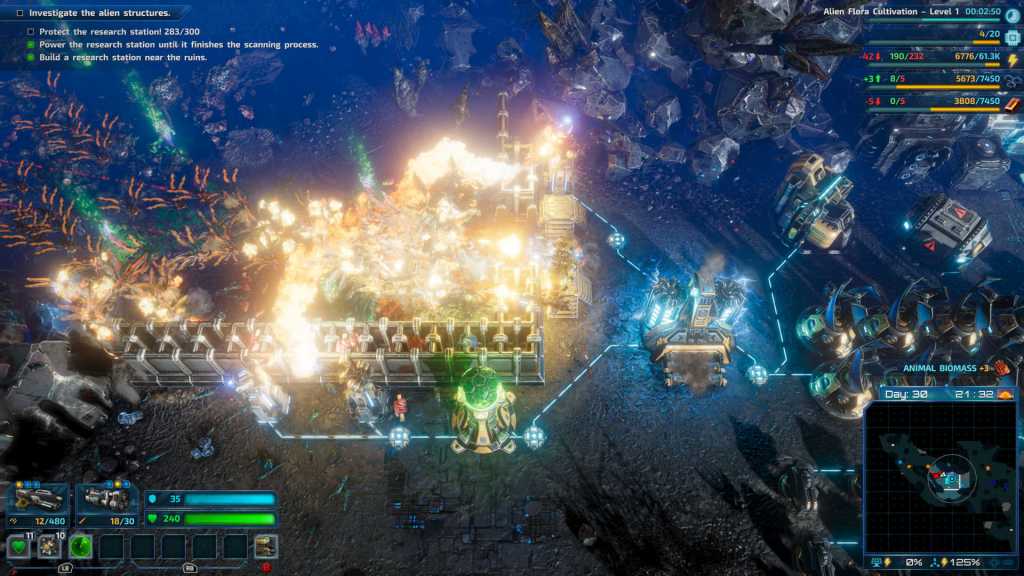
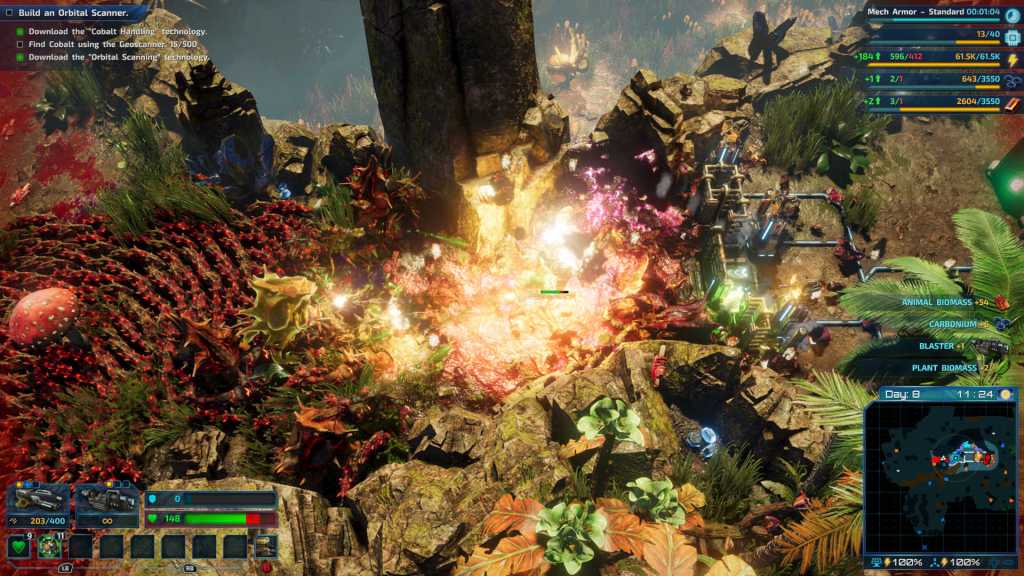
When it comes to the presentation, The Riftbreaker looks and sound great for most of the experience. The world feels ridiculously detailed, vibrant, and packed with moving and reactive parts – think foliage, liquid pools, and destructible terrain. Firefights against large hordes in forests are a particular highlight, with projectiles tearing through vegetation, while explosions send shockwaves through trees and grass. That said, it can be easy to lose track of Ashley’s mecha-suit in busier scenes. The Riftbreaker can buckle during massive horde attacks but proved scalable on PC and even performed well on the budget Xbox Series S, about 95% of the time. The audio is also a highlight, with loud and impactful combat and a catchy soundtrack that starts serenely before escalating based on nearby threats. With only two voiced characters, Ashely and Mr. Riggs have plenty of exchanges, often cheesy and overwrought. Thankfully, the voice-acting is not too bad and you don’t hear it all that often.
The Riftbreaker’s environments are vibrant, detailed, and reactive but it’s easy to get lost in the visual chaos. Large hordes can drag down the framerate on PC and console, but the experience was smooth for the bulk of my playtime.
Notable issues
A lot is going on in The Riftbreaker at any given moment and you’re rarely given any downtime (even after delving into the heavily customisable difficulty settings). This ensures the world of Galatea 37 is less a mysterious space to explore, and more of a pretty canvas on which to build and murder things. On one hand, the procedural generation ensures each new location – be that a permanent outpost or once-off scouting mission – can throw up new challenges and sights. On the other hand, I wish there was a little more structure to the narrative and lore, rather than needing to read hundreds of journal entries. Maybe some handcrafted scenarios to test your construction and combat skills, as in the They Are Billions campaign. Other irritations include the aforementioned gamepad support and the need to manually upgrade structures once you’ve researched new tiers (a thousand wall segments being a prime example).
Conclusions
Considering each mechanic in isolation, The Riftbreaker is packed with interesting systems but the learning curve, balance, and pacing often feel off. It’s a game in which you’re constantly hitting roadblocks – some of which present an engaging challenge, while others simply require you to sit around until you have enough resources or research completes. It’s possible to find yourself desperately reconfiguring your base to balance power supply, resource production, and resource consumption, while constantly stopping to fend off hordes and likely racking up more damages. There is an audience for this sort of challenge and, despite pointing out these challenges, I could not stop playing. However, I think there’s an even larger audience who’ll pick up The Riftbreaker looking for a twin-stick shooter with streamlined base-building elements, only to find themselves bogged down in base micromanagement and making little progress. That said, The Riftbreaker can be a ton of stressful fun – just so long as you know what you’re getting into.
Pros:
Fluid and responsive twin-stick shooting
Tons of research, buildings, gear, and upgrades to unlock
A lengthy, involved campaign across a procedurally-generated world
Visually stunning with decent performance on PC and Xbox Series consoles



 gameblur-v2.0