Category: Retrospective

  • Retrospective Review: Warhammer 40,000: Dawn of War – Definitive Edition

    Retrospective Review: Warhammer 40,000: Dawn of War – Definitive Edition

    If 1995’s Command & Conquer built upon early real-time strategy attempts to perfect the foundations of the genre, so too did 2004’s Warhammer 40,000: Dawn of War for the nascent squad-based RTS genre. Strategy games in which your ability to micromanage fewer squads and control territory is often more important than fortifying bases, tech-ing up, and overwhelming your opponent with a mass of units (which is not to say that can’t be done). Losing territory could swiftly strip you of resources and access to high-tier units, while losing entire squads and powerful leader units could turn the tide against you as you scramble to reinforce from scratch. Two decades on, even with real-time strategy reduced to a more niche market, the legacy of Relic’s Dawn of War is still visible in game design.

    Returning to it by way of the Warhammer 40,000: Dawn of War – Definitive Edition, I forgot how much it feels like a game of two halves – each half catering to a very different audience. If you share my fondness for fortifying every square inch of a map as you expand, upgrading every unit as far as possible, and using tactical retreats to preserve squads for a final push, the campaigns and lower difficulty AI skirmishes – either solo or coop – have you well catered for. If you prefer reactive, high-intensity, high-mobility battles to claim and hold territory, the PvP modes have you covered and, to a lesser extent, the Dark Crusade and Soulstorm campaigns on higher AI difficulties.

    If this remaster is your introduction to Dawn of War, it is one of those “easy to grasp, hard to master” games. The original campaign and Winter Assault expansion serve as lengthy, glorified tutorials that introduce basic mechanics and strategies, while providing all the narrative context and world-building you could ask for. You might think Space Marines killing aliens and demons in the God Emperor’s name has limited potential, but the Dawn of War campaign gets right what so many modern Warhammer 40,000 games gets wrong: the cast show some self-awareness of the absurd universe they inhabit, it focuses on the distinctly human flaws under a Space Marine’s superhuman physiology, and that humanity makes it easy to root for the protagonists. The Winter Assault campaigns lean more into the absurdity and hypocrisy of the universe, whereas the Dark Crusade and Soulstorm expansions only offer narrated flavour text to link together skirmishes.
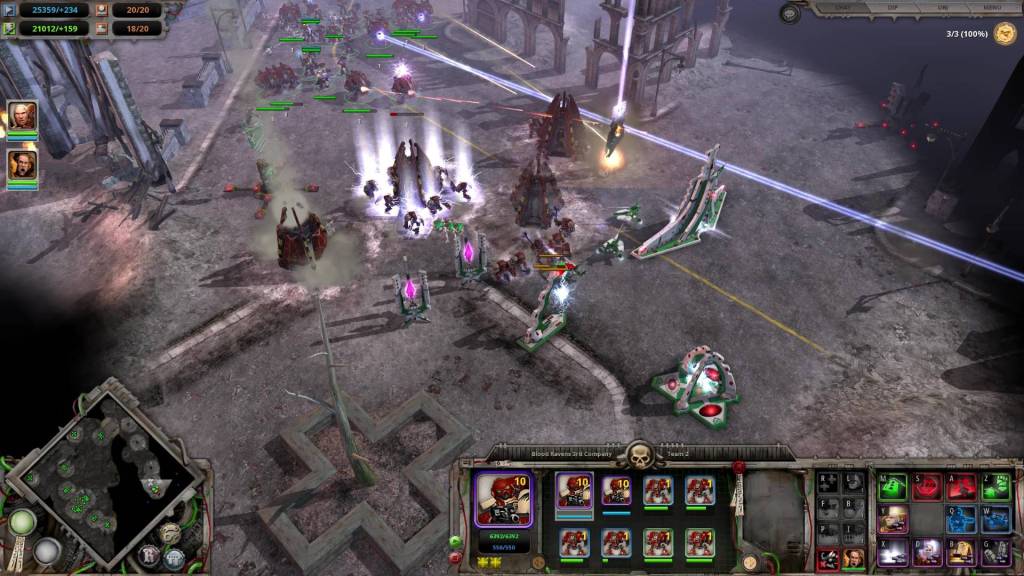
    Of course, the minute-to-minute gameplay is the draw of any RTS, and the Dawn of War – Definitive Edition offers up everything from exhilarating chaos to plodding grind, with no shortage of frustration that’ll have you cursing unit pathfinding and their lack of self-preservation. Befitting the squad-based focus, base-building is relatively simple with three resources to manage – requisition, power, whether you control a holy relic or not – and there are typically three tiers of global upgrades. Controlling units is standard RTS fare but in addition to global upgrades, you can personalise squad weapon loadouts; attach support units, define movement and engagement rules; use light and heavy cover to enhance infantry effectiveness; and exploit morale damage, negative cover, high ground, and line-of-sight to give your forces the edge.

    Irrespective of which of the nine factions you play as through the campaigns, skirmishes, or PvP modes, the basics are the same – even if the base-building and upgrade pathways may differ slightly. Control points need to be captured and fortified to generate requisition; generators or scattered plasma sources provide power; and rare holy relics must be captured and held to produce the most powerful units. Capturing points quickly requires spreading your infantry across the map; construction requires shepherding your weak builder units around; your defensive options are limited to one or two turret variants; and turtling is useless outside of scripted campaign missions that limit what enemy forces you face. There are units that can serve as base defence, but entrenched units and turrets are easily outranged. At best, defences can stall an enemy force while you move your army to intercept.
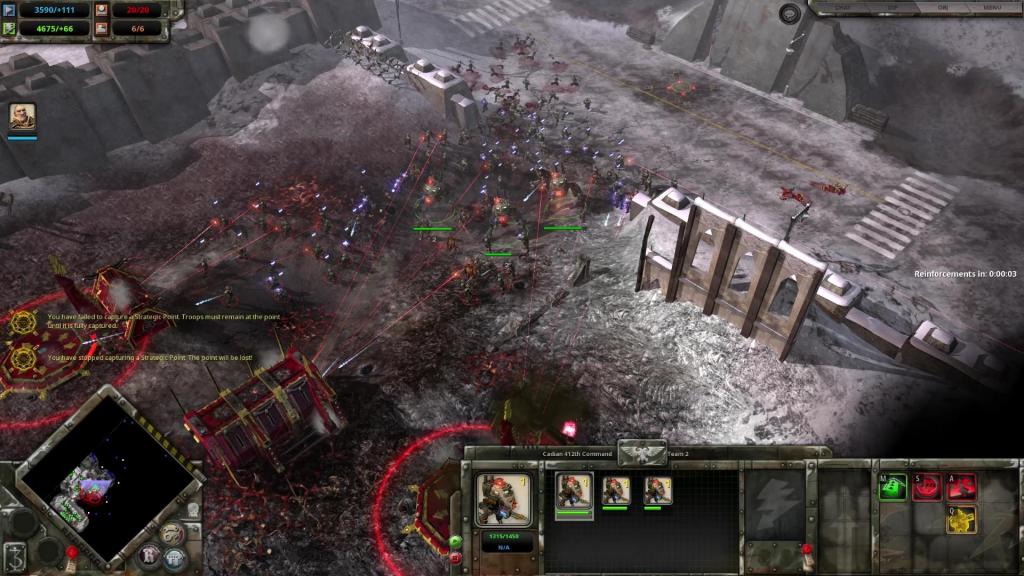
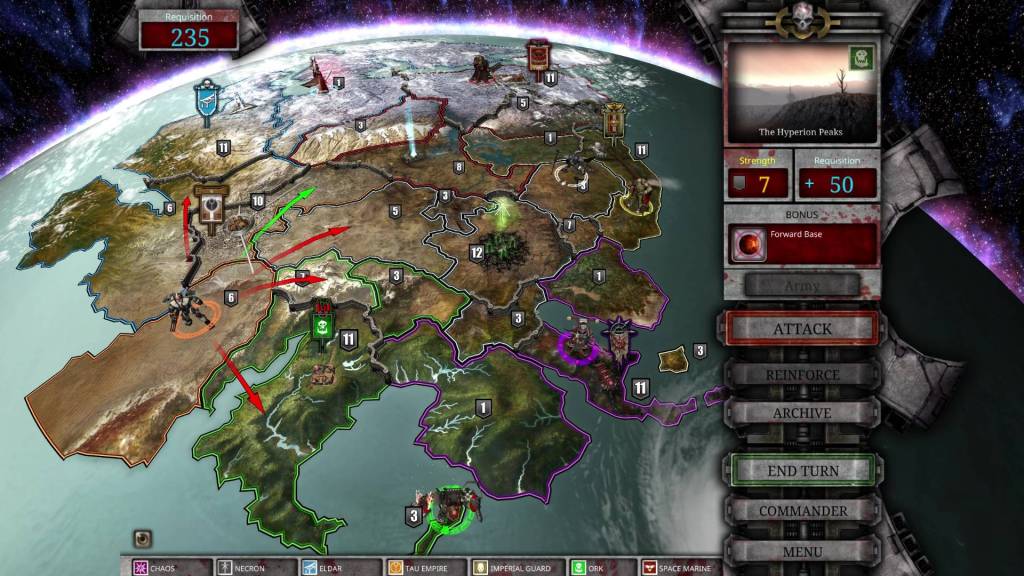
    In PvP matches, AI skirmishes, and much of the Dark Crusade and Soulstorm expansions – which offer turn-by-turn conquest maps to dominate – battles take place across broadly symmetrical maps and play out as dynamic cycles of attack and retreat, favouring those who can juggle expansion and micromanaging their army. Capturing and defending control points is beneficial (and essential for some victory conditions), but your limited defensive options mean a combined army can always steamroll a primary base if not intercepted. It makes for a stressful but thrilling back-and-forth. Even a player that has dominated territory could suddenly lose their key unit producing buildings or holy relic and find themselves with an abundance of resources they can spend on only basic squads.

    In contrast, the original campaign and the Winter Assault expansion are for those who prefer a scripted and more predictable experience. There are a few exceptions that impose time limits, but most missions allow you to slowly spread across a handcrafted map towards your objective. The methodical pacing and lower stakes might frustrate some, as even on the higher campaign difficulties the AI plays by the same rules. They may get free reinforcements at times, but as you claim control points and fortify chokepoints, they lose their ability to counterattack, and your growing force will inevitably steamroll the objective. There’s something about this predictable formula that I always enjoy, but after completing the original campaign and the Winter Assault expansion, I could understand why they wanted to change up the formula with Dark Crusade and Soulstorm.
    I’ve got this far without discussing the remastered elements of the Definitive Edition as it does a great job of presenting the game as you mis-remember it. Having a combined launcher, fully customisable controls, a pulled back camera, and proper widescreen support that doesn’t stretch HUD elements are simple but significant improvements. There are apparently pathfinding tweaks but these did little to alleviate the frustration of units shuffling around one anther instead of engaging enemies. There’s no hiding the limited geometric complexity, but the remastered 4K textures are a notable improvement that serve both the gameplay and rudimentary in-game cinematics well. It also ran at a mostly consistent 1440/60 at max settings on my 5-year-old gaming laptop with an underpowered i7 CPU and 8GB RTX3070 mobile GPU.

    Ultimately, I think the Warhammer 40,000: Dawn of War – Definitive Edition is a solid remaster – even if it’s not a particularly ambitious one. The core gameplay is still strong, even if the campaigns and PvP components can feel a world apart in how they play. Whether you’ve enjoyed structured RTS campaigns or chaotic PvP. there’s something for everyone. It should satisfy returning players looking for a nostalgia hit, and any fan of modern RTS games with a focus on managing fewer, more specialised units. If you’re someone that has spent last decade or two playing and modding the original, you might find the remastering effort too limited to justify the price – but there is the prospect of a revived and more robust multiplayer scene.

    Warhammer 40,000: Dawn of War – Definitive Edition was reviewed on PC using a code provided to gameblur by the publisher.
  • Retrospective: Citizen Sleeper (2023) is all about building a new life, one cycle at a time

    Retrospective: Citizen Sleeper (2023) is all about building a new life, one cycle at a time

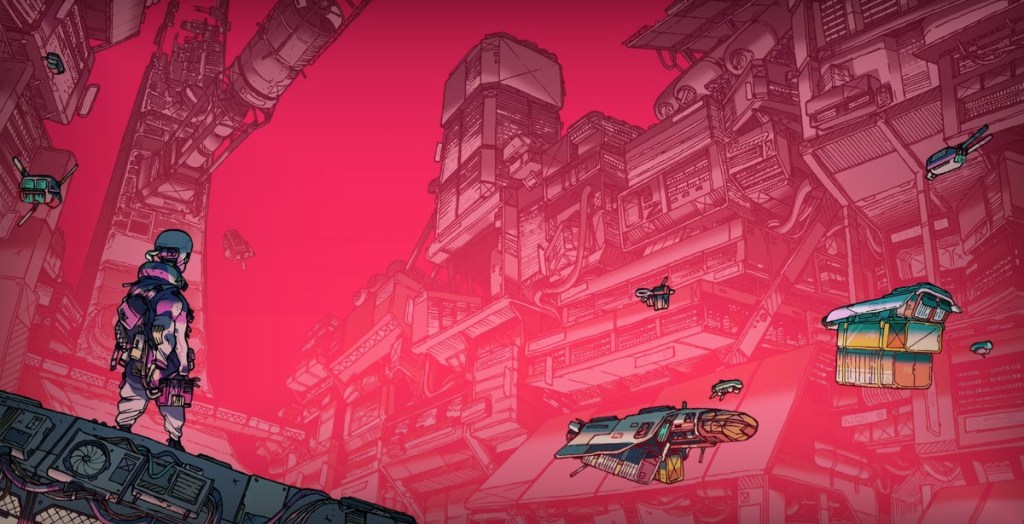
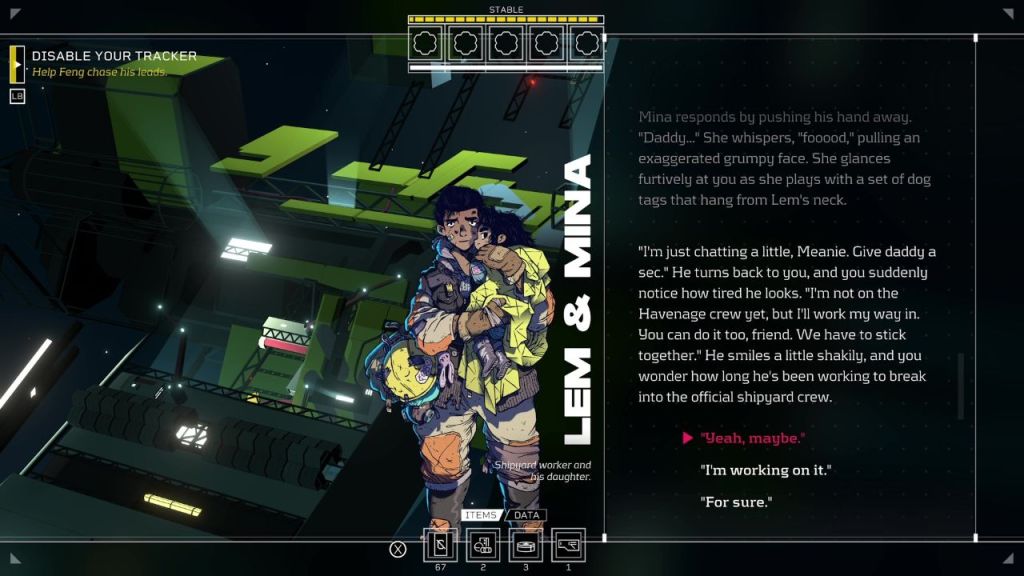
    With so many games and so little time, Citizen Sleeper was yet another indie release that caught my eye before being swamped by tsunami of gaming news promoting the next best thing. Thankfully, returning to it three years late is easy, with the minimalist but stylish visuals, slick interface, and evocative soundtrack effectively timeless. And I’m glad I did return, as there is something comfortingly familiar yet fresh about the hybrid structure that blends a choice-driven visual novel with a dice-driven, tabletop-style RPG. It’s also uplifting as hell, despite the often-bleak setting and scenarios you’ll face, and had me wondering if my life was also just a string of choices and more RNG than I care for?

    It’s worth noting up front that you need to be comfortable with a lot of reading if you’re going to gel with Citizen Sleeper. There is no voice work and often paragraph after paragraph of text to work through. From the opening sequence that introduces you to your synthetic “Sleeper” body with a transferred consciousness, through to the heartfelt culmination of relationship-building quest-lines, and the handful of potential endings, Citizen Sleeper conveys everything through excellent writing, lightly animated character portraits, and the accompanying soundtrack. I found it an impressively thought-provoking experience that generated stronger emotions than the glut of cinematic “AAA” games I’ve played over the last decade – many of which featured professional voice work and lavish motion capture.

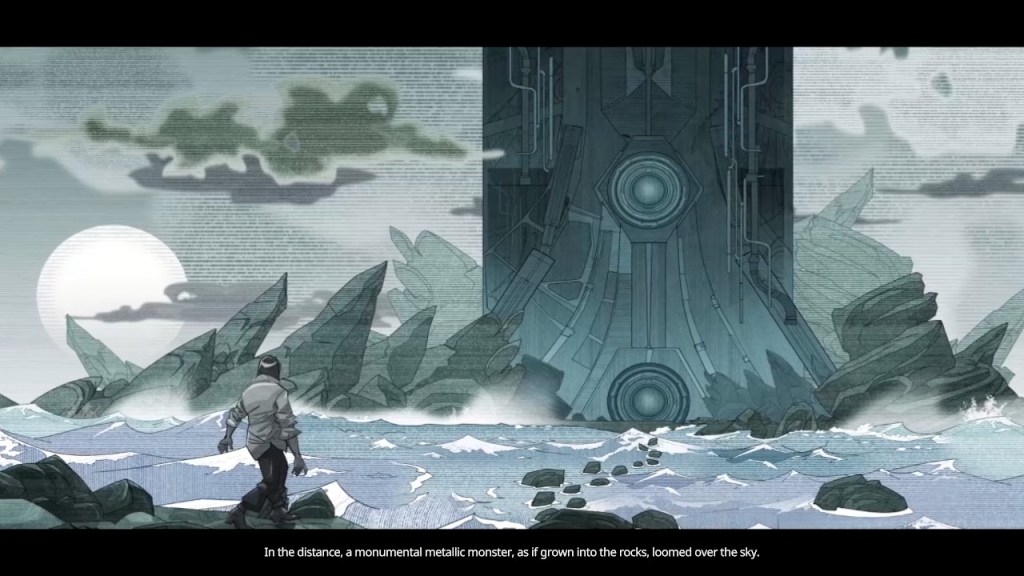
    It’s possible you will recognise many of the sci-fi tropes the world of Citizen Sleeper is built upon, but the setting remains a strong hook throughout as the game doesn’t rush to explain everything up front. Instead, each character has a link to major players in the Citizen Sleeper universe, and through interacting with them you’ll come to understand the past and present of the world you now inhabit. What’s clear from the get-go is that “The Eye”, a decaying ring station in the Helion system, on the edge of the Core region, is home to human, augmented, and synthetic workers – some bound by company contracts or gang debts – all trying to get by providing essential services or engaging in dangerous space-faring work, like terraforming, resource extraction, and salvaging.

    A corporate collapse a generation before resulted in the emergence of several factions: a workers union that evolved into a corporation with a structure it once despised; a gang straddling the line between governing body and criminality; a commune trying to make The Eye self-sufficient through novel food production methods; a charitable organisation driving new colonisation efforts; and a curious assortment of forgotten AI constructs. It is into this diverse and fragile fringe society that your Sleeper finds themselves, with no friends, no stable work, and no access to the stabiliser drugs essential for maintaining their synthetic bodies.

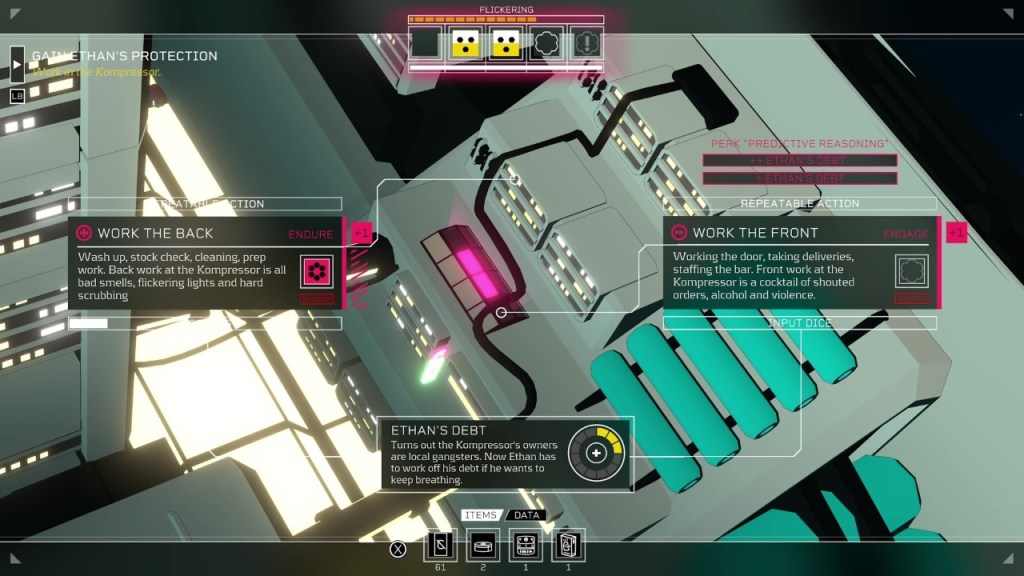
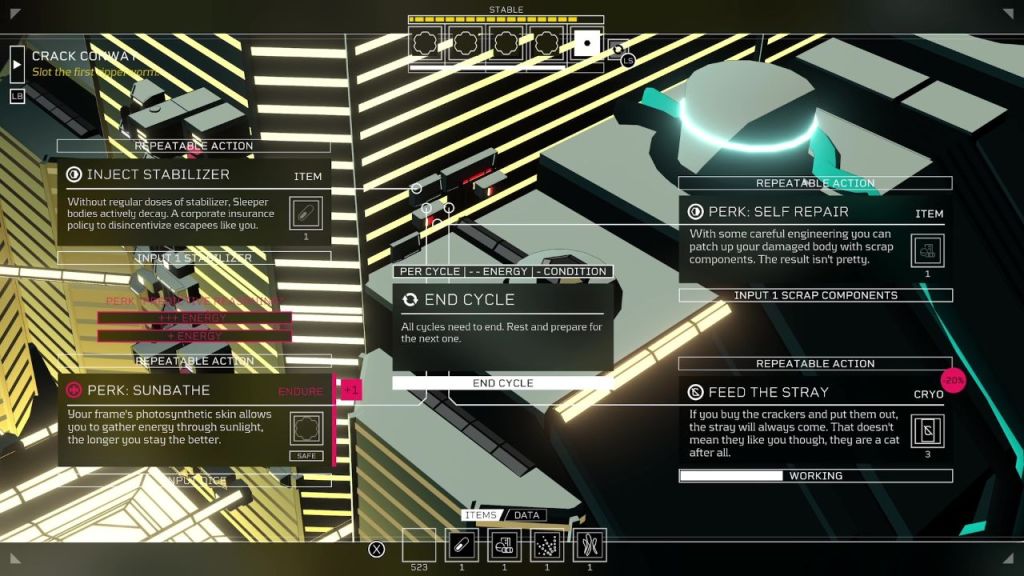
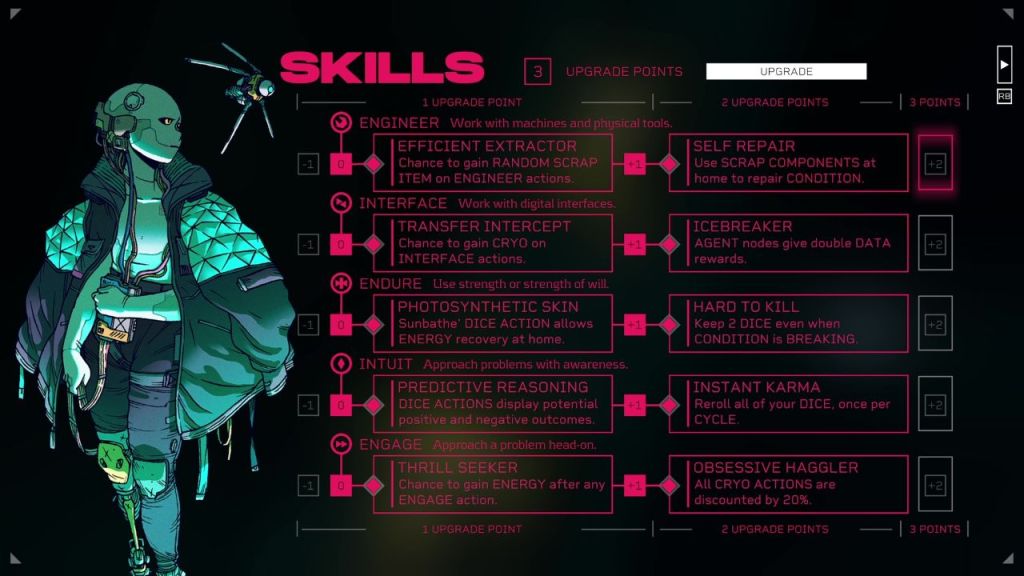
    To survive, you’ll need to explore, find work opportunities, forge new friendships, and decide what purpose your new life serves on the edge of the inhabited universe. You do that by way an abstract and menu-driven system that is mechanically simple and intuitive yet, thanks to the incredible writing and characterisation, still engaging and frequently tense. If you strip away the narrative layer, Citizen Sleeper is a combination of timers, meters, dice rolls modified by a simple skill tree, and player choices that shape future interactions. It sounds incredibly dry, but like a table-top RPG led by an experienced GM, simple actions can be thrilling with the right narrative framing and high stakes.

    Each cycle, you awake hungry and watch the condition of your synthetic body deteriorate. Each cycle, you’re dealt five or less dice that dictate your chances of successfully completing a job to earn currency to buy food or stabiliser drugs; values that influence your chances of mastering a social interaction that could improve your local reputation; or the exact values required to hack systems within The Eye’s vast and collapsing information network.

    Every time the story imposes a cycle limit before events transpire or limits the number of times you can bungle a task, a segmented ring slowly fills up with abstract but terrifying red markers. Combined with the ever-present hunger and condition meters, they serve as a constant reminder you are living on the edge, and every decision is meaningful.

    The gameplay mechanics can generate tension well enough, but what makes Citizen Sleeper special is how almost every interaction, be that player choice or dice roll, is linked to a specific faction or character. Through repetition, you’ll come to know them all, and through constant engagement, you’ll dig deeper into their lives. You’ll unlock new interactions with a cast of troubled but often hopeful citizens and slowly establish yourself on The Eye. You’ll soon realise Citizen Sleeper has few fail states beyond locking you out of some endings, but thanks to great writing and multiple quest outcomes, it’s incredibly satisfying to define your character through their choices and interactions with others – regardless of whether you choose to settle on The Eye or find a way to move on.

    Wrapping up, Citizen Sleeper is any easy addition to an ever-growing list of iconic indie games that demonstrate how much you can achieve with very little. It’s like a well-written choose-your-own-adventure novel, in which triggering the next turn of the page means engaging in some simple but satisfying table-top-style dice rolls that can sometimes work for or against you. Citizen Sleeper also remains a timely reminder that if you are looking for a place in a community, you should be looking for a collective of individuals that share your values and struggles, not some monolithic organisation – be that corporate, political, or religious – with the expectation of your adherence to some ideological dogma that those in charge rarely follow themselves.

    Citizen Sleeper was played on Xbox Series S|X using a code provided to gameblur by the publisher. It is also available on PC, Xbox One, PS4/5, and Nintendo Switch.
  • Retrospective: Ryse: Son of Rome (2013)

    Retrospective: Ryse: Son of Rome (2013)

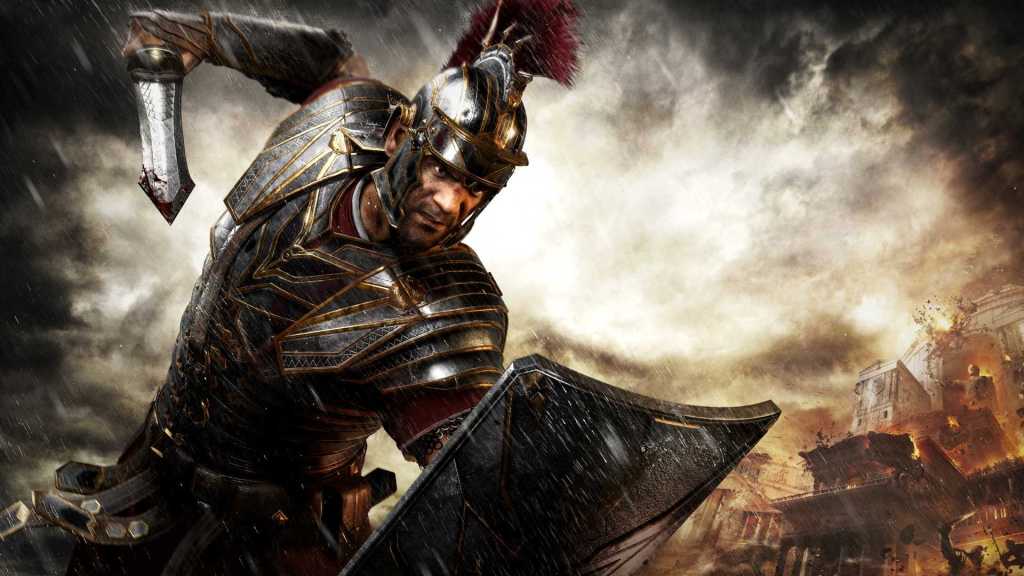
    I only picked up an Xbox One three years into the last generation, and Ryse: Son of Rome didn’t even enter my mind when I was looking for what few exclusives I’d missed. I eventually added it to my library when it was heavily discounted and promptly ignored it for another 5 years according to my transaction history. Having finally played through the campaign mode in 2024, two thoughts stood out: one, the negative sentiment towards Xbox after the botched Xbox One launch must’ve been severe if both this game and IP were swiftly forgotten; and two, I really miss big-budget games that could be completed in a dozen or less hours, and had actual endings that let me walk away with a sense of completion.

    Which is not to imply Ryse: Son of Rome is some underappreciated masterpiece. By 2013 standards, it would have felt distinctly average aside from the technical highlights. By 2024 standards, I found some of its flaws now feel like positives – so long as you go in with your expectations in check. It functions as a compact version of the formulaic action-adventure that now dominates blockbuster games: a third-person perspective with lavish character models and animations; a strong focus on the presentation with lengthy cutscenes for storytelling; and a cinematic flair to the action, with tons of canned animations and the sensation the game is sometimes playing itself for fear you interrupt the transitions into cutscenes. The only thing it’s missing is an open-world structure – which I now consider that a good thing.

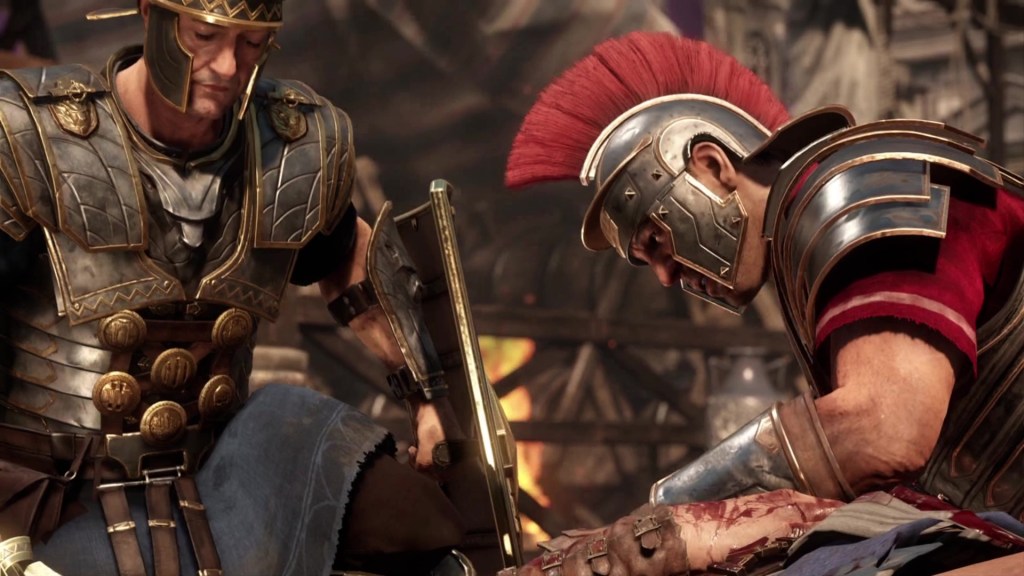
    What made it most enjoyable to me in 2024 was the pacing of its brief campaign; brevity that serves the gameplay loop well, as it probably wouldn’t hold up past the 8-hour mark, no matter how much audiovisual spectacle is thrown at you. You control Roman soldier Marius Titus, in an alternate history Rome, during the time of Emperor Nero (and yes, he has much the same physique as Demetrian Titus in Warhammer 40,000: Space Marine if that came to mind!). Political change is in the air and the vast expanse of the Empire is making it difficult to govern. After a chaotic prologue sets the stakes, Marius recounts his story to the emperor leading up to that point, beginning with a visit to his Senator father and family in Rome after completing his training. The reunion is interrupted when a barbarian war party raids the city; his mother and sister are on screen just long enough to die and provide motivation for another hyper-masculine, vengeance-driven campaign; and his father only lasts a little longer before telling him to save Rome in his dying breath.

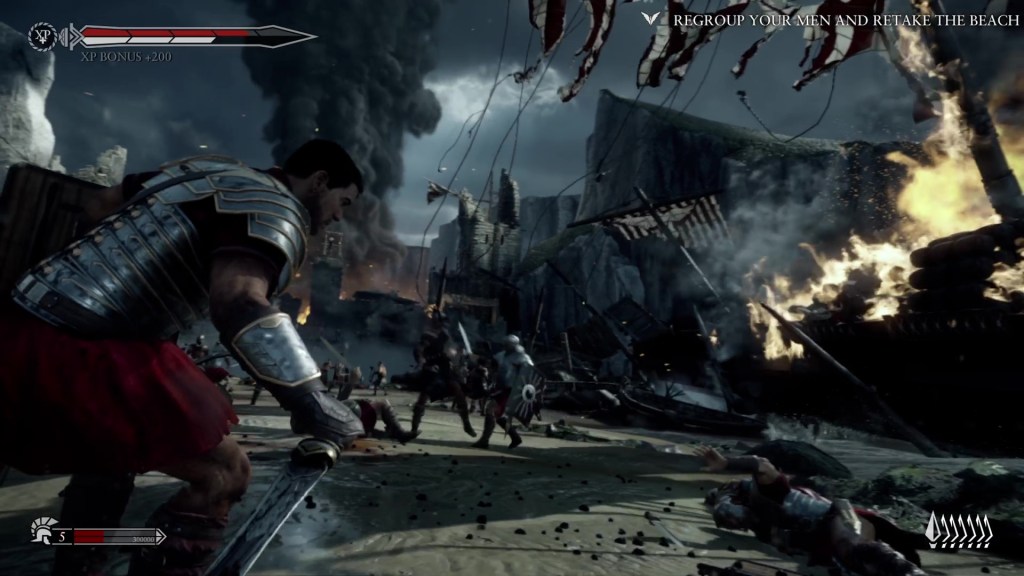
    What follows is a visually diverse and often spectacular campaign that’ll see you invade Britannia in the Roman equivalent of the D-Day Landings, battle southern rebels and wild Northmen in the fog-swathed Highlands, evacuate a fortress city under siege, and finally return to a collapsing Rome after Marius realises a cowardly emperor and his psychopathic sons might be the real problem as “barbarian” hordes rise up as a result of Roman oppression. Naturally, you’ll meet and kill several historical figures from legend in the process. On the sidelines, there’s another battle being waged by Roman gods trying manipulate mankind through prophecy and direct intervention, with Marius taking up the mantle of Damocles to enact revenge. I found the storytelling still holds up thanks to the impressive visuals and sense of scale (well, for the time), the lengthy but well-directed cutscenes, and some excellent voice work throughout.

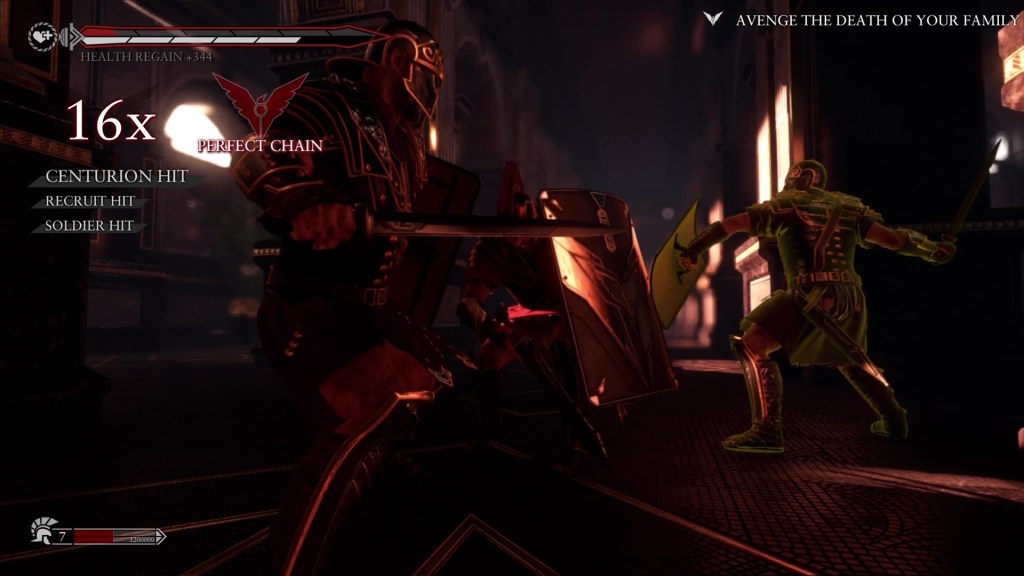
    Now I’ve got this far without discussing gameplay, as while tutorials make it sound complex, the mechanics are simple, satisfying, but increasingly repetitive by the end. Ryse: Son of Rome uses the classic attack, dodge, block, and counter rhythm that Batman: Arkham Asylum pioneered in 2009 – just with a sword-and-shield focus, less “gadgets”, and gory takedowns. You build up combos with basic strikes; you block or parry with your shield; dodge glowing attacks; kick or use charged attacks to break an enemy’s guard; use a focus ability to slow time for free hits, and trigger QTE-driven executions on a single or pair of targets. These executions never fail once started, but if you match the prompts, you get bonus points towards health and focus restoration, a temporary damage boost, or XP that goes into a perfunctory skill tree that boosts basic attributes and execution bonuses. It’s an intuitive enough system that looks and feels great when you hold off a surrounding horde and execute them all in gory fashion.

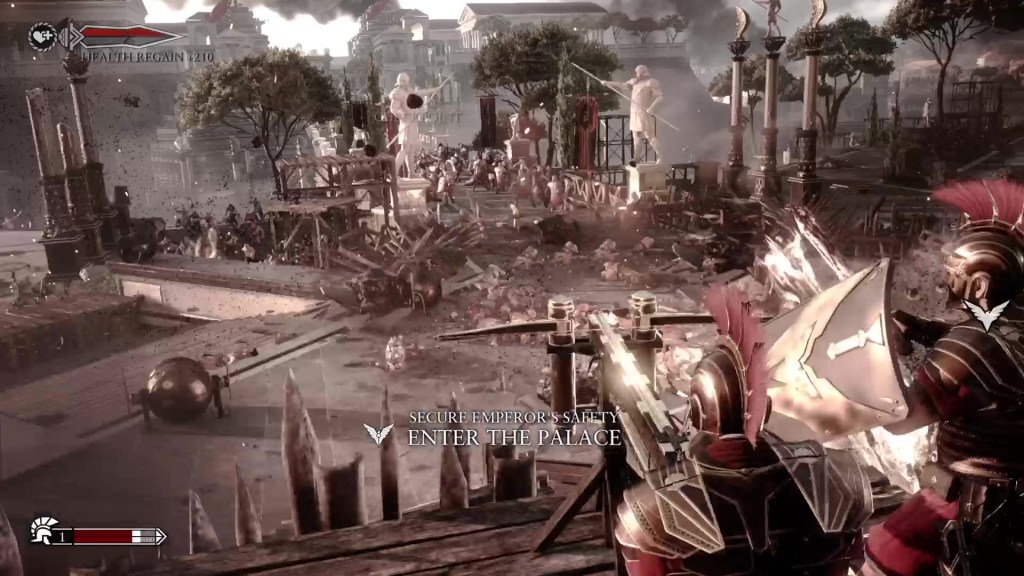
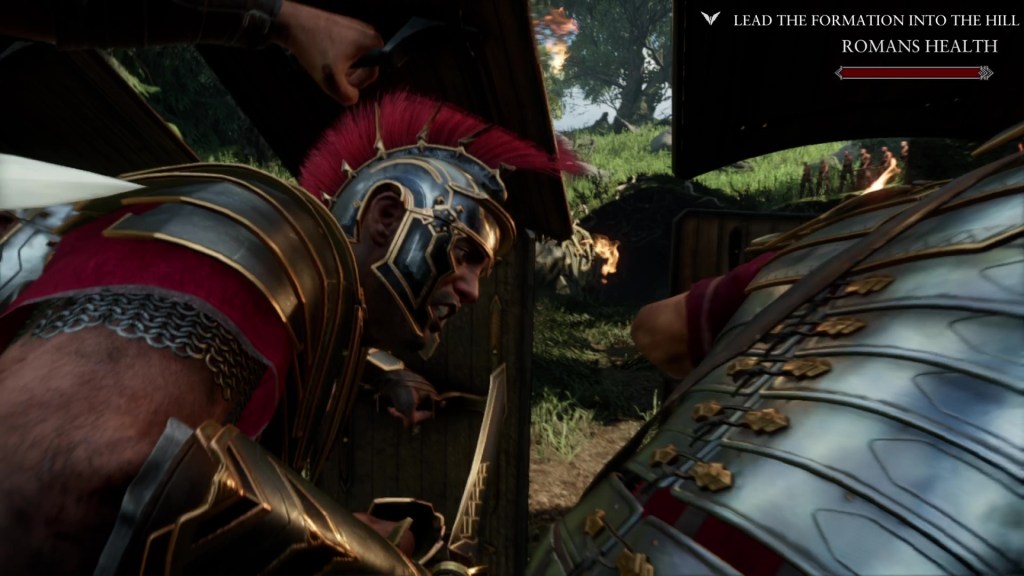
    The problem with Ryse: Son of Rome is that it barely evolves over what was a 7-ish hour campaign for me – possibly less if you just ignore the underwhelming collectibles. For the bulk of your playtime, you move down glorified corridors with beautiful and sometimes chaotic backdrops full of battling soldiers, frequently getting locked into combat arenas – sometimes literally – until you defeat all the enemies. If you’re lucky, there might be two paths you can take, or a dead-end with a collectible. To spice things up, you’ll sometimes fight alongside fellow soldiers, triggering sequences where you march in a shielded formation and fling spears at archers, defend a point by assigning shield-bearers and archers to cover paths, and even engage in turret sequences using implausibly rapid-fire crossbows. Each act also features a boss fight or two, but these are often simplistic one-vs-one battles that only ask you observe attack patterns in each phase, then trigger the right counter to chip away at their health bar. Even on higher difficulties, they’re underwhelming compared to common late-game battles that throw numerous enemy variants at you simultaneously.

    Now despite wrapping up on a negative note, most of my gameplay concerns only came to mind after I had finished the campaign and had time to mull over the experience. When you consider Sony released The Last of Us in the same year, pushing the technical limits of the PlayStation 3 and their storytelling ambitions, it’s easy to see why Ryse: Son of Rome failed to stand out. However, when you consider 2020’s The Last of Us: Part II now demands 25+ hours of trudging through misery interspersed with despair to see the end, I think there’s still good reason to return to older and shorter big-budget titles – even if they were considered unremarkable at the time. If you missed it at launch, Ryse: Son of Rome still offers a single satisfying playthough for those short on time but after a “AAA” experience.

    Ryse: Son of Rome was played on an Xbox Series S|X. It is also available on Xbox One and PC.

  • Retrospective: Tomb Raider I Remastered

    Retrospective: Tomb Raider I Remastered

    There are few games as deserving of preservation as the original Tomb Raider. Not because it’s some timeless masterpiece that holds up today, but as a reminder of where we’ve come from, and how far we’ve come. If you’re a fan of games set 3D environments and played from a third-person perspective – the vast majority of blockbuster titles – you could trace at least some part of their ancestry back to 1996’s Tomb Raider.

    Replaying it in 2024, in its freshly remastered form, has been unexpectedly compelling – albeit with a mix of highs and lows I expected. There was raw nostalgia for my 11-year-old self, sitting in front of a small CRT screen, playing it on a SEGA Saturn rented from the local video store – my first experience exploring a truly 3D world after growing up with a NES that was as old as I was, and infrequent visits to arcades to play on-the-rail light-gun games. It was a pivotal moment that ensured video games would became a lifelong hobby – with my very own PSOne and a copy of Tomb Raider II the following year cementing my love of the character and IP.

    If you only have experience with the Crystal Dynamics trilogies – 2006’s Legends or 2013’s soft reboot – Lara Croft in 1996 was a rare example of a female protagonist, at least outside of RPGs with character creation, and, rarer still, possessed a physicality typically reserved for male leads. She was an acrobatic heroine with calves, quads, and glutes so strong she could lunge-jump her own height and was strong enough to push and drag around 8 cubic-metre blocks of stone. The first Tomb Raider would pit her against an equally capable villainess and give her the chance to save the world at the expense of power and fame. I doubt representation was Core Designs’ original intent, but Lara nonetheless proved instrumental in drawing more female gamers into a hobby that all too often felt like young to middle-aged men developing games for young to middle-aged men.

    Of course, nostalgia can only take you so far and it was impossible to enjoy the remaster without looking at it through the lens of 28-years of gaming advances. Revolutionary for the time – and possessing an impressive sense of scale and verticality that early 3D FPS and dungeon crawlers lacked – Tomb Raider now offers a purity of design, so uncluttered by secondary mechanics it almost feels novel. The bulk of the experience is simply observing, planning, and traversing blocky 3D environments using Lara’s equally rigid, grid-based move-set. The goal? Rarely more complex than finding key items or switches within a level to open the exit to the next, before a crude in-game cutscene or flashier CG variant pushed the story forward.

    To spice things up, Lara will sometimes need to solve basic spatial puzzles that typically involve slowly pushing or pulling blocks; while other times she’ll need to draw her weapons to slay a shameful number of endangered species, a few that should’ve stayed extinct, tough mythical creatures, and a handful of human bosses that are an unfortunate reflection of cultural and racial stereotypes in the 1990s. Much like the platforming, combat is all about using Lara’s rigid move-set to avoid enemies that follow far less predictable patterns – often in tight spaces with perilous drops. Combat never feels more than functional, but many encounters can be rendered trivial if you horde powerful ammunition or find high-ground to exploit the limited AI pathfinding. Just don’t stop to ponder who left modern ammunition and health kits in ancient ruins supposedly unexplored in centuries.

    By far the greatest challenge comes from mastering the original controls, especially as the alternative controls offered in this remaster are a twitchy abomination not worth considering. It’s a rough transition from modern games – games that strive to make you not think about the complexity of traversal – however, once you’ve get to grips with Lara’s move-set, they feels perfectly suited to the blocky but carefully crafted environments. It’s a game that requires patience, with a strong focus on planning a sequence of moves and lining up jumps, rather than being reactive, and you’ll want to save regularly if you don’t enjoy hearing Lara’s scream followed by a sickening crunch. The obvious caveat to this design is how clumsy and frustrating simple tasks end up feeling – such as lining Lara up to interact with a switch or pick-up, and how long it can take to trek back to the start of a jumping sequence if you mess up.

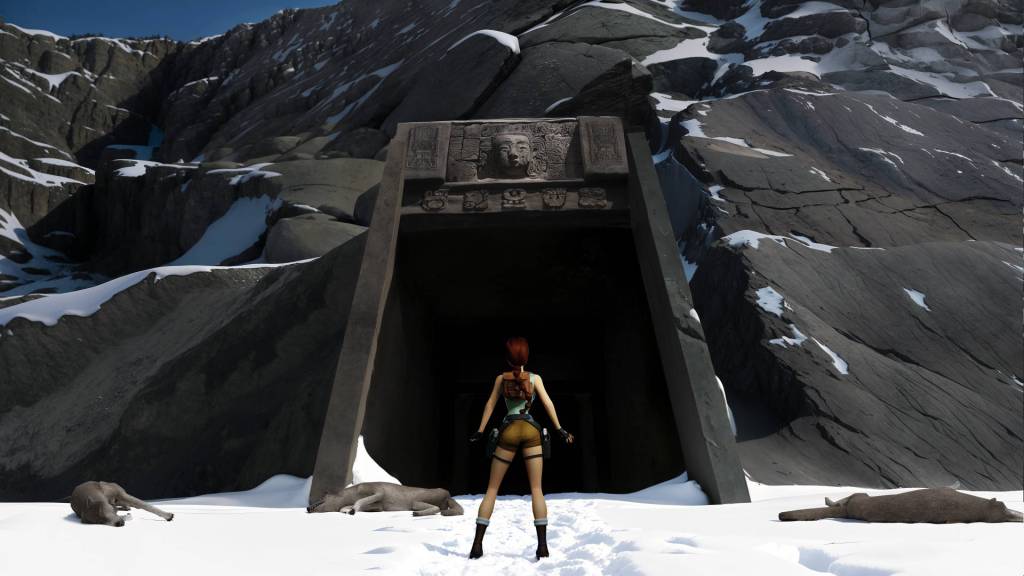
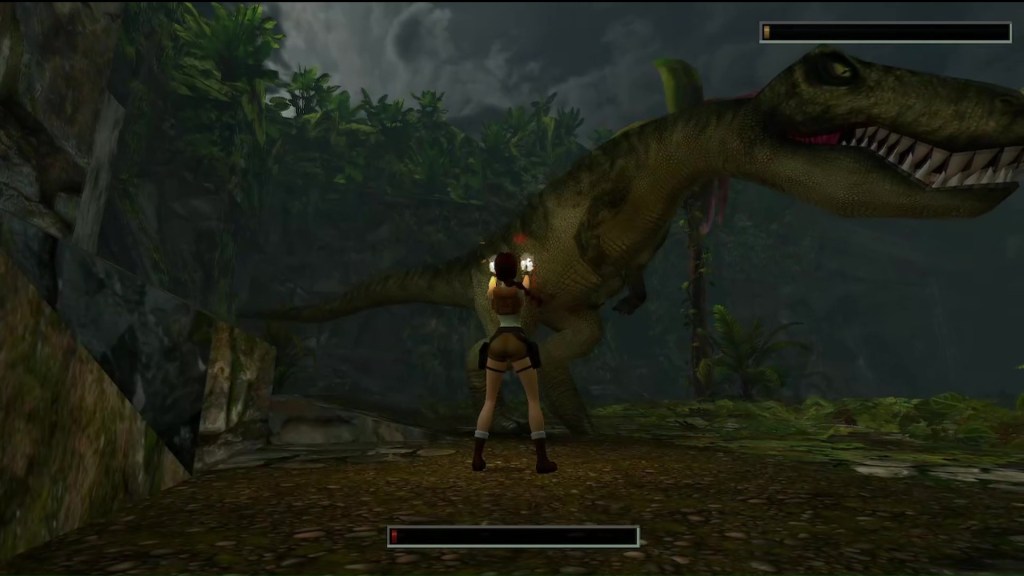
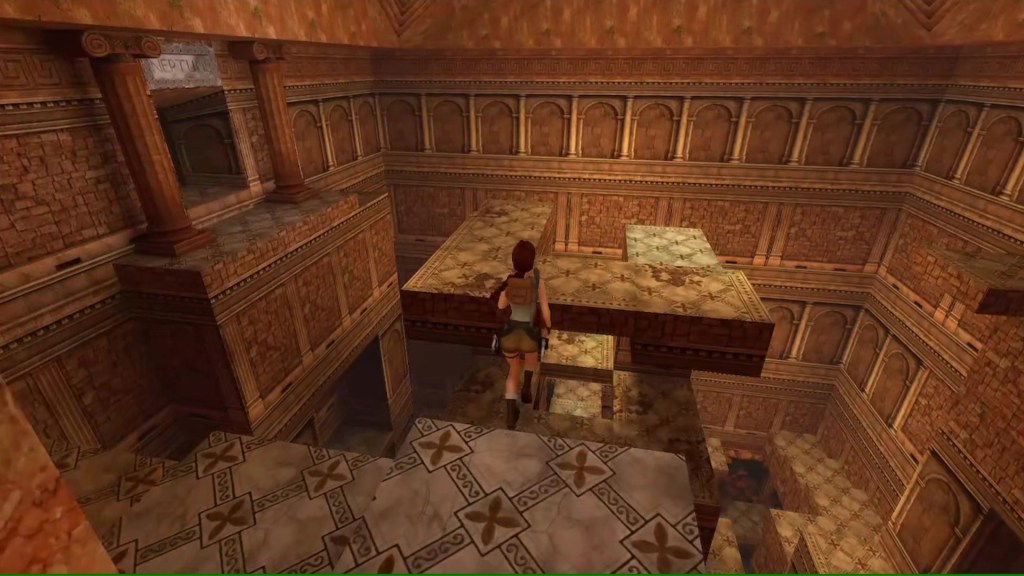
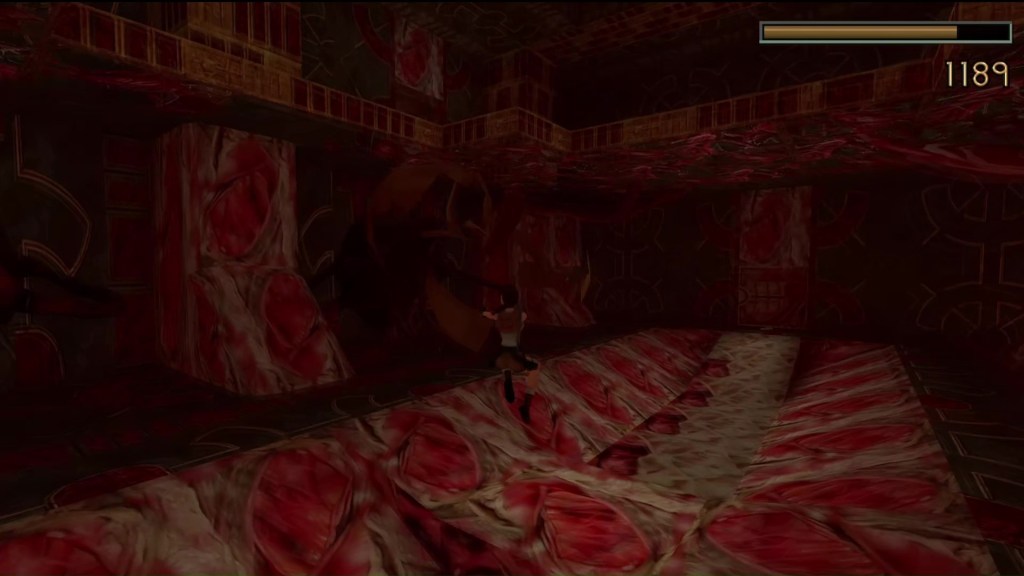
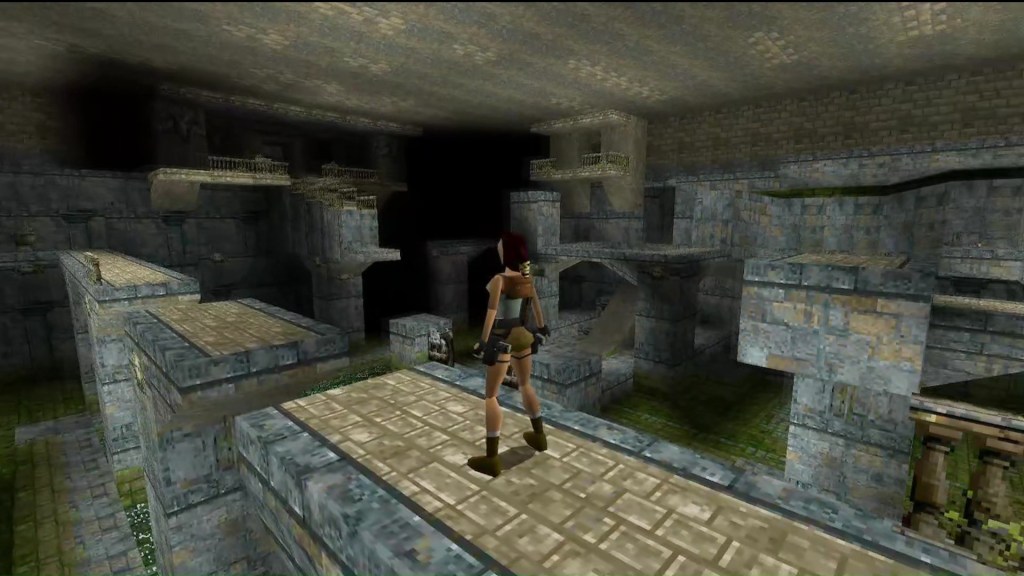
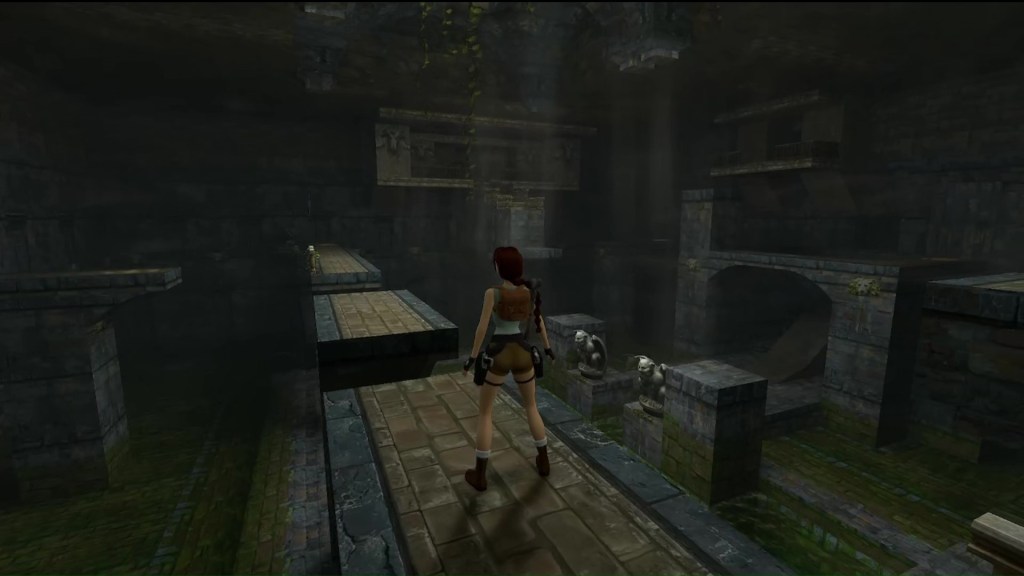
    Moving on to the remastering effort itself – Tomb Raider I Remastered feels smartly touched up and respectful of the original vision, while the only major gripe I have is aforementioned and entirely optional alternate controls. Texture work, character models, and lighting have been overhauled – with the addition of more props where appropriate, and minor geometry changes to introduce new light sources like open ceilings. The world itself is still blocky, and the seams between textures are still obvious, but they feel suitably detailed for modern TVs, those representing water surfaces or lava are better animated, and some even have an impressive parallax effect to simulate depth.

    All character models retain their somewhat angular designs and jerky motion, but they look much more detailed and have been embellished with plenty of added detail – including updated faces and basic lip-syncing for in-game cutscenes. Pixelated 2D sprites for pick-ups and props have been replaced with 3D models, and you can enable an interaction icon to make them easier to find – along with switches and key holes. The new lighting model – especially in rare locations that use beautiful new sky-boxes – looks great, adds to the immersion, and even simulates taking on the colour of the environment. There are more atmospheric effects like dust and mist, while a few locations even have puddles with reflections!

    Talking of atmosphere, Tomb Raider I Remastered still relies primarily on ambient audio to capture that feeling of isolation you’d expect exploring long lost tombs – but it feels like they’ve added a few more music triggers and possibly repurposed a few tracks from the later games. In short, this remaster excels at presenting Tomb Raider as you might remember it. There are oddities, like how some areas feel too dark and the new 3D models for key items too small, but you can always swap back and forth between the remastered and classic visual mode – though you then have to deal with a stuttering 30fps cap that feels awful compared to the remasters 60fps achieved through frame interpolation.

    All of which brings me to who I’d recommend Tomb Raider I Remastered to. From a pure preservation angle and for those interested in the history of video games, it’s an essential remaster. For those just considering the entertainment potential – this is more for fans of the original, especially those without the patience to deal with DOSBOX settings on PC, or console players that once had to deal with a frustratingly restrictive save crystal mechanic. As a long-time fan, the first three acts in Peru, Greece, and Egypt remain the highlight – and levels like The Lost Valley, St. Francis’ Folly, Temple Midas, Obelisk of Khamoon, and Sanctuary of the Scion have not diminished with age. If anything, they finally have a degree of visual spectacle to complement their impressive scope.

    For everyone else still curious in Lara’s original outing, I’d rather suggest Crystal Dynamic’s excellent 2006 reboot, Tomb Raider: Anniversary, which can still serve as an excellent stand-alone experience.

    Tomb Raider I Remastered was reviewed on Nintendo Switch using a code provided to gameblur by the publisher. It is also available on PC, Xbox One/Series S|X, and PS4/5.
  • Retrospective: The Last Guardian (2016)

    Retrospective: The Last Guardian (2016)

    There are many games I enjoy that are objectively average or bad, and quite a few I dislike that consensus tells me are good. The Last Guardian sits somewhere in the middle as one of the rare games I desperately wanted to like more than I did.

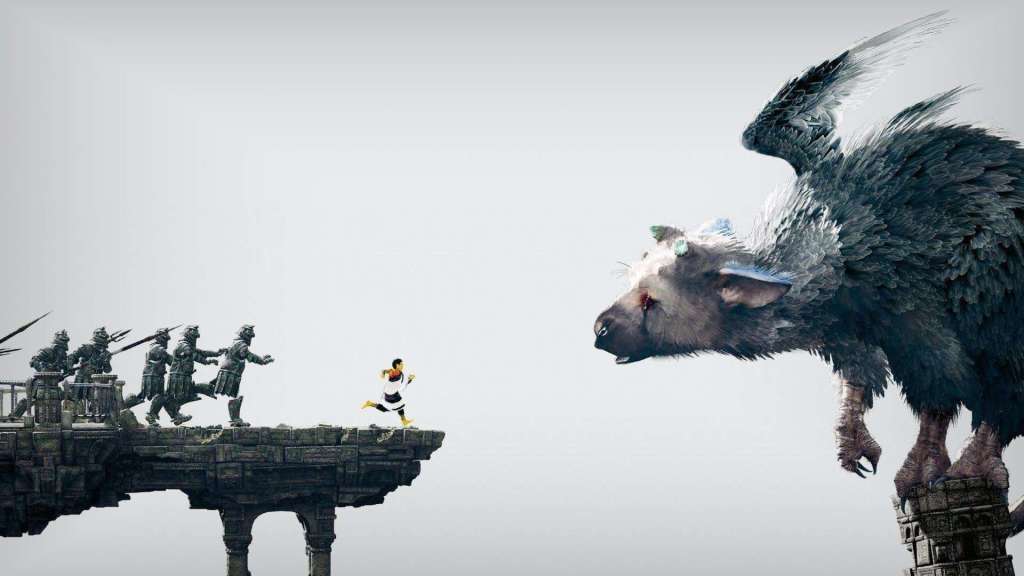
    Coming from the now defunct Studio Japan and director Fumito Ueda – of Ico and Shadow of the Colossus fame – and having gone through a tortuous development cycle going back to the PlayStation 3 era, The Last Guardian is an unevenly paced journey, with incredible storytelling and audiovisual spectacle shackled to clunky and often frustrating gameplay.

    The Last Guardian follows the trials and tribulations of a young boy who awakens in a cave alongside a wounded chimera, “Trico”, with no idea where he is, how he got there, or what the tattoos that now cover his body mean. Just like Ueda’s prior games, it features a compelling mix of oppressive isolation, risky platforming, and wondrous discovery that only makes sense from the perspective of a child.

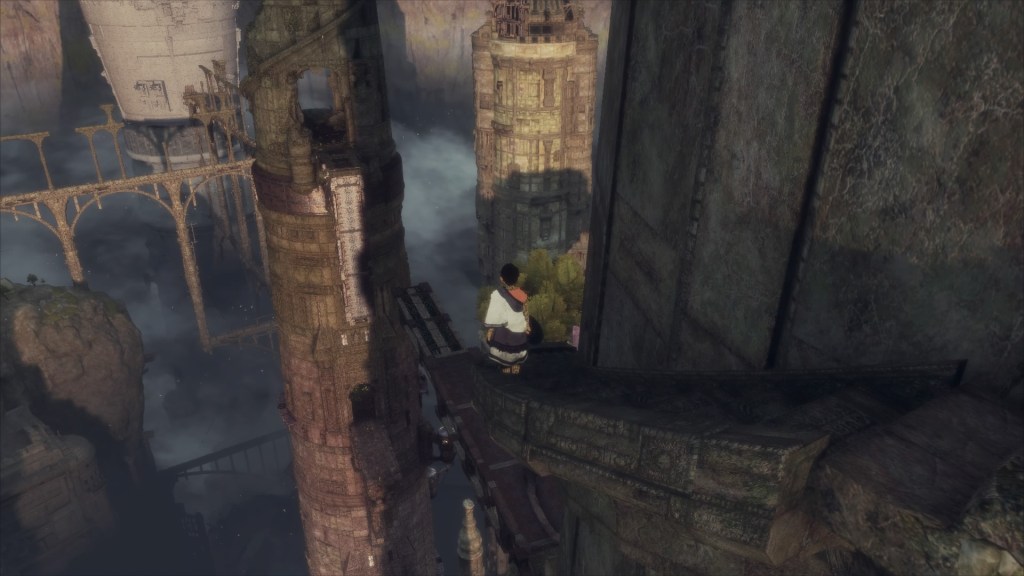
    The ancient ruins are sprawling but also vertical and continuous, ensuring you can often see where you need to be and look back from whence you came. Despite the scale, there’s plenty of fine detail as both environmental storytelling and character interactions carry the story, with limited narration – much of it for guidance if you get stuck – and only a handful of cutscenes that eventually reveal past events.

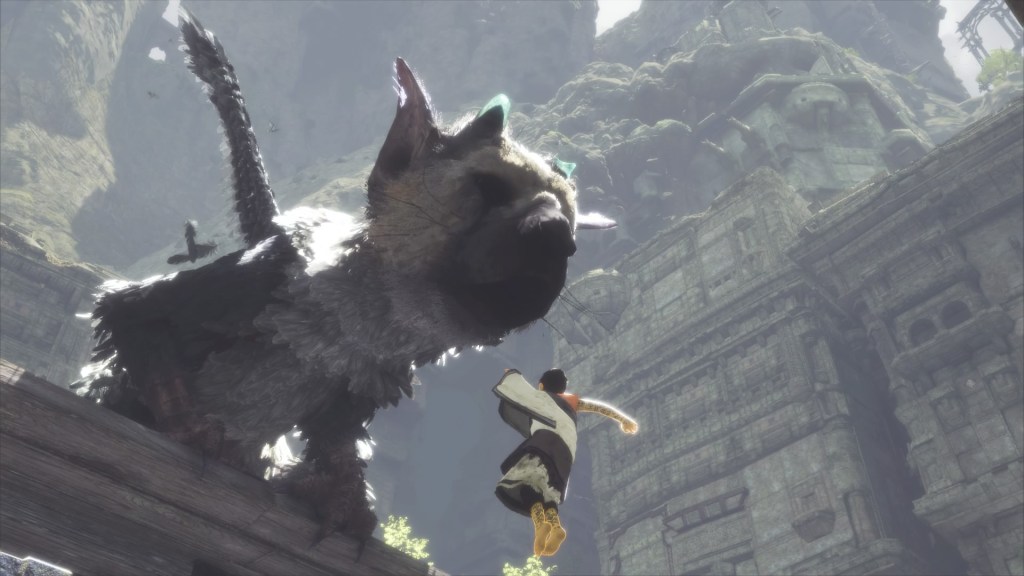
    It’s not the most original story of a child and beast bonding and saving one another from a shared threat, but it is beautifully told through the aforementioned cutscenes and evolving in-game interactions. The journey is full of literal ups and downs as the boy and Trico try to access a mysterious tower that dominates the ruins – a tower seemingly protected by other aggressive chimera and a source of much pain for Trico.

    After key moments in the story, their bond grows and the boy gains more direct control of Trico through a series of simple, exaggerated gestures. Simultaneously, Trico regrows its feathers and horns, becomes more assertive in pointing out the way forward, and acts without needing player input – but it also becomes more tender and protective of the boy.

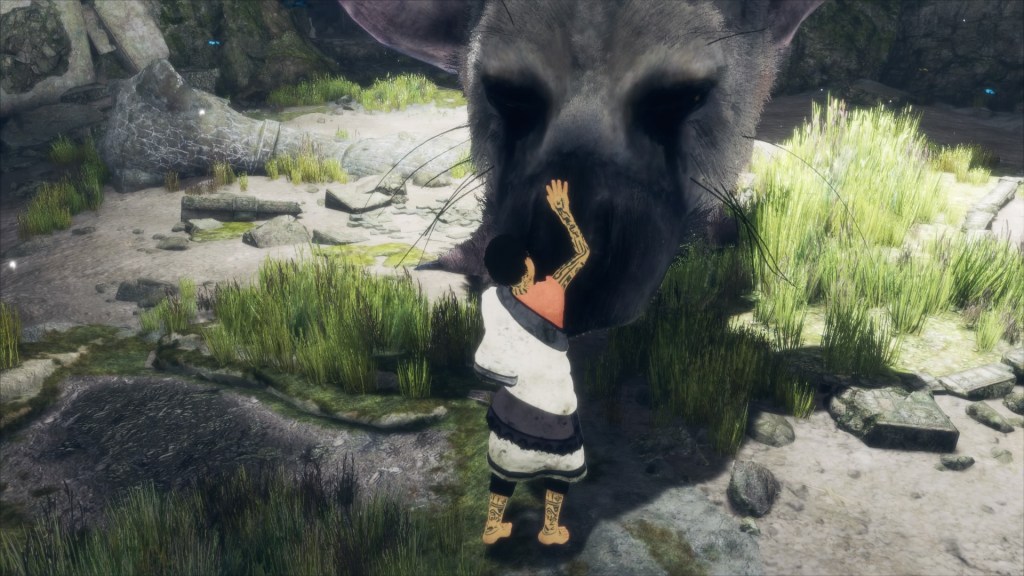
    If nothing else, The Last Guardian is a game for pet lovers – so long as you can take the emotional highs and with the gut-punching lows. Trico feels like a mix of kitten and dog – clumsy, playful, and nimble, but also loyal, protective, and food-obsessed. Interactions are wonderfully animated, as Trico investigates and prods the environment, fixates on barrels of blue food, and nuzzles the boy playfully if you remain idle. On the other hand, it’s devastating to watch Trico limp around and whimper when injured, or become manic and uncontrollable when frightened or enraged.

    Feeding and calming Trico are in-game mechanics, and the boy can stroke it in several spots to elicit different reactions. Despite the increasingly weird and fantastical setting, these small and significant animation details make their evolving relationship feel real.

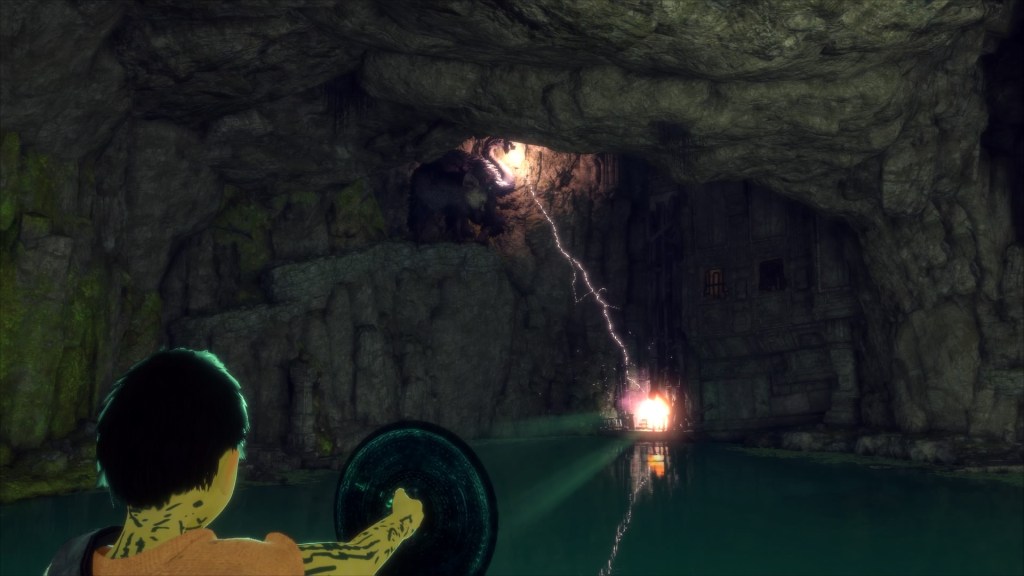
    Unfortunately, The Last Guardian rarely plays as well as it looks and sounds – especially during an opening half that features gameplay scenarios frustrating by design. For the first few hours, the boy can only call Trico towards a location; cling to Trico’s flank or leap from its back to reach high places; and very briefly use a shield to clear obstacles with tail-spawned lightning before it disappears until the final act.

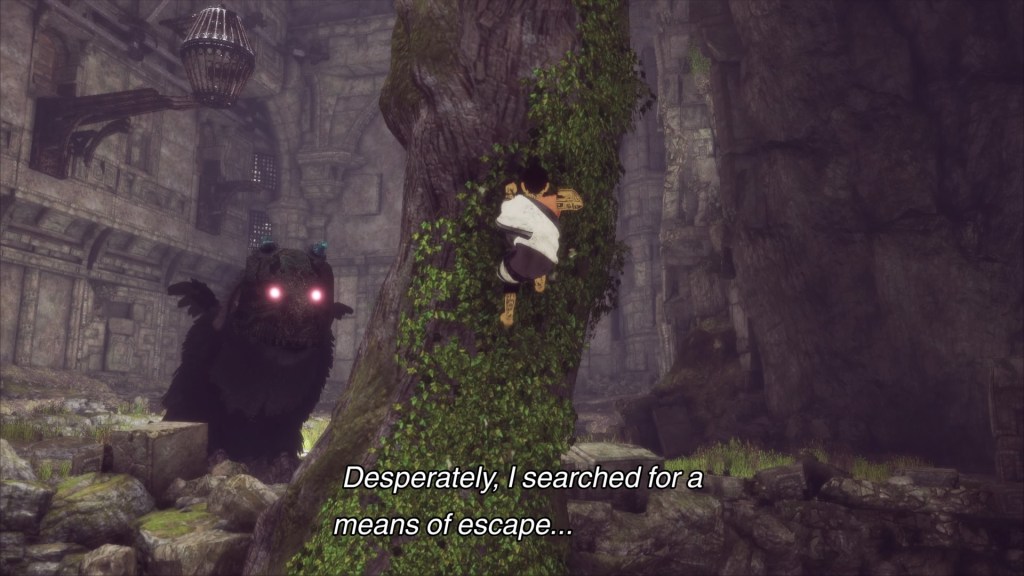
    Given Trico’s often erratic movement in confined spaces and around jump points, far too much time is spent repeatedly shuffling the boy around and spamming the “call” button, then desperately clambering onto Trico’s back while praying it doesn’t start moving.

    Now, given Trico becomes more controllable and helpful over time – saving the boy from certain doom multiple times thanks to his indestructible shirt and wrists of steel – it’s much easier to forgive this design when The Last Guardian can be completed in a dozen hours.

    What doesn’t improve, however, are the loose and inconsistent controls, which make platforming and puzzle elements feel too unpredictable. A big part of the problem is how The Last Guardian frequently shifts between free- and semi-fixed camera control, which makes it difficult to predict which direction the boy will jump, and often sends Trico leaping back across a chasm you just struggled to clear. Mercifully, checkpoints were frequent enough to limit time lost.

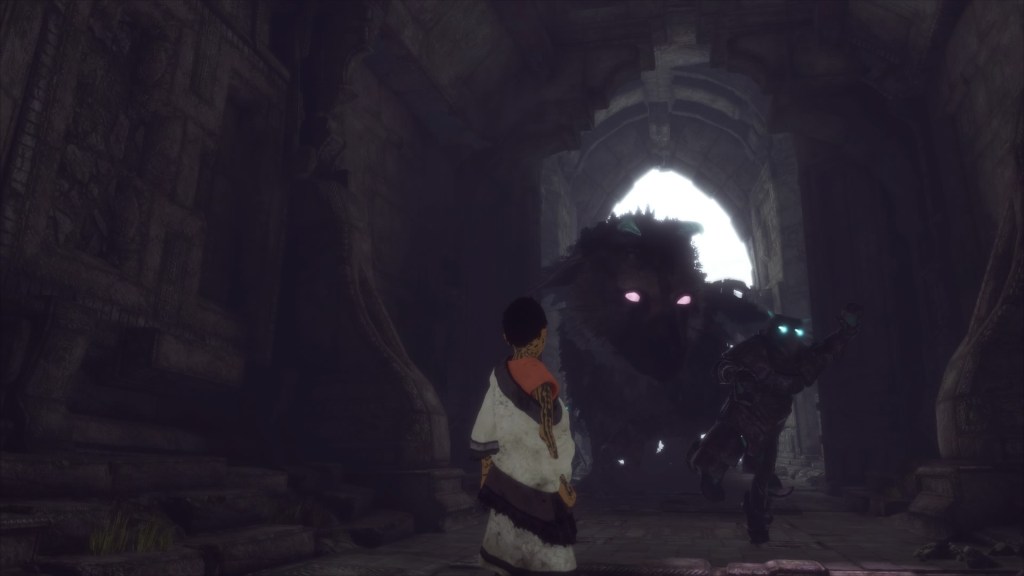
    Unfortunately, there are other gameplay issues. The first is a common problem with all cinematic games – not doing what the developers expected. A prime example was a cave-in that had me clambering around trying to free Trico, when what I needed to do was abandon Trico and walk away down a corridor until I encountered hostile spectral armour, triggering a scripted sequence.

    Talking of spectral armour, Trico is quick to smash them apart but, when separated, they chase down the boy and attempt to carry him off. It’s a fate easily circumvented by mashing buttons, but while it initially added tension to puzzle sequences, these encounters soon become annoying. You either run loops to clear space or just accept endless button-mashing disruptions.

    To The Last Guardian’s credit, there is a cutscene around two-thirds of the way through the game that felt like a pay-off, followed soon after by the reappearance of the shield and the catharsis that comes from blasting them apart with lightning.

    Now returning to my point about wanting to like The Last Guardian more than I did, it is still a game I’d recommend everyone try despite my issues with it – and not least of all because it’s frequently discounted, still looks incredible, and has a 60fps update for the PS5 that make it feel smoother but does little to remedy the control issues.

    Aside from being an intensely cinematic, audiovisual spectacle the PlayStation brand has become renowned for, The Last Guardian is one of the few games that manages to capture the subtleties of human-animal bonds by smartly working into the narrative, animations, and gameplay mechanics. Animal companions have become ubiquitous in modern games, but most are little more than easily marketable gimmicks that function as cute accessories you can pet when you’re bored. Despite the potential for frustration, The Last Guardian‘s mythical Trico feels more real than any other animal companion in video games that came before it or since.

    The Last Guardian is available on PS4 and PS5.

  • Retrospective: Syberia (2002)

    Retrospective: Syberia (2002)

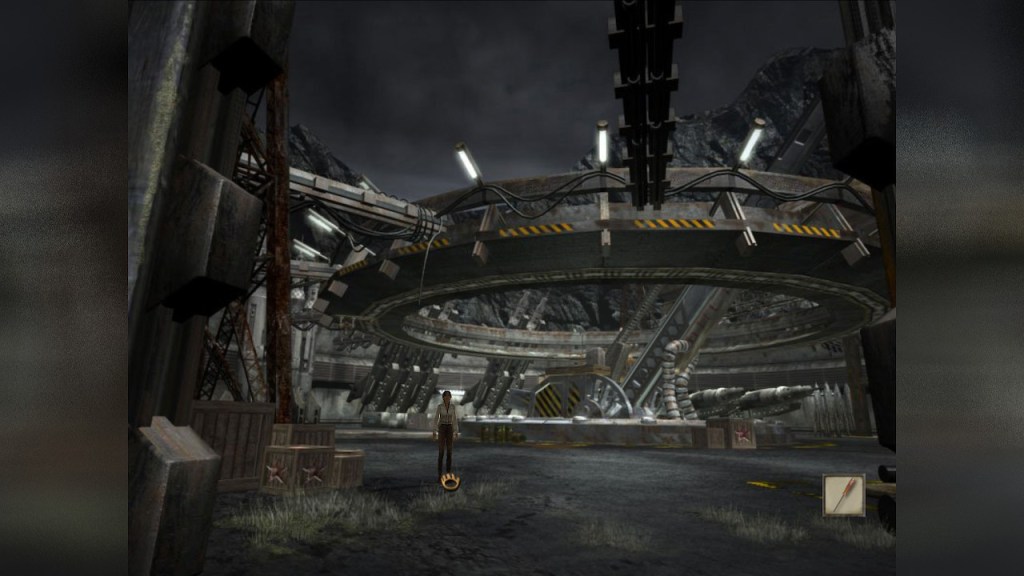
    As a point-and-click adventure originally released on PC in 2002, it’s easy to criticise elements of Syberia’s gameplay, but replaying it for the third time on the Nintendo Switch – the best console port by far – I’m still impressed by its relatable protagonist, timeless artistic vision, and serenely melancholic atmosphere.

    Kate goes adrift

    Syberia wastes no time setting the scene and offering a tantalising glimpse of what awaits Kate Walker, a young and idealistic lawyer from New York, sent to the moribund town of Valadilene in the French Alps to conclude the sale of an ageing automaton factory.

    She arrives just in time to witness the funeral precession for the late factory owner, Anna Voralberg, who revealed the existence of a living heir in her final correspondence. Given the importance of the deal, Kate is left with little choice but to track down Anna’s brother Hans – initially thought to have died decades before – and discover more about his troubled family and the legacy he left behind while traversing Eurasia with an automaton engineer named Oscar and a fantastical wind-up train of his design.

    Despite her obvious commitment to the task, it’s clear from the outset that Kate isn’t comfortable in a rigid corporate environment. She marvels at the weird, wonderful, and sometimes terrifying things she encounters on her journey, but takes them all in her stride. She respects locals with quirky customs and is compassionate when helping others, but she also has a strong set of morals and won’t hesitate to call out scheming or dishonest behaviour – even if she’s willing to bend the rules a few times to progress.

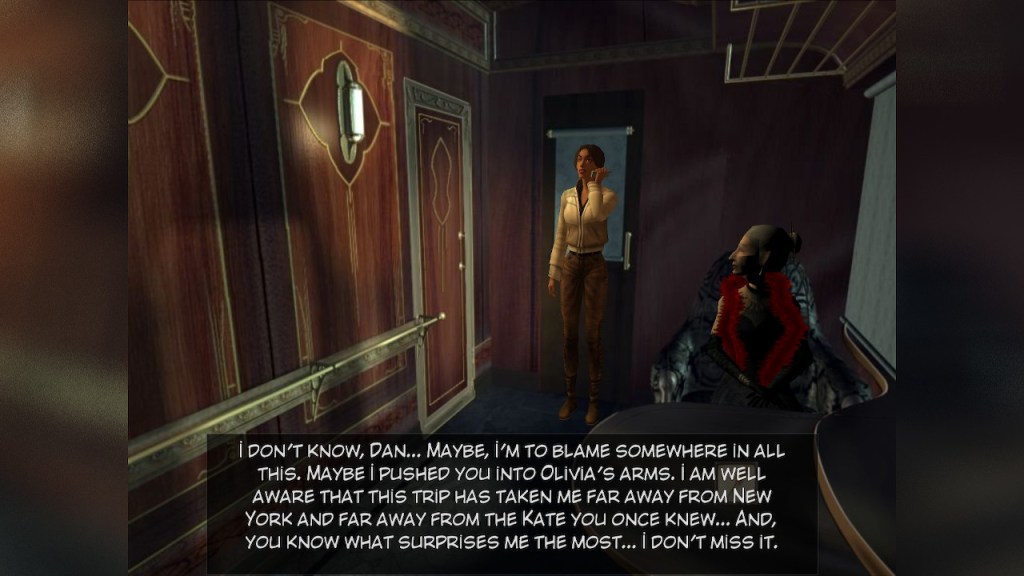
    In contrast, the people she left behind in New York are mostly brash, self-interested, morally flexible, and possess limited imagination. Her boss has no interest in her situation beyond her ability to seal the deal; her fiancé Dan seems unable to differentiate between their romantic and business dynamic, treating her more as an accessory to his ambitions; her mother frequently talks over her and uses guilt as leverage; while her friend Olivia seems has little passion for their profession beyond the lifestyle it allows.

    Kate frequently receives calls from them or calls them for assistance during her adventure, and they serve as useful foils that highlight Kate’s character development. Their lives are so ordinary they can barely comprehend what she’s describing and experiencing, while their desperate attempts to discourage Kate and bring her back home to re-establish the status quo border on self-destructive.

    As a result, simply watching Kate discover who she really is – or maybe rediscover herself – is even more satisfying than the overarching narrative and circumventing the many roadblocks along the way.

    Artistic vision > technical prowess

    Of course, a great protagonist and interesting premise still need a good setting, and Benoît Sokal’s creative vision ensures Syberia is one of the few games with legitimately timeless aesthetics.

    Kate’s world is similar but not exactly our own, though it’s not hard to immerse yourself in it with many modern and historical parallels. There are European towns still dealing with the devastation of the Second World War on industry and families, while Russia – possibly still a Union of some sort – is full of ageing industrial and military complexes abandoned after a Cold War era.

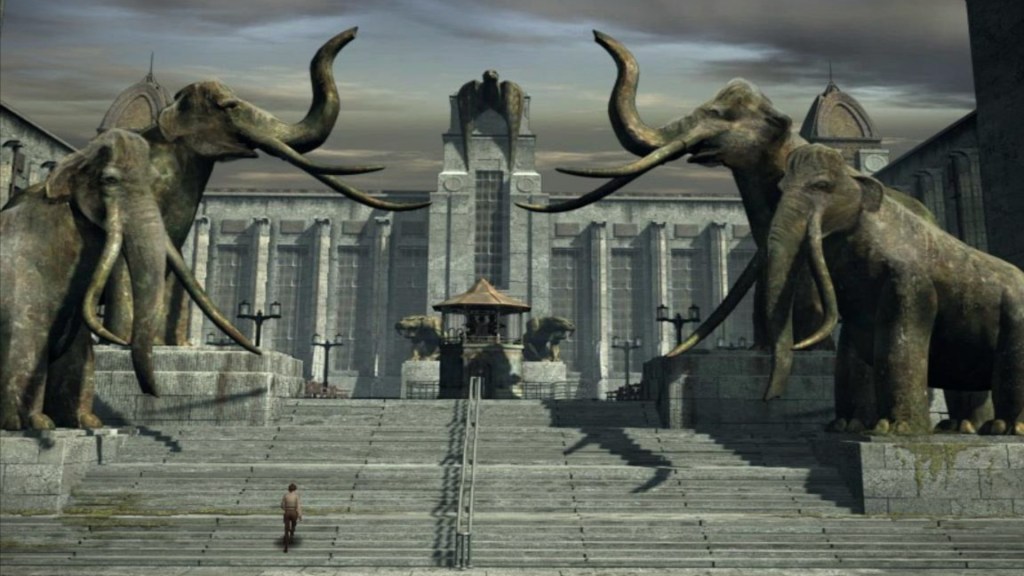
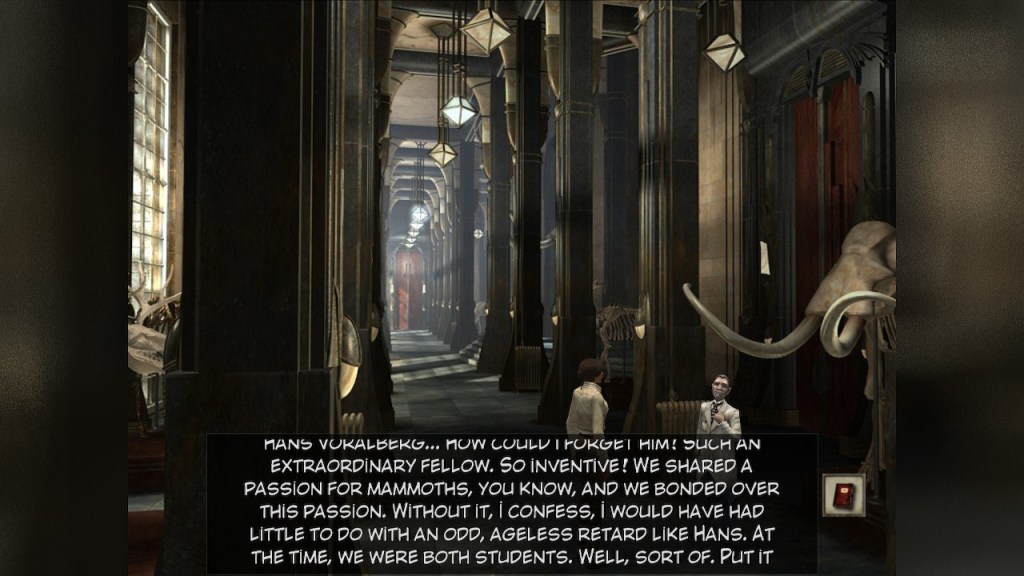
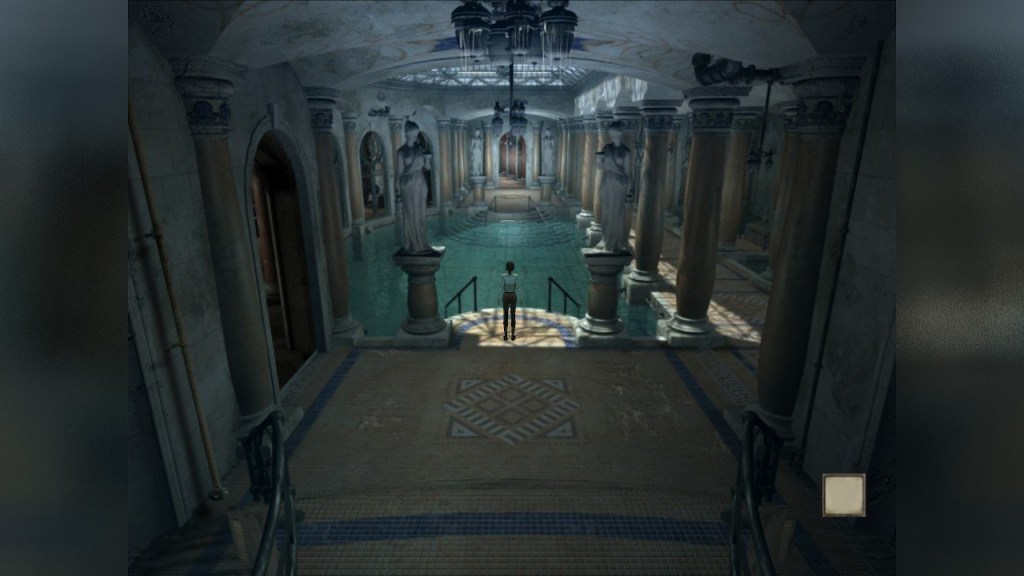
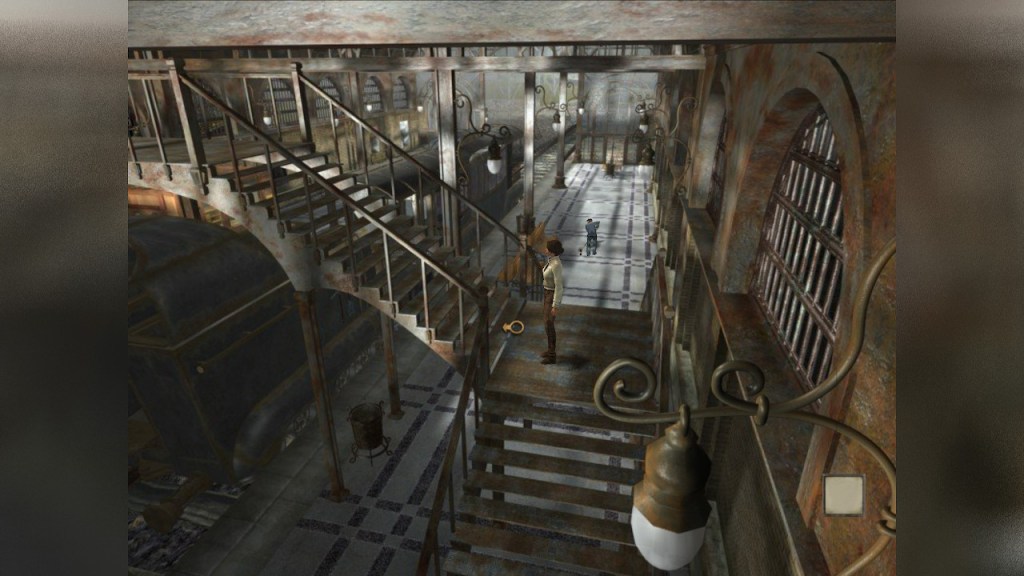
    Valadilene sports cobbled streets, art-deco houses, and an intricate automaton factory, but only a handful of people with nowhere else to go remain. The Barrockstadt University, with its massive mammoth exhibits and tropical aviary, is fading into obscurity, with a few lingering staff and fewer students, all surrounded by decade-old military fortifications and damaged houses that were never restored. The decrepit Komkolzgrad industrial complex and cosmodrome are inhabited by two solitary caretakers with unfulfilled dreams. The Aralbad resort is a refuge for faded stars, situated on the edge of a corrosive salt lake, full of rusted shipwrecks that hint at a more prosperous past.

    Although most backdrops are beautiful and smartly framed static images, there are a handful of video-loop backdrops for more intricate structures, simple water shaders, and 3D character models that add life to many scenes. As a reward for solving more complex puzzles, there are several cutscenes that demonstrate Sokal’s intricate automaton designs in action or handle a few action-centric moments.

    The visuals are complemented by an immersive ambient audio mix and a limited but evocative soundtrack themed around each location – but only sometimes. Syberia has moments of near silence, and I was never sure if it was by design or just audio bugs that have plagued prior releases to varying degrees.

    So Syberia is not exactly subtle about using art and music to express its themes, but this does ensure Kate’s journey through forgotten places filled with forgotten people provides a strangely compelling combination of intricate beauty and haunting solitude.

    Streamlined adventuring but dated designs still frustrate

    When it comes to actually playing Syberia, well, it’s a traditional point-and-click experience that can feel anachronistic by modern standards – even if it’s more streamlined than many of its contemporaries.

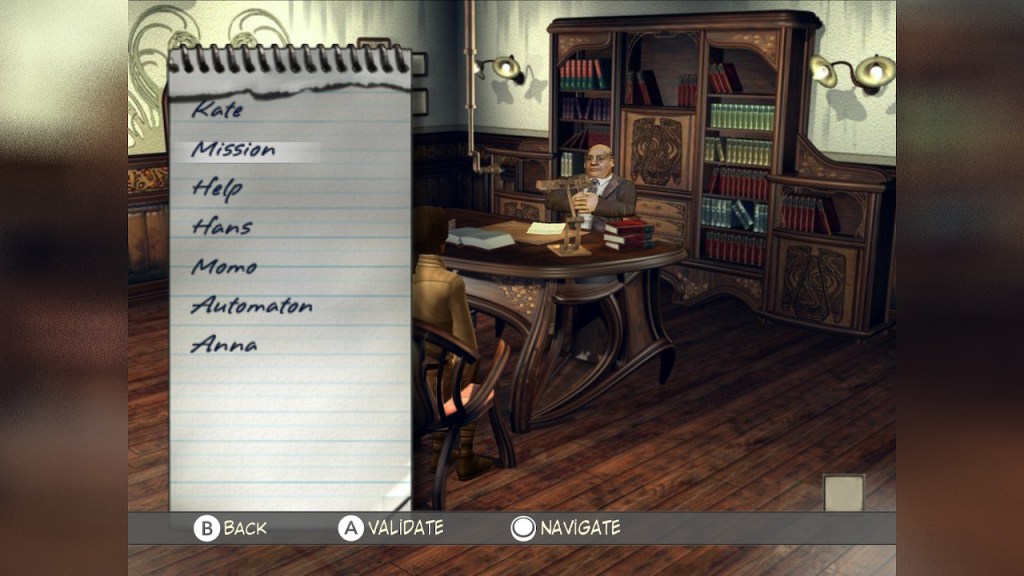
    To solve an assortment of contrived and often absurd puzzles, you’ll be conversing with the small secondary cast, making the odd phone call, collecting notes for clues, collecting key items to use on the appropriate object, and flicking switches and levers on intricate contraptions or control panels.

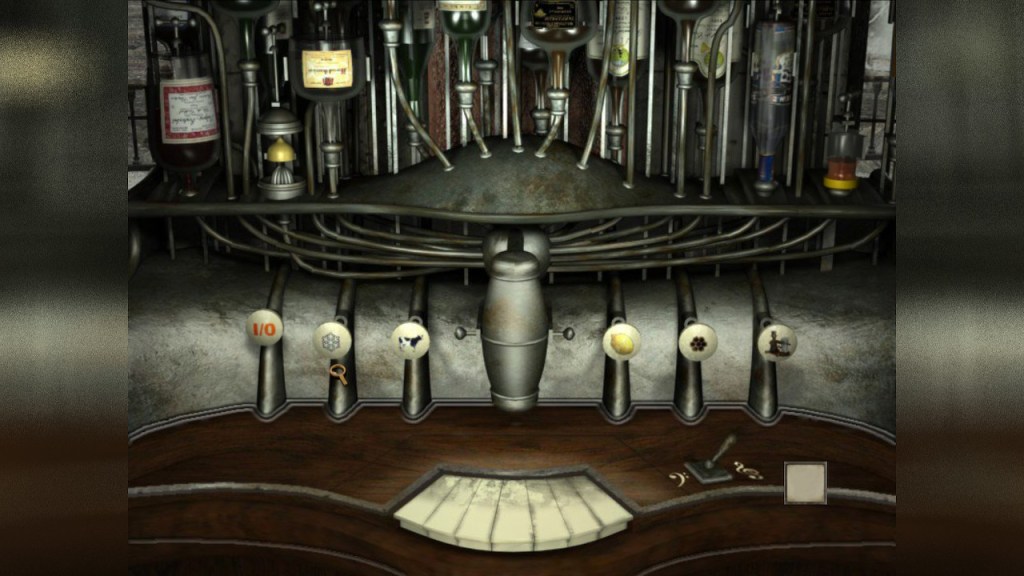
    To Syberia’s credit, there are only a handful of puzzles per location, and they all feel reasonably logical given the setting – aside from a late-game cocktail mixing contraption. They never require too many steps or items to solve; there are no red herrings; and there are only 2-4 significant NPCs in any location you need to interact with.

    Furthermore, the puzzles and dialogue sequences are usually sequential and scripted, so you’ll never be overwhelmed trying to juggle multiple puzzles and inventory items. Unfortunately, that doesn’t mean Syberia is devoid of classic point-and-click bullshit.

    The first issue, spotting key items within detailed backdrops, can be resolved by enabling icon highlights in the assists menu, but the second issue is inherent to the design of the game – the size of each location and the impact that has on puzzles that force you to backtrack. Unlike many modern point-and-click adventures that feature fewer but denser locations, Syberia aims for an impressive sense of scale, with many of its beautiful backdrops serving as nothing but set-dressing you need to traverse repeatedly.

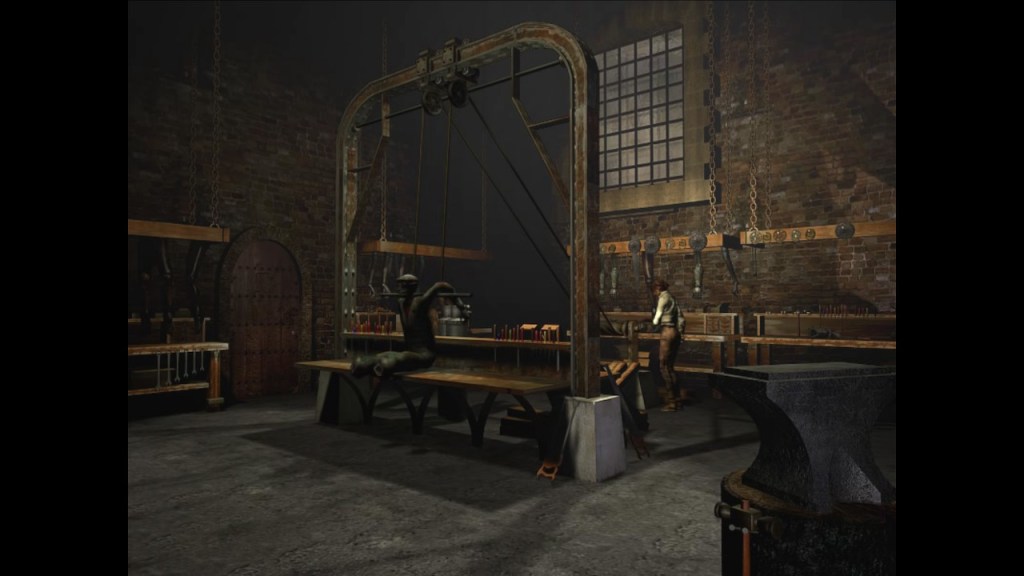
    In Valadilene, your departure is interrupted when you have to trudge across town to forge a clearance certificate; in Barrockstadt, discovering the location of a rare plant species requires talking to several NPCs scattered across the university grounds repeatedly; in Aralbad, you’ll run up and down an unnecessarily long pier. These moments are compounded by Kate’s sedate pace, inconsistent screen transition triggers, and fixed camera angles that make it easy to mix up your inputs.

    It’s not as bad as it sounds if you know where you’re going, but should you ever get confused, it makes aimless wondering a pain in the arse.

    Going off the rails, on the rails

    So Syberia is not without flaws inherent in the genre but, on balance, I’d still recommend picking it up if you’ve got any interest in the history of point-and-click games; or if you’re willing to forgive a few anachronistic elements for an uplifting narrative that sees Kate grow as a person while journeying through a weird, melancholic, but wondrous world.

    As for which versions to play – PC players who want a classic mouse-driven experience should stick to the GOG or Steam releases, both of which have been updated a few times for modern systems. It’s a tougher choice for console players as I’d only recommend the Nintendo Switch version that sports functional shaders, the ability to switch to the original 4:3 ratio, and even touch-screen play. At a push, the backwards-compatible Xbox 360 version – or PlayStation3 version if you’ve still got it plugged in – are fine but the backdrops and character models are stretched to fit that widescreen aspect ratio, the audio is even more buggy, and many backdrops feel completely static.

    Syberia was played on the Nintendo Switch 1. It is also available on PC, Nintendo Switch 2, Xbox One/Series S/X (back compat), and PS3.

  • Retrospective: Vaporum (2017)

    Retrospective: Vaporum (2017)

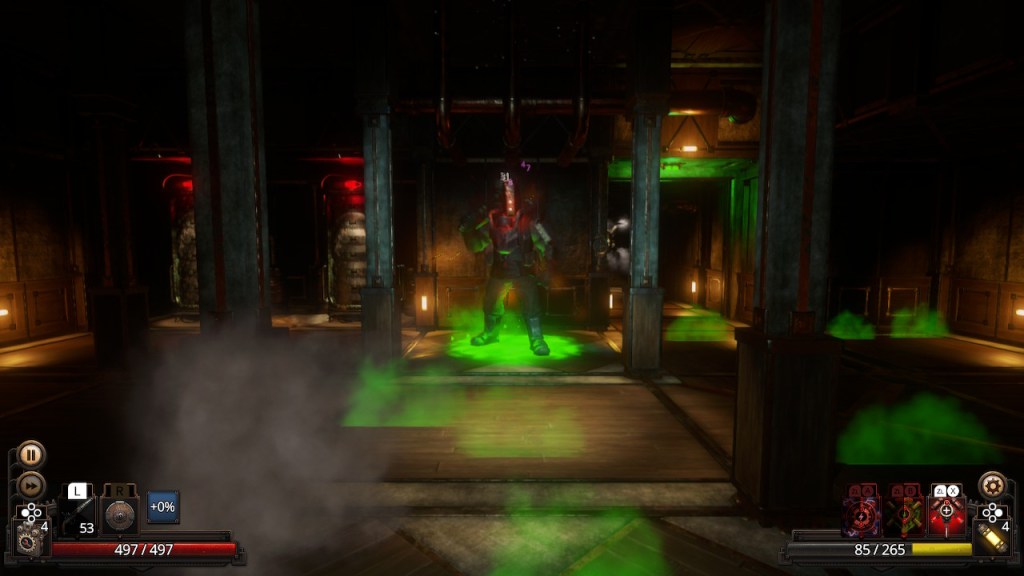
    I love Vaporum and many of the classic games that inspired it, but it’s a difficult sell to newcomers. Clunky, archaic movement limitations and artificial grid-like environments – elements you might criticise in any other modern game – are core gameplay features and, if you buy into the nostalgic aspect, all part of the charm

    Vaporum is a retro-inspired but infinitely more accessible modern “blobber” – think first-person dungeon-crawler, usually party-based, and with RPG elements. You trudge around labyrinthine grid-based levels, searching for keys, solving puzzles, hunting for secret areas, avoiding hazards, and defeating enemies to progress between floors. It’s a wonderfully contrived game world that makes little sense unless the primary purpose of the facility was to frustrate and/or kill its researchers.

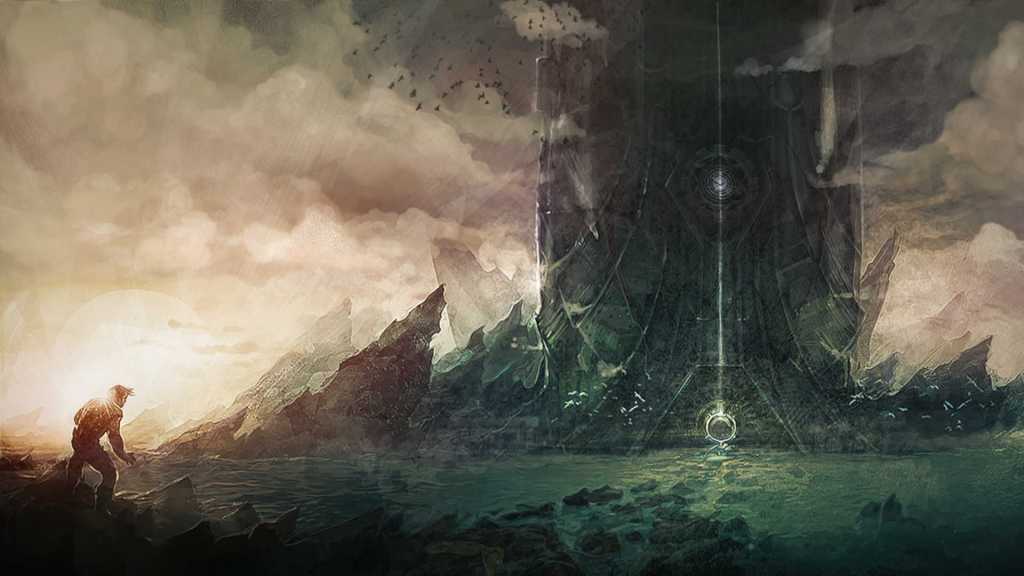
    Events take place entirely within a massive steampunk tower, in the midst of a raging and stormy sea, though figuring out who the protagonist is forms part of the early mystery. The ominous tower beckons them in and although they know they have some connection to it, everything else is a blur.

    As you explore, a combination of written notes and scratchy audio logs spur on their memory, leading to revelatory monologues that slowly reveal the truth about their past and the present research into a mysterious substance known as “Fumium”. It’s a dated but effective approach that works in a game not particularly suited to conventional cinematics – though I wish there was a little more world-building to flesh out events beyond the tower.

    Although many games in this sub-genre – from 1985’s The Bard’s Tale to 2017’s StarCrawlers – shift into turn-based combat when you encounter a foe, Vaporum uses the real-time approach first pioneered by 1987’s Dungeon Master and almost perfected by 2012’s Legend of Grimrock. Unlike many of its predecessors – and one of the reasons it received multiple console ports – is that is Vaporum is not “party-based” and doesn’t rely extensively on an emulated mouse cursor in combat.

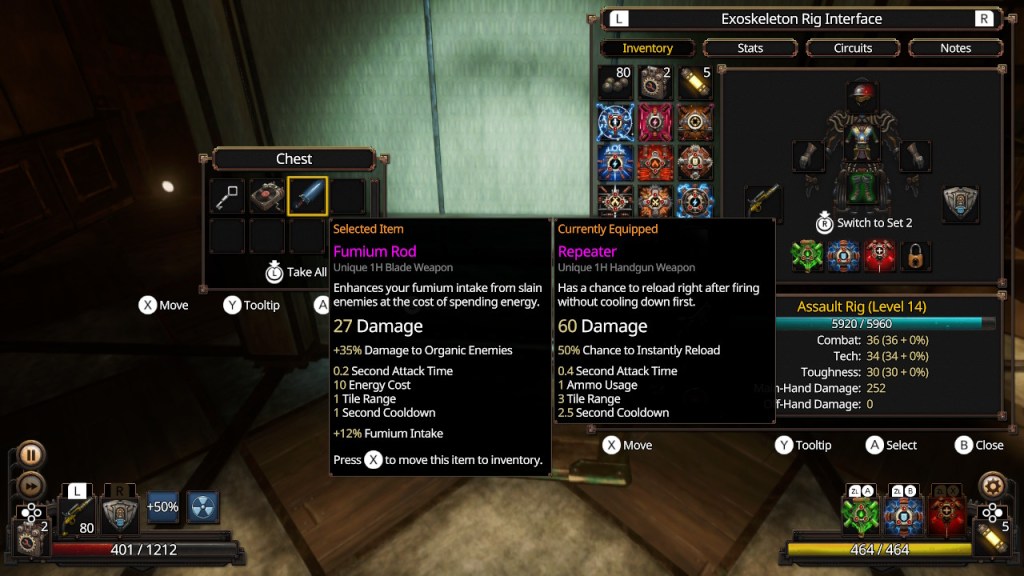
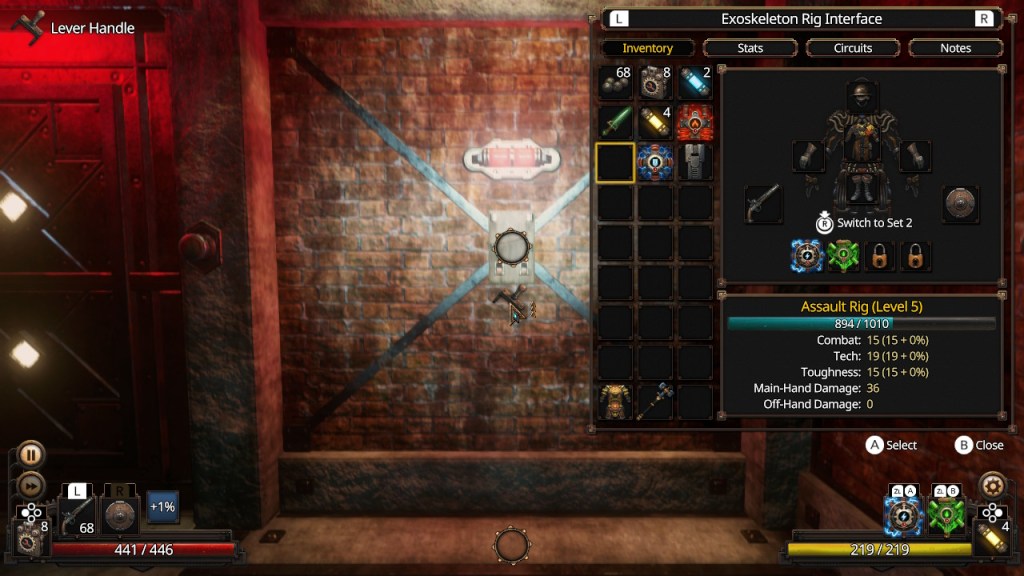
    You control a lumbering exoskeleton rig – a sensation not dissimilar to Delta in BioShock 2 – with four starting classes to pick from. These range from pure offence to pure defence, with a few unique perks and 10 gear slots that can be configured without restrictions. There are two offensive slots that can either handle one-handed maces, blades, or pistols combined with a shield, or a single but powerful two-handed weapon. You unlock up to four “gadget” slots that provide elemental damage or support abilities akin to spells, and there are four armour slots to mix and match attribute-boosting gear.

    Fumium gained from destroyed enemies goes towards increasing your rig level, unlocking circuits to invest in a dozen linear skill trees that cover weapon types, energy generation for gadgets, elemental damage and resistance, and general survivability. Each point invested provides a useful but incremental upgrade, while the third level provides a minor perk, and the fifth a choice between two major perks.

    On the whole, it’s a versatile and adaptable system that replaces multiple less-specialised party members. It also feels reasonably balanced given you can only max out 3 or 4 skill trees in a single playthrough. You could prioritise damage output to quickly remove threats; turn yourself into a physical and elementally resistant tank that reflects back a huge portion of damage; or pick a middle ground.

    Whatever your choice, exploration, puzzling, and indeed the combat all hinge on understanding and navigating the grid-like environment, rather than simply increasing your level and gear quality – a design many seem to ignore when you consider the number of videos with players retreating into a corner to just trade blows with enemies.

    Vaporum can look and sound great despite its relative simplicity. The throbbing, clanking, and hissing industrial-steampunk setting is a perfect match for the artificial grid-based world. That said, Vaporum is at its most boring when you’re plodding down claustrophobic corridors or backtracking to a locked door, moving past hundreds of near-identically-textured walls and floors.

    You move block by block in any direction relative to your view, which you can swing 90 degrees at a time. Free-look is great to scan for nefariously-hidden switches and objects, and you’ll engage in some light inventory management and menu-ing to use key items.

    Thankfully, what it lacks in fluidity, it makes up for with purpose.

    When you’re forced to move quickly to hit switches, dodge floor traps, or engage in combat with multiple foes, you’ll come to appreciate the convoluted but engaging movement system that forces you to be actively aware of your position in grid space.

    There are times you need to dash between multiple switches by picking the most effective route. Other times you’ll be dashing between safe spots to avoid fireballs or pit traps. Far too much time is spent shifting around large boxes around to open a path. No matter what you’re doing,

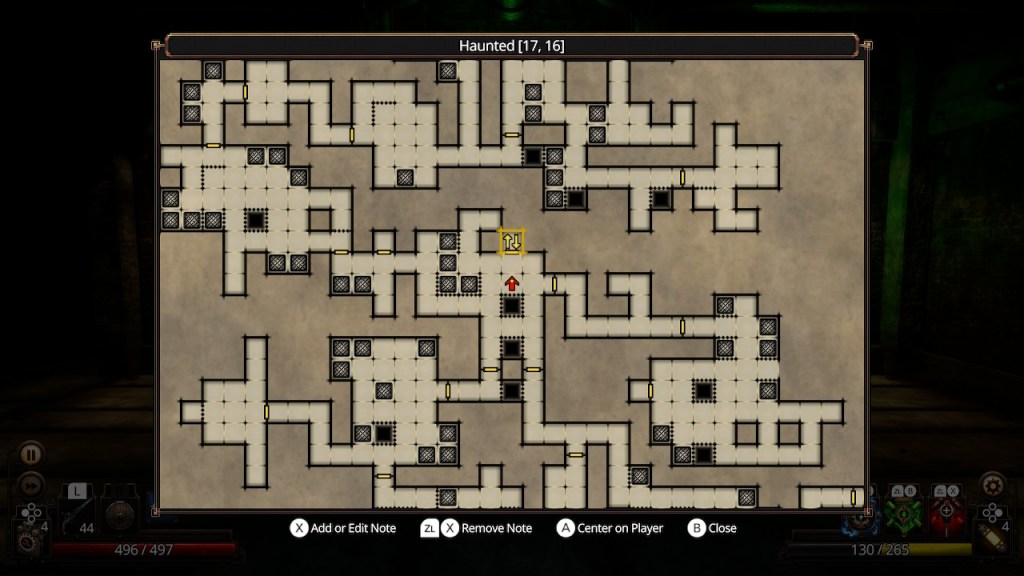
    When it comes to secret hunting, the predictable and repetitive grid-like nature of the environment is both a blessing and a curse. A quick look at the map often reveals blank spaces that hide a secret room but opening them can mean hunting for the tiniest differences in a common texture. It’s worth the effort though, as powerful gear, consumables that permanently increase your basic attributes, rare upgrade circuits, and even revealing documents are common rewards.

    Battling on a grid can feel a bit limited at first and, so long as you’re up against a single enemy and have a 2-by-2 grid space, it’s possible to simply shuffle around them and get in free hits as they transition or reorient. Vaporum attempts to spice things up by giving some enemies projectile attacks, quick strafes, area-of-effect attacks, knock-back attacks, and sideswipes, but one-on-one battles are always survivable if you’re patient.

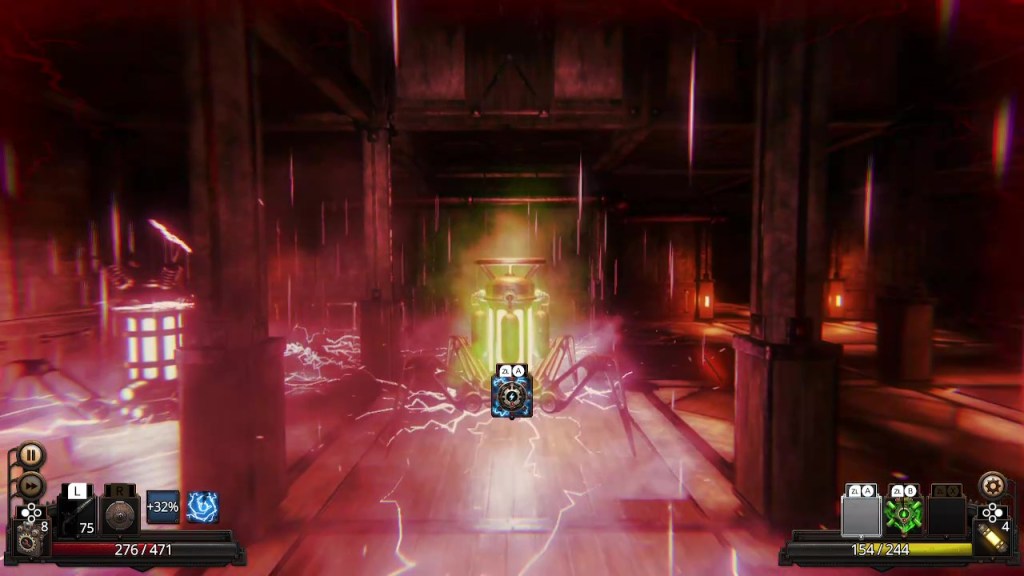
    In contrast, group battles – especially those with hazards thrown in – will quickly tax your powers of observation, planning, adaptability, and reflexes. Vaporum is perhaps too fond of locking you in rooms, resulting in combat that feels like an awkward dance as you avoid being boxed in, try not to strafe into a hazard or AoE attack, dodge crisscrossing projectiles (or lead enemies into them), clear space to trigger a repair kit, and line up priority targets.

    It’s often chaotic and unpredictable but if you keep a clear head and have a decent sense of spatial awareness, it can be a lot of fun and you’ll often come out on top.

    So, six years on from launch, and 36 years since Dungeon Master introduced real-time combat to the formula, Vaporum is an interesting mix of old designs with more modern sensibilities. The PC version feels most intuitive to play but the console ports are great, irrespective of which platform/s you own.

    I strongly recommend it for dungeon-crawler and RPG fans, though I’d hazard a guess the audience will always be niche. That said, if you can wrap your brain around the grid-based structure, Vaporum provides a weirdly compelling mix of methodical exploration and secret hunting, plenty of mentally taxing spatial puzzles, and high-intensity combat that requires you simultaneously plan and react.

    Screenshots were captured on the Nintendo Switch. Vaporum is also available on PC, Xbox One/Xbox Series, PS4/PS5.

  • Retrospective: Terminator: Resistance

    Retrospective: Terminator: Resistance

    Initial reviews for Terminator: Resistance from traditional media were broadly negative but, within a few hours of launch, positive user reviews emerged. It didn’t take long before comment sections, Reddit threads, and several YouTube channels were full of positive sentiment – ranging from outright praise to cautious recommendations. As someone with a fondness for janky, mid-tier games that would never score higher than a seven, this piqued my interest.

    Perhaps as a testament to its underdog popularity, it took a long time for Terminator: Resistance to hit a price point I deemed suitable for a low-risk purchase. I eventually picked up the Xbox One version to play on an Xbox Series S – the release day experience, I guess? – and while I don’t begrudge my purchase, I found it a staggeringly middling experience elevated by one standout element.

    The storytelling is dated but it adheres to the canon

    Although the storytelling feels last, last-gen, one of Terminator: Resistance’s unexpected strengths is its strict adherence to the canon of the original timeline from the first two Terminator films. The date Skynet acquired sentience; Judgement Day; the formation of the human resistance; the emergence of Terminator Infiltrator models; the Time Displacement Equipment; the endless cycle of diverging futures – all these plot threads are accounted for a worked into its narrative.

    I had assumed Terminator: Resistance was going to avoid messing with canon by telling a stand-alone story set during the Future War but, by the midpoint of a 13-hour casual playthrough, it became clear Teyon developed it as a prologue to the films. John Conner makes an appearance (and Kyle Reese in the Annihilation Line expansion), there are references to other important figures in dialogue, and the protagonist – Jacob Rivers – participates in significant events that lead into the opening of both 1984’s The Terminator and 1991’s Terminator 2: Judgement Day.

    The story itself is fine, with a few highlights whenever the game ditches the open-zone approach for more linear set-piece-style sequences, but the entire middle portion drags – especially if you’re tackling side missions. The tightly controlled opening sees Rivers saved from a Skynet ambush by a suspiciously knowledgeable stranger, who guides him towards a ragtag group of survivors that – after a few hours of hunting for clues – finally put him in contact with the local resistance. If you can tolerate the assortment of clichéd character archetypes, the opening provides several tense set pieces and some rapid relationship-building.

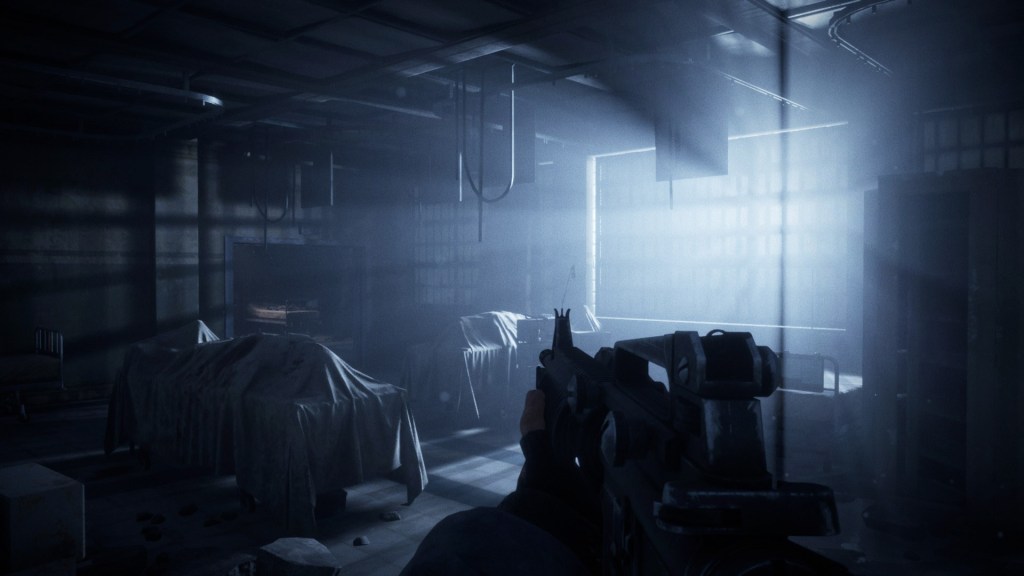
    The primary missions see you search through abandoned resistance outposts, sneak through a Skynet-controlled hospital to free some captured resistance soldiers, come face to face with the Terminator Infiltrator that has been tracking Rivers, take down an HK-Tank, and storm the central core. The more open zones offer no shortage of rudimentary fetch quests to raise the trust level of the civilian survivors that, in turn, reveal more of their backstory and the current state of the world.

    It’s a dated but familiar structure, however, the dialogue- and choice-driven role-playing elements feel half-baked. Regardless of the choices you make, or whether you complete or ignore side missions, 90% of the experience plays out in exactly the same way. There’s always an easy alternative as to why events can still occur as the central narrative and ending sequence is beholden to the first two Terminator movies.

    The longer you play, the more obvious it is that the civilian survivors are irrelevant to the overarching plot – yet account for the bulk of the role-playing moments. Any significant changes to their fate are mostly relegated to a narrated montage, while the system feels so transparent that it’s easy to get the “best” ending. When in doubt, be nice and always follow the stranger’s advice.

    Ultimately, they felt like an excuse to add “depth” to an incredibly basic choice-and-consequence system and the in-game impact is minimal. Two optional survivors you can save during the prologue just hang around in corners doing nothing. Completing a mission to find a puppy or chalk for the young survivor Patrick leads to a few visual changes in the shelter, but primarily serves to notch up the trust meter of his sister Jennifer. The same logic applies to the doctor, Erin, and mechanic, Ryan – with higher trust levels from completing side missions making it easier to influence their fate leading into the finale.

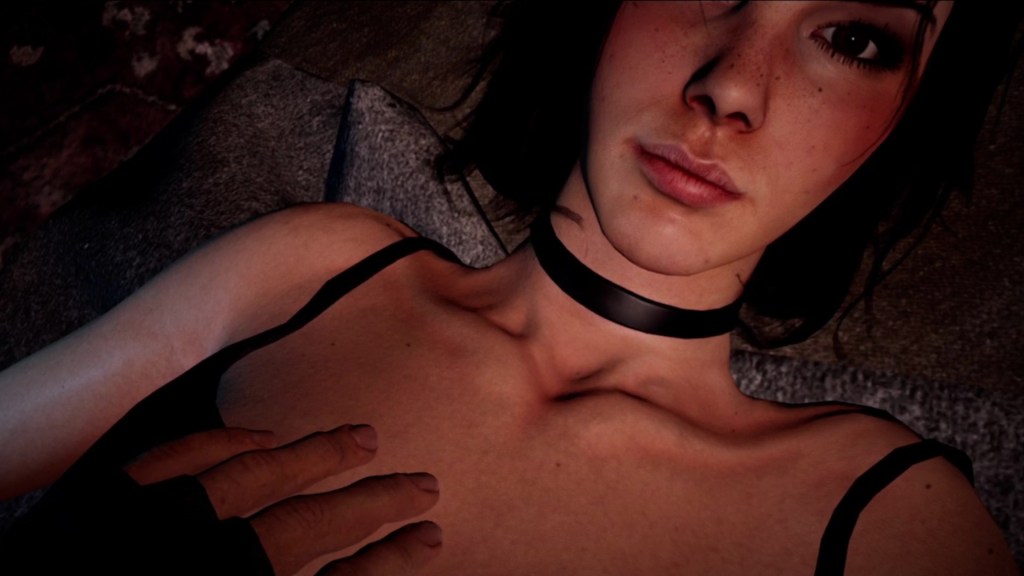
    Of course, no RPG is complete without romance options and both Jessica and resistance leader Baron fall neatly into the “damaged woman looking for a strong man” archetype. Your trust meter is also your ticket to potential romance – with one or both of them, Terminator: Resistance doesn’t judge. If you’re foolish enough to select the dialogue options with a heart next to it, you’ll be treated to some spectacularly bad first-person sex scenes – featuring music and moaning straight out of vintage pornography – serving as a reminder that fade-to-black is always the right choice in video games.

    A bit of this, a bit of that, all of it average

    So I’ve had a dig at the storytelling and limited choice-driven outcomes, but it’s the traditional gameplay mechanics that make and eventually break Terminator: Resistance. The best way to describe it is a scaled-back Fallout 4 set in the Terminator universe.

    It’s no open world but you explore smaller open zones sequentially as the story plays out and the situation evolves. You’ll interact with minor characters and even fight alongside small groups of resistance soldiers – typically impervious to harm until the plot decides otherwise. It features similarly janky shooting that never feels as responsive or precise as a dedicated FPS, at odds with the ability to hit weak spots to inflict critical damage. It’s competent enough – and maybe better when using a mouse and keyboard – but the focus is clearly on upgrading Rivers’ abilities and arsenal to produce bigger damage numbers.

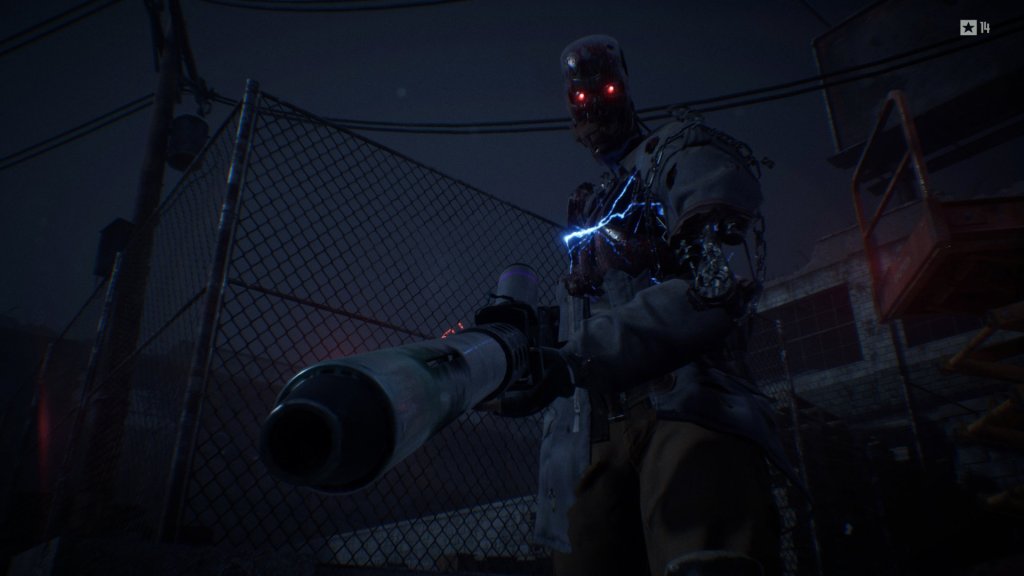
    I feel part of that initial post-launch positivity has a lot to do with the opening hours. You’re stuck with an assortment of conventional human firearms that are fine for spider scouts and drones, but larger robots force you to get an angle on their weakspots to do significant damage. Although encounters are rare and heavily scripted at first, the hulking Series-800 Terminators are invulnerable to standard firearms and need to be stealthed past or, if you’re flush with crafting resources, pipe-bombed.

    If you up the default difficulty a notch to make all mistakes potentially fatal, the opening hours force you to explore the semi-open environments carefully, use the rudimentary stealth system to get a good angle before attacking, engage in hit-and-run tactics against groups of foes, and scavenge continuously to craft explosives and healing items. It feels like the kind battle resistance fighter would be waging and the Terminators prove a particularly terrifying enemy that, as a bonus, requires no complex AI. Once detected, they march doggedly towards you at a brisk yet unhurried pace, their red eyes and plasma shots emerging from the distant gloom.

    Of course, Terminator: Resistance has RPG-lite mechanics integrated into the gameplay too, so you’re constantly earning XP towards new levels and investing skill points into three branching but straightforward tech-trees (Combat, Science, and Survival). There are some powerful abilities at the end of each branch – think health regeneration or the ability to use Terminator weapons – but most are just incremental upgrades to damage done with weapons and explosives, increased toughness, more effective stealth, and improved efficiency when crafting, lockpicking, and hacking.

    In theory, this gives you some control over your character build but it doesn’t pan out that way. Firstly, skill upgrades are level-gated so you can’t super-specialise early on. Secondly, while you can prioritise your point distribution within these level brackets, there’s more than enough XP to unlock all but one or two skills by the finale. You become a powerful all-rounder irrespective of your preferences.

    Another unbalanced mechanic is the ability to upgrade plasma weapons by creating a sequence of three circuits, which offer buffs like increased damage, clip size, and fire rate. They come in different rarities, and the connector types you need to line up is randomised, but you can eventually loot or buy dozens of them, letting you tear through many Terminator types with ease by the mid-game.

    If I wanted to be harsh, I’d describe Terminator: Resistance’s mechanics as wide as an ocean but deep as a puddle. However, that relative simplicity in tandem with the short runtime work in its favour. Although the mid-game drags on for too long and returns you to the same regions too often, it remains a more-ish experience. Every outing means XP for new skills, access to new weapons, and a few new upgrades.

    The importance of looking the part

    So far, so six out of ten – but Terminator: Resistance has a trump card.

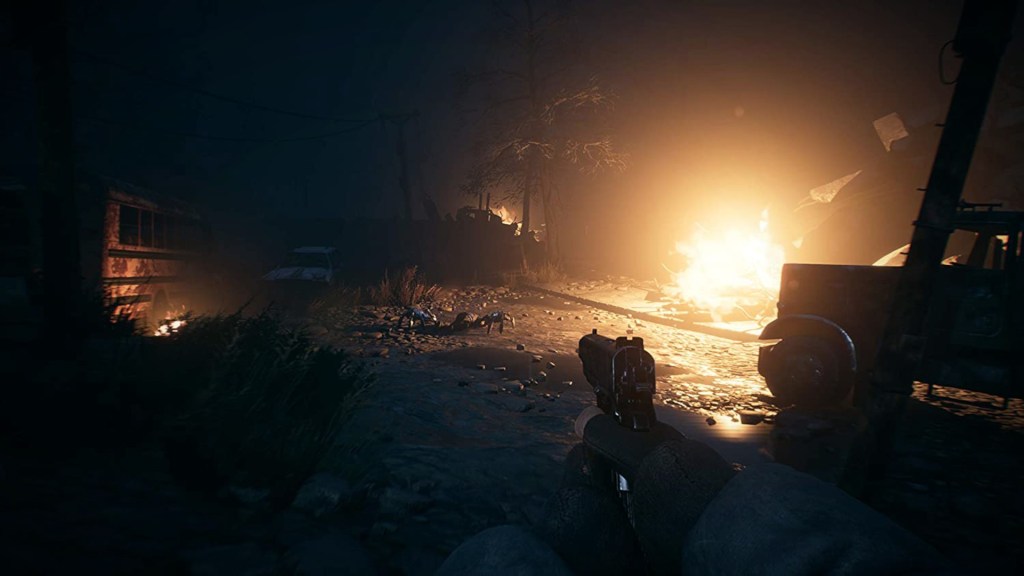
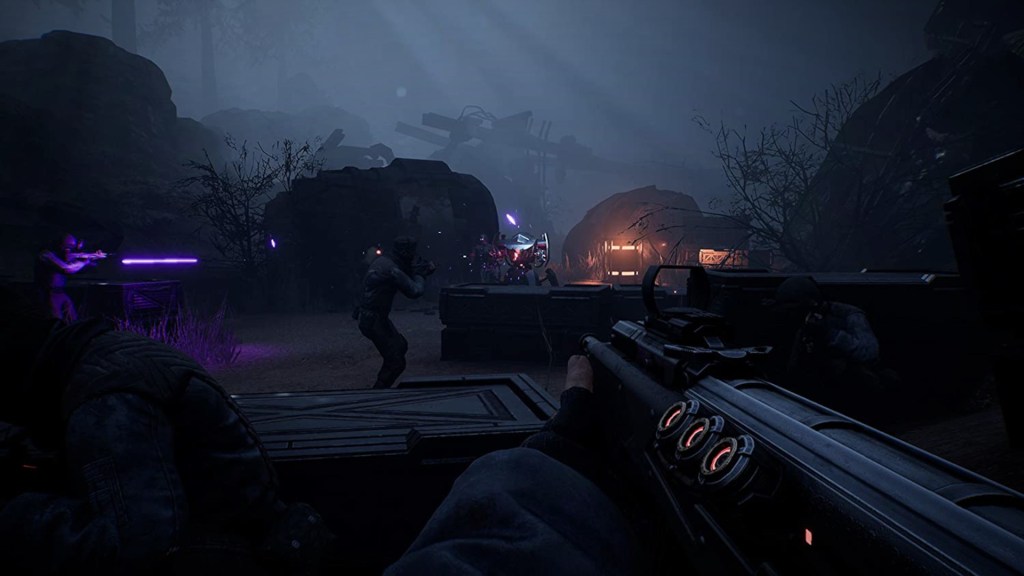
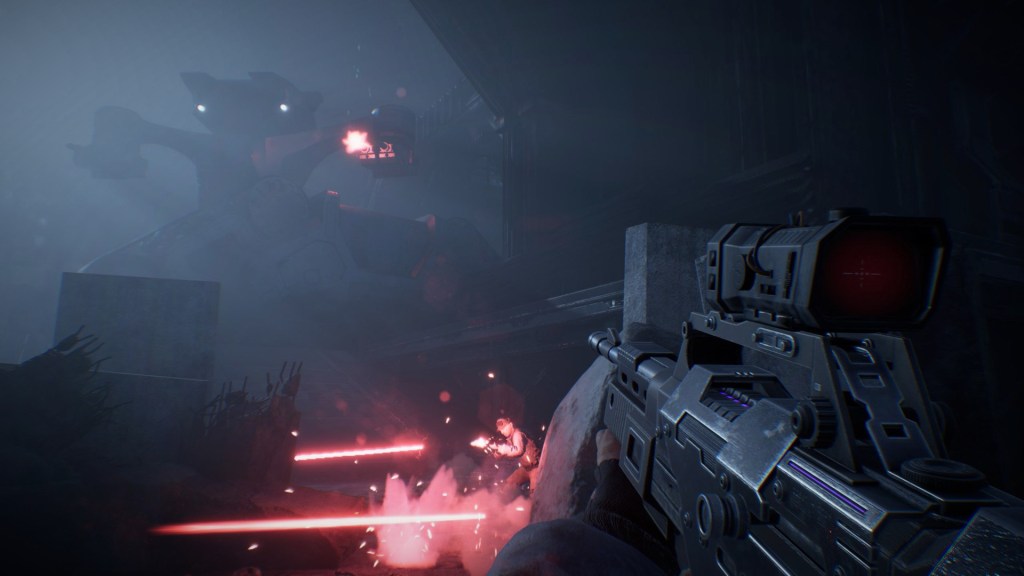
    Even accounting for the increased resolution and texture quality offered on PC, Terminator: Resistance is not a technically impressive or beautiful game – but it does have some style. I earlier compared it to a scaled-back Fallout 4 and that holds true for the visuals. The environments look dated and lack fine geometric details but the overblown volumetric lighting and depth-of-field are used to create an oppressive atmosphere and mask many limitations, like distant scenery.

    Although missions set during the day can look flat and washed out, most of your excursions are after nightfall when the world is drenched in shades of cold blue, lit by the harsh glare of fires, piercing spotlights, neon plasma colours, and glowing Terminator eyes.

    Character models are not particularly well-animated or expressive, but humans look suitably detailed and, most importantly, a lot of attention has been placed on recreating the iconic Series-800 Terminators, other recognisable machines like the HK-Aerial and HK-Tank, and the Resistance weapons.

    The soundtrack – unfortunately not available officially – is the true star of Terminator: Resistance. It feels like a diverse original score, not just a reworking of Brad Fiedel’s iconic themes, and could have been a perfect fit for the 1984 original or the sequel. It’s one part electronic rock, one part marching band drum beat, one part moody synthwave, and consistently incredible – well, aside from during the aforementioned sex scenes.

    It elevates almost every moment, regardless of whether you’re skulking through ruins hiding from the spotlight of an HK-Aerial; circling around the world’s least competent HK-Tank in an otherwise dull boss fight; or charging the defences around Skynet’s Time Displacement Equipment with a reprogrammed HK-Tank, dozens of resistance fighters, and neon plasma bursts crisscrossing overhead.

    Style over substance?

    Wrapping up, I can now appreciate how Terminator: Resistance has cultivated a modest but vocal fanbase, especially among fans of the original timeline movies. Hell, I’m even tempted to pick up the PC version at some point – though damn you Teyon for making that a requirement to play the Annihilation Line expansion.

    Terminator: Resistance reaffirmed my belief the audiovisual experience can’t carry a game, but it sure can elevate it. Sadly, in this case, it’s from a middling six-out-of-ten game to a mildly entertaining seven-out-of-ten – the sort of game that’ll always find an appreciative fanbase that might keep it popular enough to warrant a better sequel at some point.

    Between its adherence to events in the original timeline, neon-soaked colour palette, and satisfyingly authentic soundtrack, it’s by far the best Terminator game – or at least the best FPS Terminator game if you’ve got a soft spot for the 8- and 16-bit crossover titles. However, if you’ve got no nostalgic hook or limited playtime that you’d rather fill with only quality titles, you can easily give it a skip.

    Terminator: Resistance was played on Xbox Series S|X. It is also available on PC, Xbox One, and PS4/5 (and got an Enhanced edition for PC and current-gen consoles with a DLC campaign).

  • Retrospective: Castlevania: Lords of Shadow 2 (2014)

    Retrospective: Castlevania: Lords of Shadow 2 (2014)

    The origins of that undead scallywag Dracula was a story I never cared to see. You see, when you’re trying to give a beginning to some of entertainment’s truly big bads, it’s very difficult to create a story that can outdo the mystique around those characters.

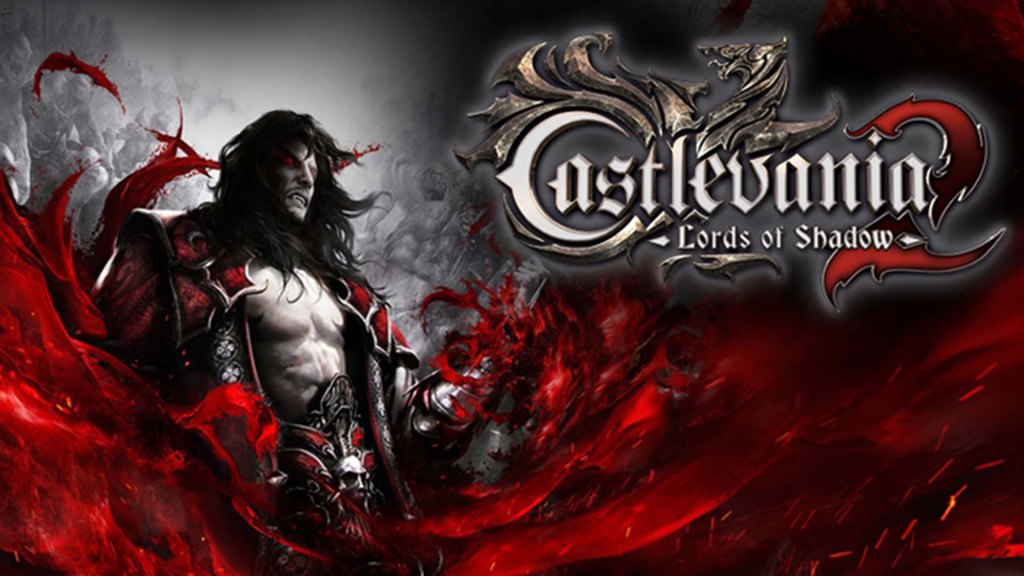
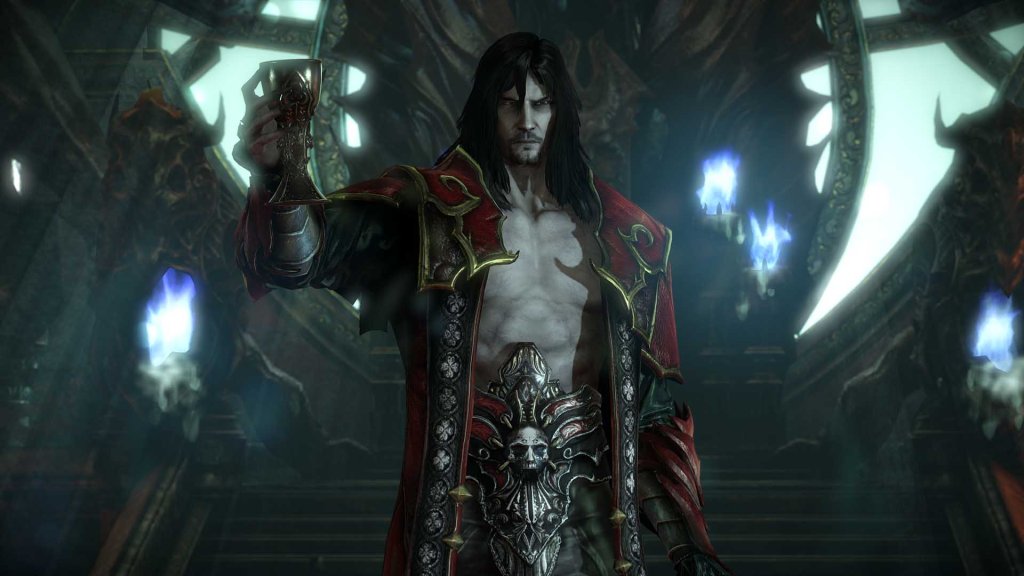
    In 2010 developers Mercury Steam in conjunction with Kojima Productions managed to do just that. At least in the Castlevania universe they did. Players took on the role of Gabrielle Belmont in what was a dark and twisty narrative that saw him go from the right hand of God to, well, the Prince of Darkness. The game drew some fantastic voice acting from Robert Carlyle and Patrick Stewart as we saw how doing the right thing took Gabrielle down the dark path to becoming one of the greatest monsters who ever unlived.

    Coupled with some fantastic visuals in linear levels, that showcased exactly what classic 2D Castlevania levels would look like in 3D, the great combat in Castlevania: Lords of Shadow set up the beginnings of a fantastic series that was all too short lived.

    In 2014 Mercury Steam released Lords of Shadow 2. The game drew on what made the first game so great and then translated it into what I had always wanted from a Castlevania series: a sprawling, epic open 3D world.

    Now this wasn’t the first time that Konami had attempted to translate Castlevania from its 2D origins to 3D. The PS2 saw two 3D entries in the series while the N64 saw two 3D entries of its own. All four games are better left in the past and, in many ways, best not mentioned again either. Capcom’s original legendary Devil May Cry became the closest to a good 3D Castlevania game I ever thought I would get.
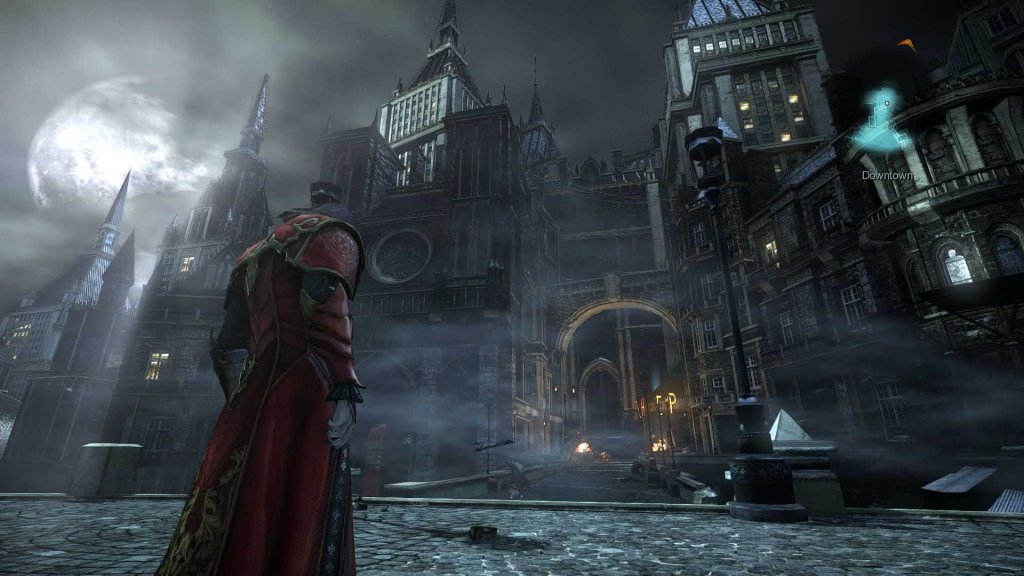
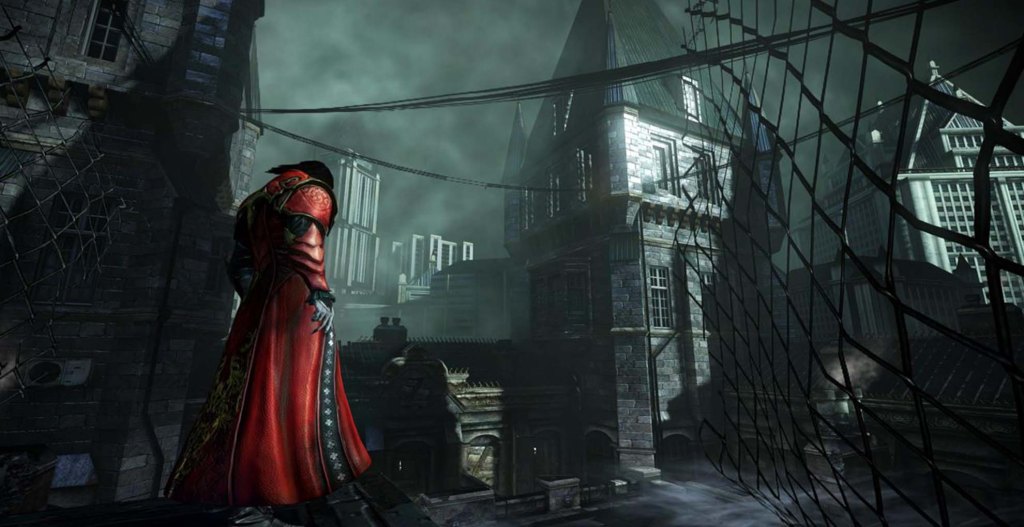
    Lords of Shadow 2 surpassed my expectations of what Mercury Steam would be able to develop. Set both in the modern day and the medieval past of the castle, Lords of Shadow 2 pulled out some fantastic vistas for you to stop and marvel at along your journey. The modern day sections were set in a city that was built upon the dessicated bones of Castle Dracula while the more supernaturally set medieval sections of the game were a triumph of epic, screenshot worthy vistas.

    Mercury Steam managed to translate the Metroidvania style into 3D. As you once again took on the role of an underpowered Dracula, the more you explored and fought, the more powerful you would become and this in turn opened up new areas for you to explore, to both progress the game, and find secrets. It certainly could not have been an easy feat, but I always felt that Lords of Shadow 2 nailed this aspect of what made Castlevania so great. It was an absolute joy to explore the environment which added a grand sense of majesty to the narrative.

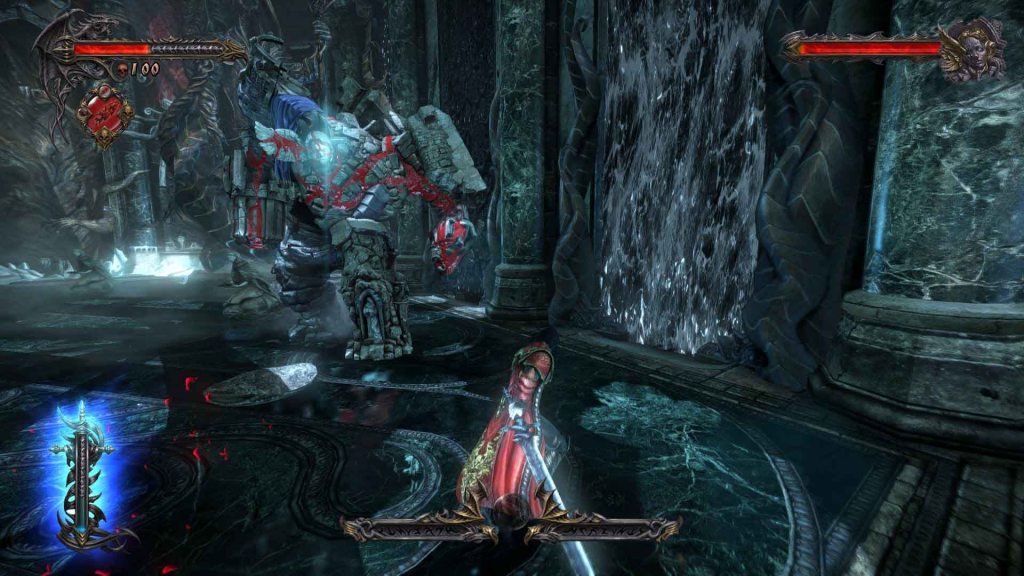
    While the exploration is the main reason I truly love this game, the combat was no slouch either. Dracula uses his own blood as a weapon, creating his own version of the now iconic Castlevania whip. However there are new offensive and defensive moves and weapons. The dash and counter system needed to be mastered to be truly effective, especially in later fights, while two new weapons, the Void Sword and Chaos Claws helped you to heal and deal with armored enemies respectively. Using them would drain your magic meters so there was some tactical play in when to use them.
    As much as I loved Lords of Shadow 2, it launched to rather mixed reception. In short, the game didn’t do well with low sales. Add a lot of apparent behind the scenes drama and negativity and Lords of Shadow 2 became the last entry in the series.

    Having replayed it yet again recently, Lords of Shadow 2 still holds up fantastically in environment design and combat, though, visually, its age is starting to show. The PS3 and Xbox 360 era games have a tendency to be rather… muddy. The fantastic exploration still remains highly addictive and the combat is chaotically cathartic and challenging still.

    While the story may have been definitely concluded, this is Castlevania and Dracula after all, who has more than once proven that you can’t keep a good Count down. That said, the chances for a series revival for this are non-existent. The chance of some sort of HD remastering is also non-existent considering the poor sales. Thankfully if you have either an Xbox 360 or PS3, you can still play the game. If you have an Xbox One or an Xbox Series machine, the Lords of Shadow series is part of the Backwards Compatibility program meaning you can still give it a go there, and I highly urge you to.

    Now if you’ll excuse me, I feel a need to explore a certain musty old castle again…