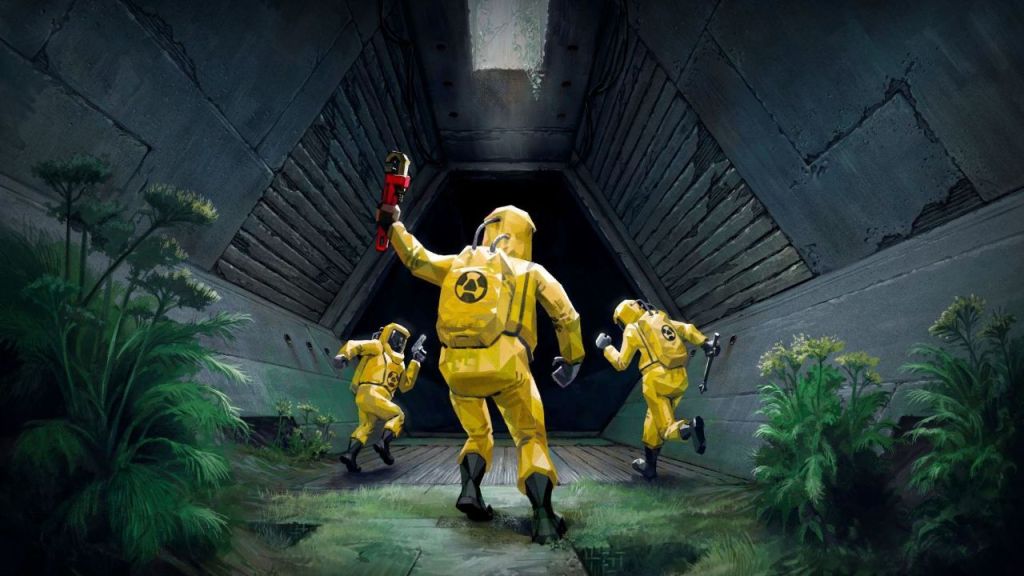
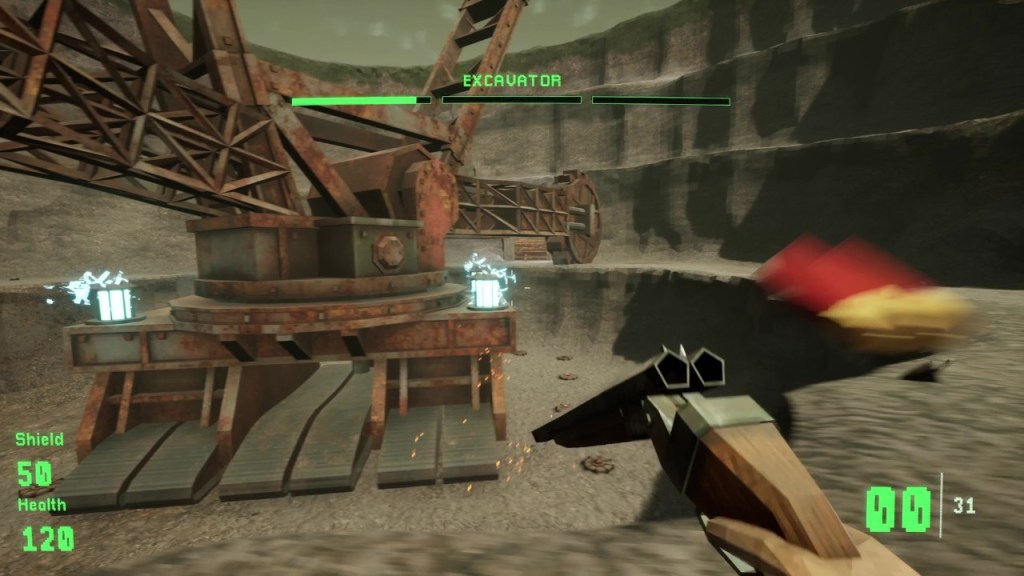
Looking at Kvark’s retro-styled visuals, industrial complex setting, and science-gone-wrong premise, it is easy enough to make Half-Life comparisons – but those features could apply to hundreds of games released since 1998. The Half-Life characteristic that Kvark emulates best is that satisfying, cyclic rhythm between exploration, environmental puzzles, and brief, brutal firefights. Kvark released on PC near the end of last year, but I wanted to replay the console port as there are few games that capture the essence of Half-Life on console, and Valve seems disinterested in preserving access to their Xbox 360- and PS3-era ports like The Orange Box collection and the Left 4 Dead games.
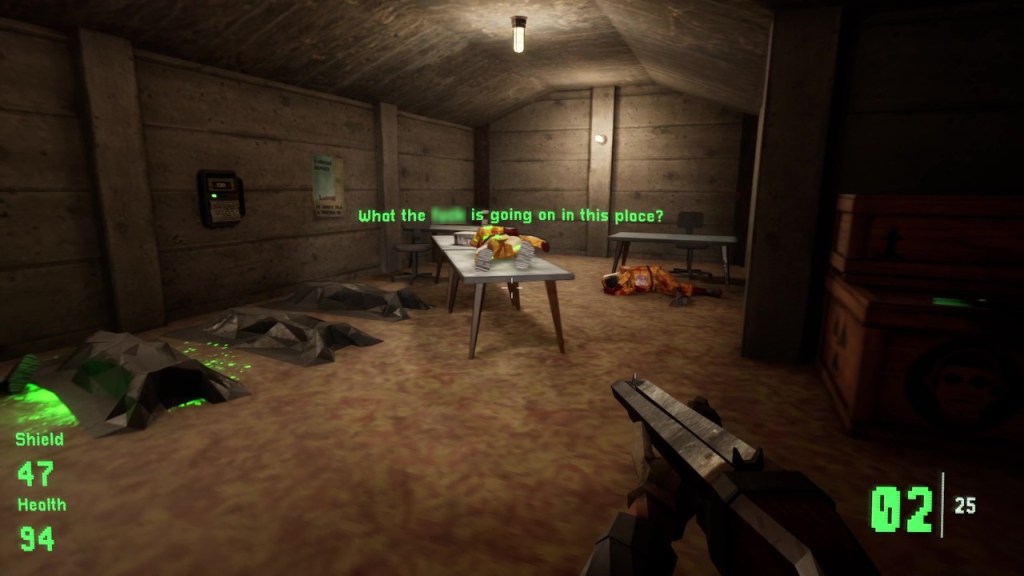
Having turned off subtitles for the propaganda videos that play between chapters, this was more or less my thoughts on the narrative throughout.
Unlike Half-Life‘s unexpectedly strong narrative thread, Kvark sticks to the classic retro-FPS approach of providing some light context and leaving the rest up to the player. It takes place in an alternate-history Czech Republic, under Soviet-style rule during the Cold War period. The titular “Kvark” corporation has moved on from nuclear power, to nuclear weapons, and finally a dubious injectable substance – “anethium” – to create super-workers and super-soldiers. It’s a videogame setup we’ve seen a hundred times before, so it should come as no surprise your prisoner protagonist wakes up in a cell to discover both human clean-up teams and grotesque mutants are out to kill them.
There are entertaining propaganda videos that reveal what the corporation has been up to and hint at the threats you’ll face in the upcoming chapter, but the bulk of the storytelling is handled by scattered notes or hidden drawings that reveal the ineptitude of the government and staff, or provide the odd code or hint to access secret areas. Survival is your primary goal, and as the Kvark complex was relocated far underground to avoid the gaze of Western imperialist spies, that means an 8–10-hour gauntlet through prisons, sewers, manufacturing facilities, mines, laboratories, and quarantine zones. The overall tone is one of dark, cynical humour, but it can feel suitably oppressive and tense, with open skies only appearing in the final third of the game.
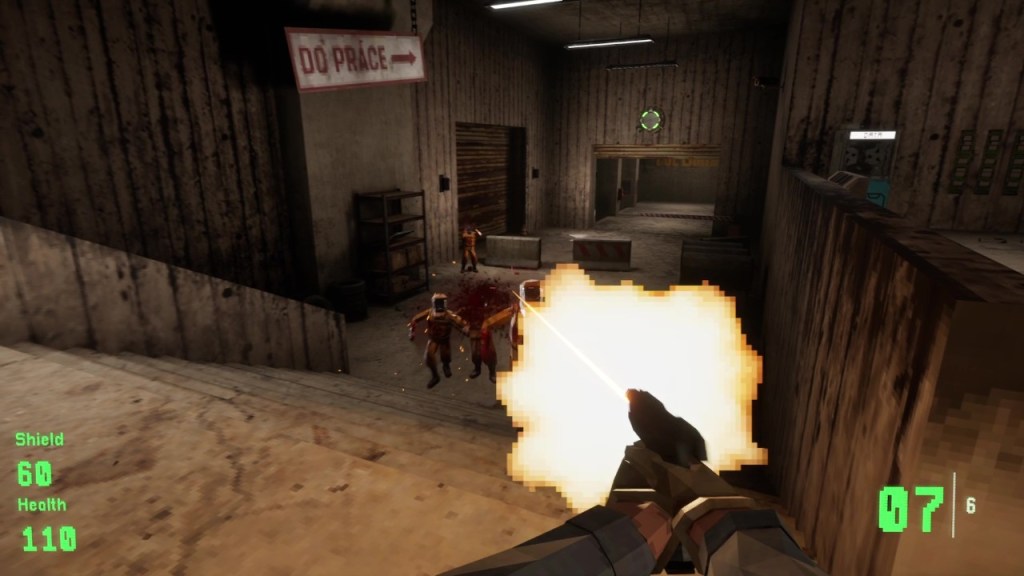
Kvark is excessively gory, with improbably huge blood splatters and abundant severed limbs, but it’s more comical than gruesome.
Gameplaywise, Kvark focusses on what all good first-person shooters should: responsive movement; weapons that look, sound, and feel good to use; and hand-crafted combat encounters against a variety of enemy types that force you to use your full arsenal. There’s nothing inherently novel about the shooting or the traditional weapon categories – ranging from a mostly ceremonial wrench through a pistol, shotguns, rifles, a crossbow, an energy weapon, a grenade, and a minigun – but they all have a situational use and limited ammunition reserves that prevent you from just sticking to an allrounder. Even the perfunctory skill tree, which encourages you to hunt for anethium injectables, offers mostly incremental buffs and one risk-reward perk that reduces total health and healing efficiency in exchange for health gain through kills.
With solid but familiar foundations, it’s that aforementioned rhythm of exploration and environmental puzzling, interspersed with bouts of violent combat, that channel Half-Life vibes. Aside from a few short-lived platforming sections in the second chapter, both the level design and variety feel good given its length, with many looping back, over, or under themselves to give an impressive sense of scale. Within the ruined corridors, rooms, and vents of the facility you’ll scrounge for weapons, ammunition, and secrets; you’ll flip switches, connect cables, ride carts, and activate machinery to open the way forward; and you’ll deal with clean-up squads and hordes of mutants by staying mobile, kiting melee enemies, prioritising those with ranged attacks, and making use of explosives (or explosive hazards) – all before shifting back to exploring for more resources in preparation for the next combat encounter.
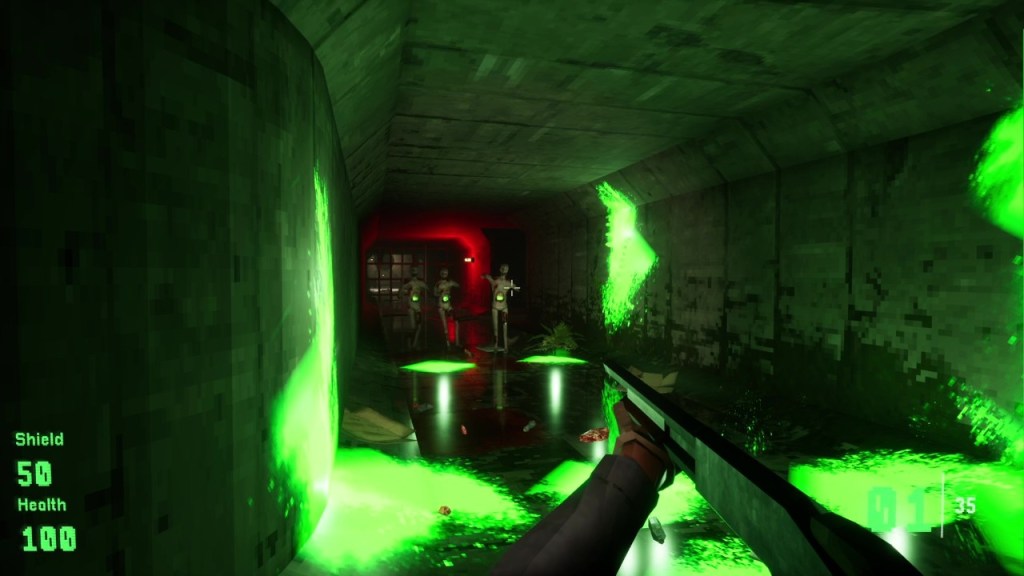
Anethium-mutated creatures are uniformly irritating and a pain to fight in tight spaces.
Kvark feels more forgiving than it did during early access period, but the checkpoints and resource stashes still feel balanced around surviving a handful of significant encounters each level – encouraging a more methodical and tactical approach to firefights on all but the easiest difficulty. As the game progresses, you’ll encounter larger mobs in bigger and more hazardous arenas that’ll test your shooting skills or your ability to scavenge resources mid-battle. Mutated rats, spiders, and zombies rush you or spew glowing goo and webbing that make fighting in tight spaces a pain. Clean-up squads force you to use cover as they evolve from baton- and pistol-wielding goons supported by flying drones, into armoured squads with shotguns, flamethrowers, miniguns, and robot support. With the action confined to an arena, it was only the three boss encounters that felt more annoying than challenging, with the focus on dealing with mobs while avoiding AoE attacks and hitting weak-points.
When it comes to the presentation, Kvark will likely be divisive. I enjoy the clean, retro-styled visuals imitating early fully-3D environments and the ability to interact with so many objects, but there is a lot of asset reuse to build out the more sprawling levels. Every other element feels near-perfect, from the blocky character models, crude weapon animations, and chunky gore effects, to the ambient audio, roar of gunfire, and a mostly subdued electronic soundtrack that ramps up during combat. It also ran smoothly on an Xbox Series X – performance that’ll likely hold true for current-gen consoles – with a helpful touch of auto-aim and some decent rumble feedback for gunfire and footsteps. The only notable issues I found (as of this review going up) were several crashes during the second level of the first chapter, and the placement of some checkpoints at the entrance of restock rooms instead of at the exit, so you have to collect everything again after reloading.
The boss fights are a mix of traditional and weird, but I never found them as exciting as most common combat scenarios.
Taken as a whole, Kvark doesn’t offer much novelty when it comes to the premise, mechanics, or visual style, but it has something so many modern games lack – rhythm and pacing. You could go back and call Half-Life dated based on the visuals, limited set-pieces, and no progression mechanics, but I’d challenge anyone to play it and claim it’s not fun. Kvark is not as timeless, sure, but it finds a similar groove by ensuring you’re constantly cycling between exploration, light puzzling, and brutal firefights, all before hitting the next checkpoint and starting the cycle anew. As such, Kvark is easy to recommend – especially at an indie price-point – to fans of the genre that play on console and want a taste of that classic Half-Life formula.
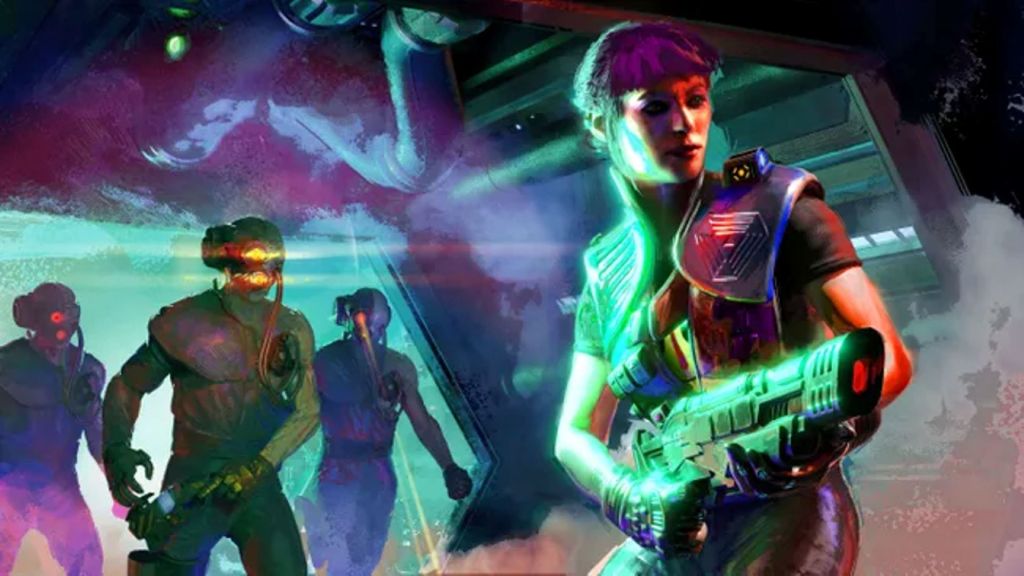
As a fan of the immersive sim genre, it’s hard to decide which was the greater tragedy: having to wait 18 years between System Shock 2 and its closest spiritual successor, Prey (2017); or watching Prey (2017)’s developer, Arkane Texas, forced to churn out Redfall in 2023 before being unceremoniously shuttered by Xbox. At least that year Nightdive Studios’ remake of the first System Shock finally arrived on PC, after a turbulent 8-year development cycle that included IP licensing concerns, extended periods of silence, three complete restarts, and a shift from Unity to Unreal Engine 4. To their credit, the result was mostly worth the wait.
Replaying it by way of 2024’s excellent console ports (for both current- and last-gen hardware), the System Shock remake is faithful to a fault in some regards, but still infinitely more playable without the original’s clunky FPS/point-and-click hybrid controls. System Shock (2023) is far more involved than a traditional FPS, but it controls like one and works well enough when using a controller – aside from sluggish inventory management and an awkward lean toggle.
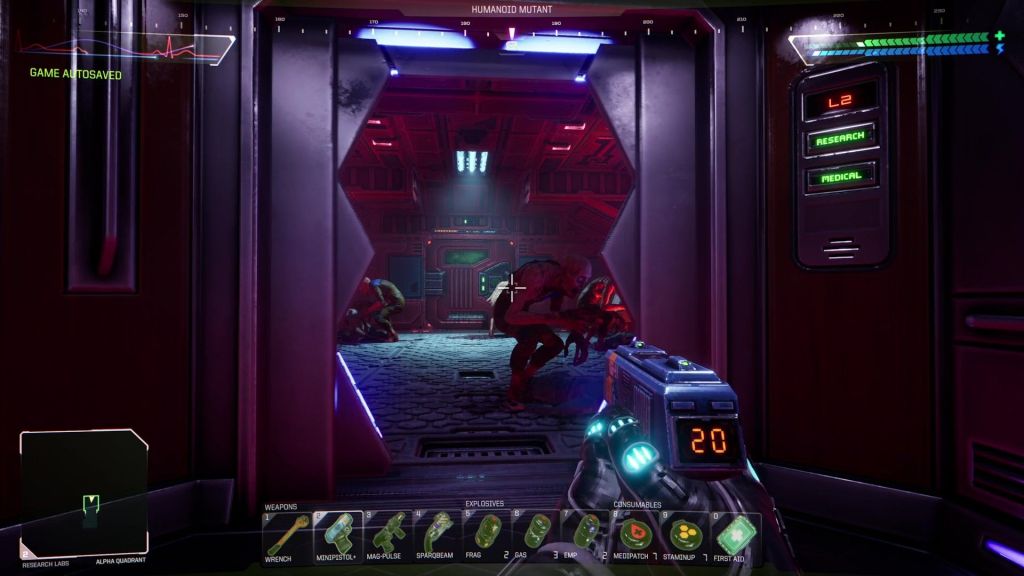
The updated UE4 visuals and new synth-heavy renditions of the original soundtrack generate late-‘80s/early-‘90s sci-fi vibes – think harsh lines, retro-futuristic tech, an abundance of specular reflections, and overblown neon lighting – and those fresh visuals are enhanced by a pixel filter that adds a veneer of retro-inspired chunkiness to close-range textures, character models, and 3D objects.
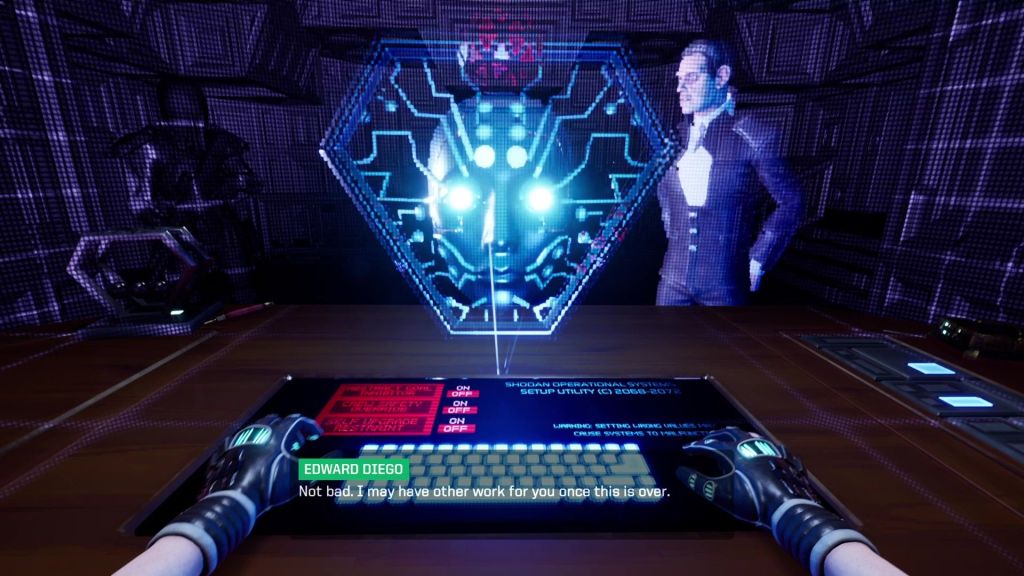
What could possibly go wrong if I remove the ethical constraints on an AI designed by an unethical corporation?
While the audiovisual overhaul and updated control scheme are obvious changes up front, System Shock (2023) deserves more praise for how it manages to recreate much of the original’s level design, mission flow, and iconic encounters, despite expanding and enhancing every element.
Moving through the multi-level and often maze-like Citadel Station still feels tense and sometimes terrifying, especially given how little handholding there is and the high level of challenge. In stark contrast to the “follow-the-icon” mentality of most modern games, you need to pay attention to your map and signposting to navigate. You also need to parse radio transmissions and audio-logs for clues on how to progress, slowly piecing together the desperate plans of the former crew.
It helps that System Shock has a cliched but compelling “AI gone rogue” plot. After being arrested for attempting to steal designs for a Tri-Optimum neuro-mod, your hacker protagonist finds themselves transported to Citadel Station and confronted by Vice President Edward Diego with a simple offer: become part of their dubious experiments or utilise their skills to remove the ethical constraints on the station AI, SHODAN, and receive the modification they were after as a reward. Emerging from a medical pod six months later, it turns out unshackling an AI with a god complex was a poor choice and she now wants you crushed like an insect.
The environments may look wildly different, but returning fans will spot the same basic level layout and familiar encounters.
It’s a great setup, but aside from a handful of calls from survivors or Earthside Tri-Optimum staff, the bulk of storytelling is conveyed through optional audio-logs that near-perfectly correlate with environmental details. The more attention you give to the narrative elements, the more you get out of them.
A first playthrough also nails the sensation of awakening amid a disaster, alone and out of your depth. However, the updated mechanics and returning difficulty levels allow you to tailor the experience to be more forgiving of rushed exploration, poor planning, or scrappy combat.
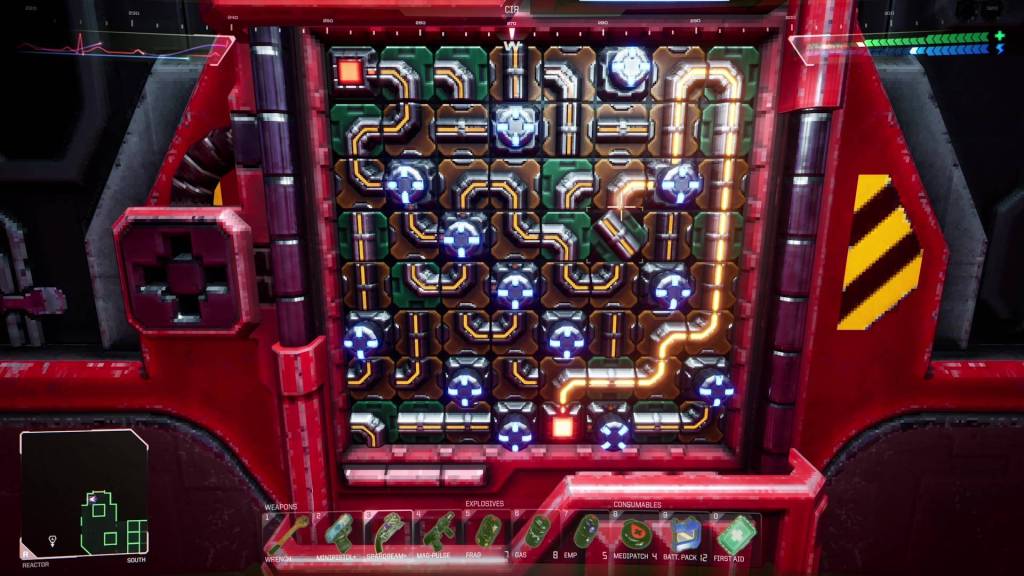
The overhauled UI and menus better track progression, grid-based inventory management and quick slots for combat are a godsend, and you can customise the difficulty of individual systems. You get simple map markers on the easiest mission difficulty or a 10-hour time limit on hard. Combat is always challenging, but you can tweak incoming damage, mob sizes, and the respawn rate. Cyberspace battles – which play out like classic 6DOF shooters – can be colourful diversions or bullet-hell chaos. Puzzles – a mix of balancing voltages, rerouting power, and finding codes – can be brief distractions or leave you wishing you had a logic probe to simply override them.
I set the puzzle difficulty hard and never used a single logic probe – but I know these are not for everyone.
There are fans of the original that would suggest maxing every difficulty aside from enforcing the time-limit for a first playthrough, but I’d argue even on the easiest settings, System Shock (2023) never loses that inherently challenging immersive sim core. Running straight into a horde of cyborgs is likely to see you shredded regardless of the difficulty, while too many scrappy fights early on will leave you short on supplies and forced to adapt.
The ability to revive at Restoration Bays is available regardless of the difficulty, so adding a few basic map markers, or simplifying cyberspace combat for those who hate that style of gameplay, is a worthwhile addition if it encourages a modern audience to stick it with it long enough to understand and appreciate the genre’s distinctive player-driven flow.
All of which brings me to what I love most about System Shock (2023) and the genre as a whole. A good immersive sim punishes a player for a thoughtless approach and sloppy execution, but rewards preparation, planning, and the smart or unconventional use of the tools provided. It’s a genre that facilitates save-scumming, but not to encourage a trial-and-error approach; rather, it allows the player to iterate on a plan and master its execution. An ambush or boss fight shouldn’t require constant quick saving behind every piece of cover to manipulate the odds of being hit; you should want to reload a boss fight because you’ve thought of a way to optimise your approach and finish them off more efficiently.
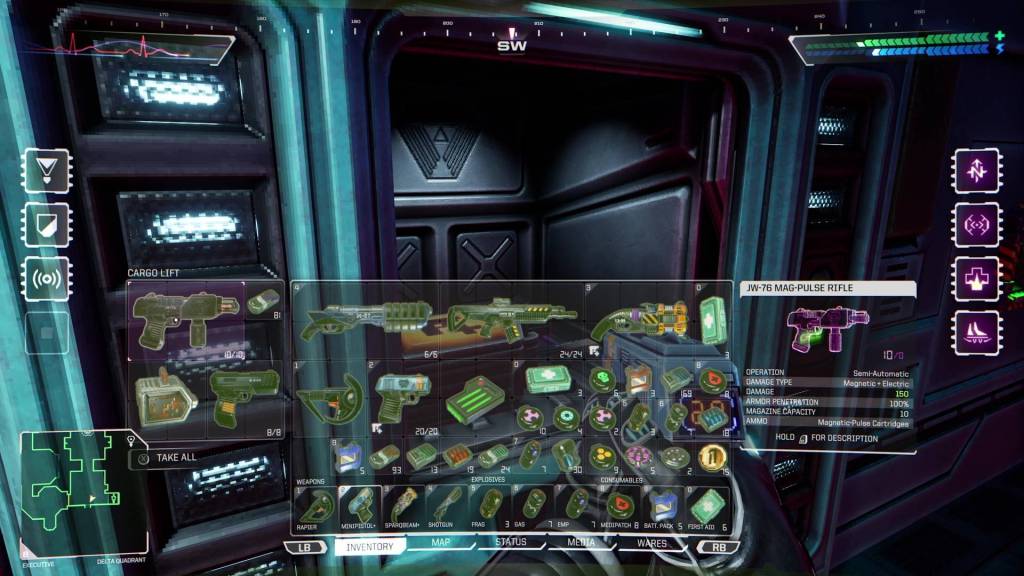
The more you explore, the more tools you’ll have at your disposable, but inventory management becomes essential.
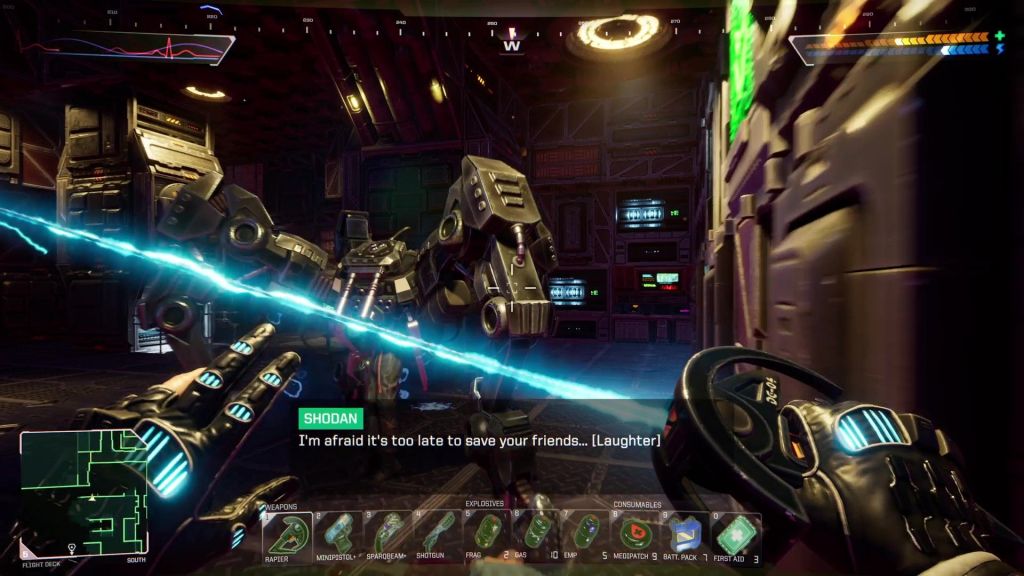
System Shock (2023) features a handful of mandatory boss fights and ambushes, but most can be subverted by finding alternate paths; engaging in some minor sequence-breaking using the upgraded jump boots; or simply burning through stockpiled ammunition and consumables to trivialise battles. An early boss encounter against a cyborg Diego can play out as a panicked firefight that has you scrambling to dodge plasma rounds and flee as he teleports in close with a laser rapier. Alternatively, you could apply a Reflex Reaction Aid to slow time, a Berserk Combat Booster to buff melee damage, charge in and finish him off with a flurry of your own laser rapier before he can even trigger his teleport.
The same flexibility applies to conspicuously empty rooms that scream: “ambush”. You could also bolster yourself with dermal patches in preparation for a slow-mo scrap, or you could fling disc-like proximity mines at every wall panel, engage your shield mod, and rush to the middle of the room to watch your foes disintegrate in a flurry of explosions around you.
Of course, with a limited inventory and storage options, the tools at your disposal are dependent on your willingness to explore, backtrack, and prepare. There’s almost always enough to get by – even within boss arenas if you survive long enough to find them – but cautious and systematic explorers are rewarded with early access to powerful weapons, mod and weapon upgrades, and no shortage of character-enhancing dermal patches and meds.
If you’re struggling with any of the mandatory boss fights, a laser rapier coupled with a Reflex Reaction Aid and Berserk Combat Booster will see you through every encounter aside from the last battle in cyberspace.
Wrapping up, I’d reiterate my argument that a good immersive sim should ensure players can always progress using the tools or mechanics provided, conventionally or otherwise; it should reward them for exploration, preparation, and planning; and punish them for thoughtlessness or scrappy execution. I’ve played far too many modern games that, while often technically impressive and mechanically polished, are so reliant on familiar and effortless gameplay – the idea that player friction should be minimised – that my brain switches off and I run on autopilot until the next set-piece or elaborate cutscenes regains my attention.
A good immersive sim may lack that scripted spectacle and controlled pacing, but I prefer games where the minute-to-minute gameplay – that essential “game” part of videogame – is consistently engaging and rewarding. If you feel the same, the immersive sim genre is well worth your attention and the System Shock (2023) remake is one of many excellent options available on console and PC.
With a wildly successfully sequel and extensive modding support for the original release, The Elder Scrolls IV: Oblivion Remastered falls in an unfortunate middle ground.
I’m part of an audience of existing fans happy to purchase another Elder Scrolls game several times over, no doubt thanks to a heady dose of nostalgia for time when we had the time to “live another life, in another world”. However, there’s a reason they went with “remastered” in the title instead of “remake”, and I feel your history with the game – if any – could have a significant impact on your experience.
Honestly, I’d have preferred The Elder Scrolls III: Morrowind received this level of attention, but there’s no denying Oblivion was instrumental in popularising the IP on consoles and it laid the foundations for the success of The Elder Scrolls V: Skyrim. Still, after 25 hours spent following the primary questline with a few diversions, it’s easy enough to recommend this remaster if you’re after a mostly vanilla Oblivion experience in 2025 (assuming you have the hardware to run it).
For newcomers or those who loved Skyrim but missed Oblivion for whatever reason, it’ll scratch a lot of familiar itches – so long as you can accept its fledgling mechanics and systems can feel underdeveloped and even more janky at times. For returning fans, it’ll depend on your tolerance for Oblivion’s most notable failing.
Sir Patrick Stewart only gets a handful of lines before his assassination. Remarkably, Sean Bean survives the entire game before meeting his fate.
For newcomers, The Elder Scrolls IV: Oblivion Remastered is, unsurprisingly, set during the “Oblivion Crisis” – an event often mentioned in Skyrim as the catalyst for the rise of the Third Aldmeri Dominion that would go on to fracture the Empire unified under the Septims.
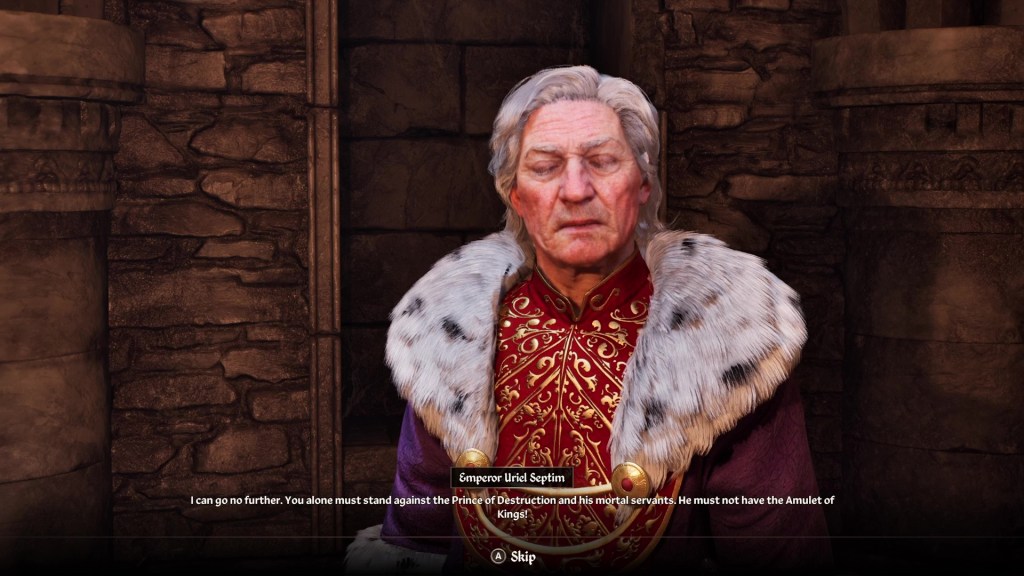
Your protagonist is another prisoner who finds themselves swept up in events and during a bland cave- and sewer-based tutorial, they witness the assassination of the emperor; they’re tasked with finding a hidden heir to the throne; and told to help him “close shut the jaws of Oblivion”.
Of course, this is an Elder Scrolls game so you can pursue those instructions with vigour or just ignore them for hundreds of hours if you wish. Almost two decades on, Oblivion still excels at what Bethesda Game Studios have always done well: presenting the player with a massive world to explore, packed with things to see and do, and the flexibility to tackle it in any way you choose – in theory.
You craft your would-be hero using a horrific selection of cosmetic options somehow worse than the original; you wade through innumerable tutorial screens; pick your starting class, major skills, and star sign; and finally emerge into the high fantasy-inspired heartland of the Empire, Cyrodill.
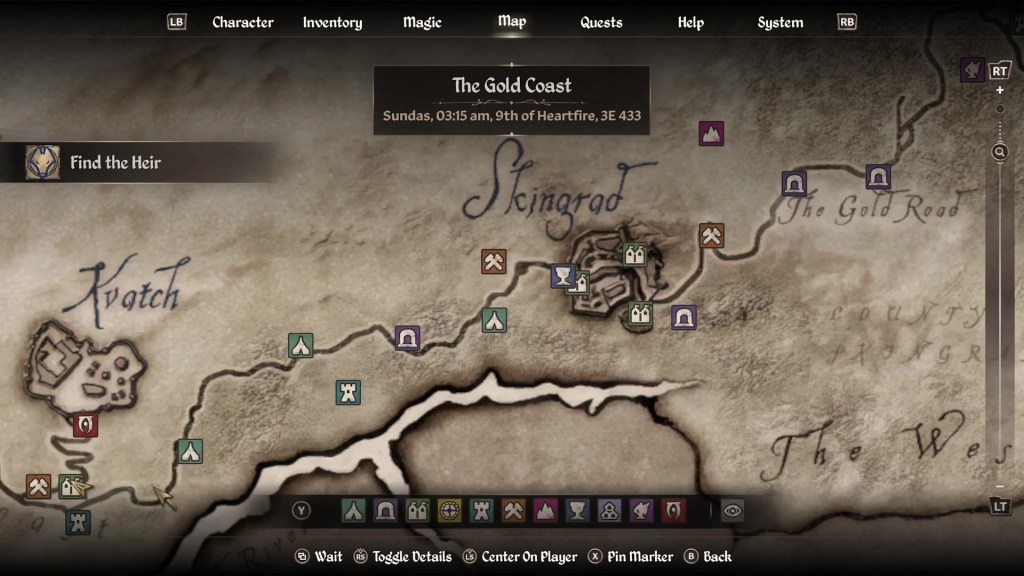
The primary quest points to a small priory to the north-west; the Imperial City looms over you; there’s a dank cave entrance or beautiful Ayleid ruin near at hand; and the map screen provides a half-dozen other cities you can instantly fast-travel to. It’s still a sensation as overwhelming as it is exhilarating even in 2025.
Even sticking to the critical story path, it’ll take you through all of the cities and past a ton dungeons to explore.
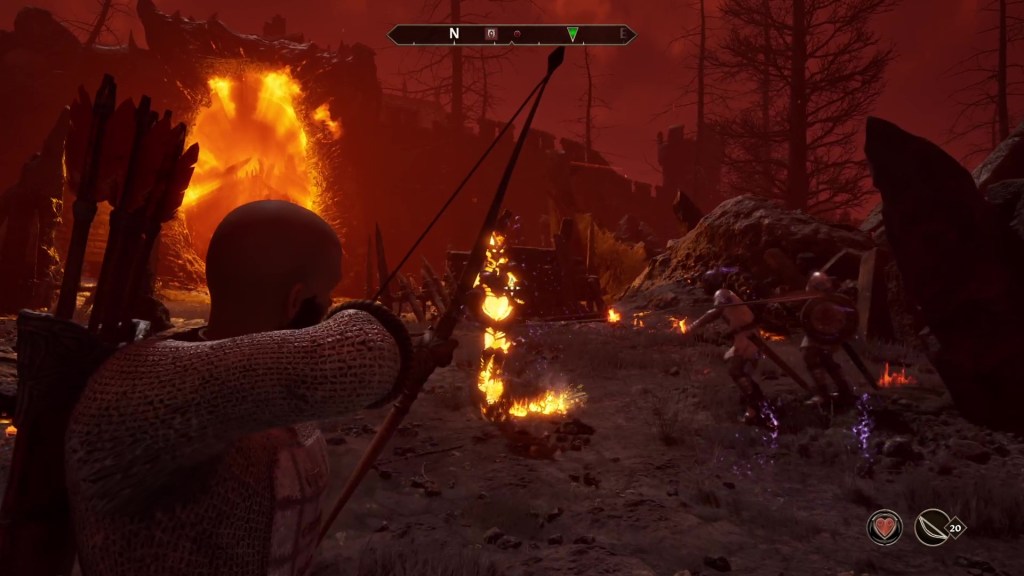
If you prioritise the primary quest, you’ll be knee-deep in cultists, Oblivion portals, and Daedra as you seek the last Septim heir and fight back against the schemes of Daedric Prince, Mehrunes Dagon. Alternatively, you can join and climb the ranks of the fighters, mage, or thieves guild – each dealing with nefarious plots to destabilise them from within and without.
You can seek out Daedric shrines to complete a mix of questionable and often hilarious quests to gain their favour and unique gear, or you can just travel from city to city, solving local problems that are sometimes exactly what they seem but often come with unexpected twists.
On paper, and for a dozen or so hours, Oblivion really sells that “live another life, in another world” premise. It’s also at its best when tackled organically. I’d neither recommend mainlining the primary quest, nor systematically clearing every location on the map. The end-of-the-world threat will happily wait on you and, attempting to do everything, everywhere, all at once, just highlights the AI routine limitations and dialogue inconsistencies.
If you just go with the flow – mixing up exploration and combat with persuasion challenges, thievery, and alchemy – it’s easy to get pleasantly side-tracked for hours at a time and better immerse yourself in a game world that, when studied too closely, is bizarrely dense yet underpopulated.
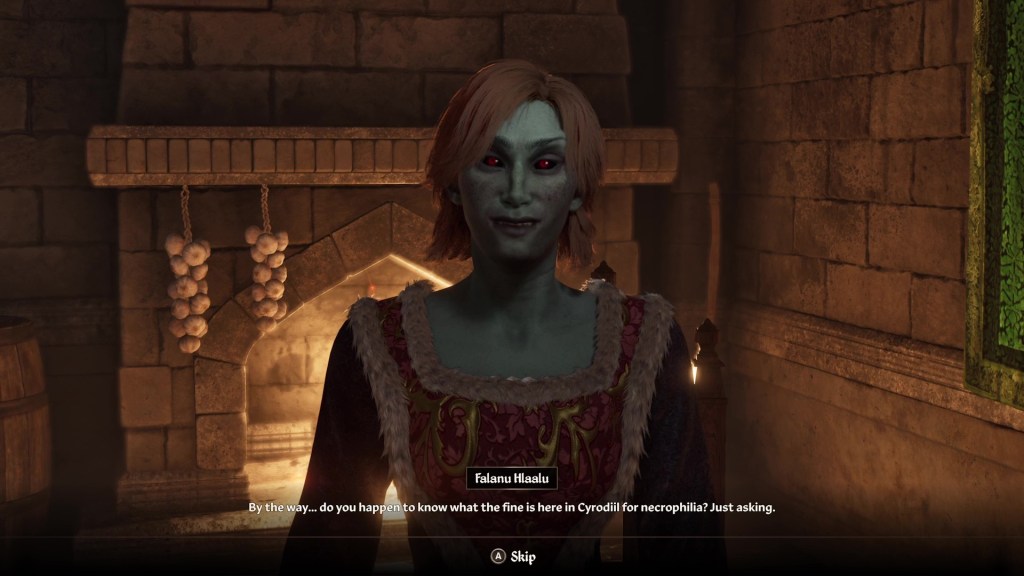
In retrospect, I don’t know what to make of The Elder Scrolls racial stereotypes but they certainly have some choice lines.
Of course, all open-world games face the same challenge: how do you keep players engaged while maintaining some semblance of pacing when you’re offering up a hundred hours’ worth of questing and dungeon-delving?
Oblivion’s answer was level-scaling. The idea being no matter what path you took, you’d face off against increasingly tough enemies with your upgraded skills, while looting higher-tier gear from their corpses or chests (with increasingly tough locks).
It was a noble but inherently flawed effort, and it remains an issue the remaster has lightly tweaked but not resolved. The obvious problem with this design is that level-scaling robs the player of any sense of meaningful progression for much of their playtime.
The need to balance player progression and the difficulty curve is always an issue in RPGs, but the modern approach is to reward over-levelled players with an easier time on the critical path, while still providing optional challenging content and the promise of greater rewards to keep them engaged.
In Oblivion, you’re constantly improving your skills through use, boosting attributes each time you level-up, and you’ll be looting or purchasing better gear and spells as you go; however, every combat encounter and dungeon-delve plays out much the same way for several dozen hours.
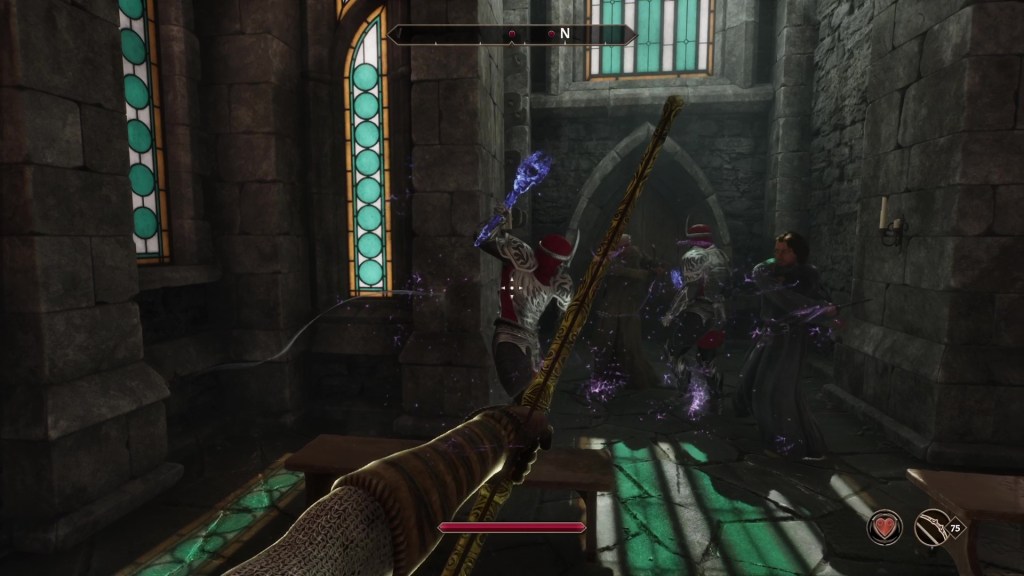
It’s a sensation compounded by the fact Oblivion is still more RPG than action game. You can stay mobile and block or dodge but combat ultimately boils down to hitting things with blades, arrows, or spells until they die. Progression is measured by how few hits it takes to kill something.
It’s only when you unlock the highest skill perks and access game-breaking enchantments – such as Chameleon-enchanted armour and paralysis-enchanted weapons – that it’ll satisfy the typical RPG power fantasy.
An epic battle alongside short-lived NPCs that sadly don’t benefit from the level-scaling system your enemies do.
It should also come as no surprise that level-scaling can play hell with quest design and what passes for rudimentary set-pieces.
Skyrim had its moments, but I feel most fans would agree the sense of exploration and the prospect of discovering something unique-ish was the main draw, not the quest design. Oblivion nails the first part, but you’ve got even simpler quest scripting, clunky set-pieces, and no traditional companions to liven things up
Quests are typically a variant of “go here”, “fetch this”, or “kill that”, with the most memorable boing those that offer multiple or unexpected outcomes. However, those are almost always standalone quests that will, at most, result in a different reward item or trigger a new generic line from townsfolk when you bring up the topic.
Oblivion is notable for introducing the “Radiant AI” system to give NPCs a simple daily routine that is significant to some quests, but it doesn’t take long to realise the bulk of scripting boils down to whether an NPC is in possession of an item, at a location, or flagged as dead.
Many of these basic quests are elevated by hilarious writing, goofy voice work, and plenty of animation jank, but the bulk of your time is spent away from settlements, scouring overlong, multi-zoned dungeons or Oblivion planes on your own.
Expendable NPC companions that feature if a handful of quests don’t benefit from level-scaling and die almost instantly if you’ve out-levelled them – either in battle or through sheer stupidity – leaving you alone once again to slog through hordes of enemies.
The only way to circumvent this is to exploit invulnerable plot-critical NPCs, dragging them along as silent but useful damage sponges without completing their respective quests.
Never waste the opportunity to drag plot-critical and immortal NPCs along as unofficial companions.
Although The Elder Scrolls IV: Oblivion Remastered does little to address the game’s fundamental flaw, it does include some significant gameplay tweaks to go along with the gorgeous Unreal Engine 5-powered visual overlay.
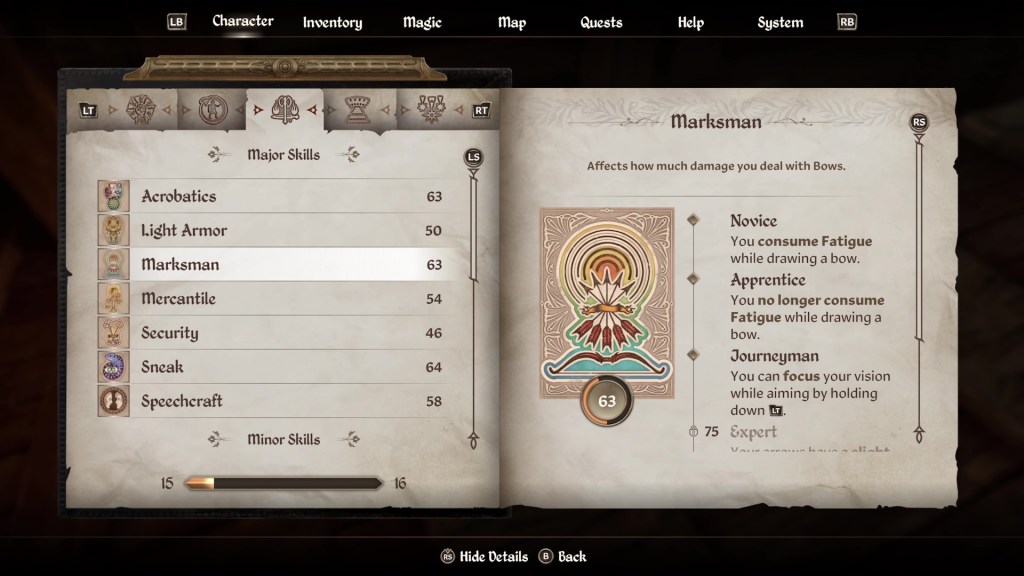
The most impactful changes are how both major and minor skill gains now contribute towards the player level, and which skills you improve no longer influence how many points you can boost attributes. You simply earn 12 “virtue points” each level, which you can invest across three attributes of your choice. You can still make your own bad levelling decisions, but as you retroactively gain health for strength and endurance boosts, it removes the likelihood of non-combat classes being one-shot at higher levels.
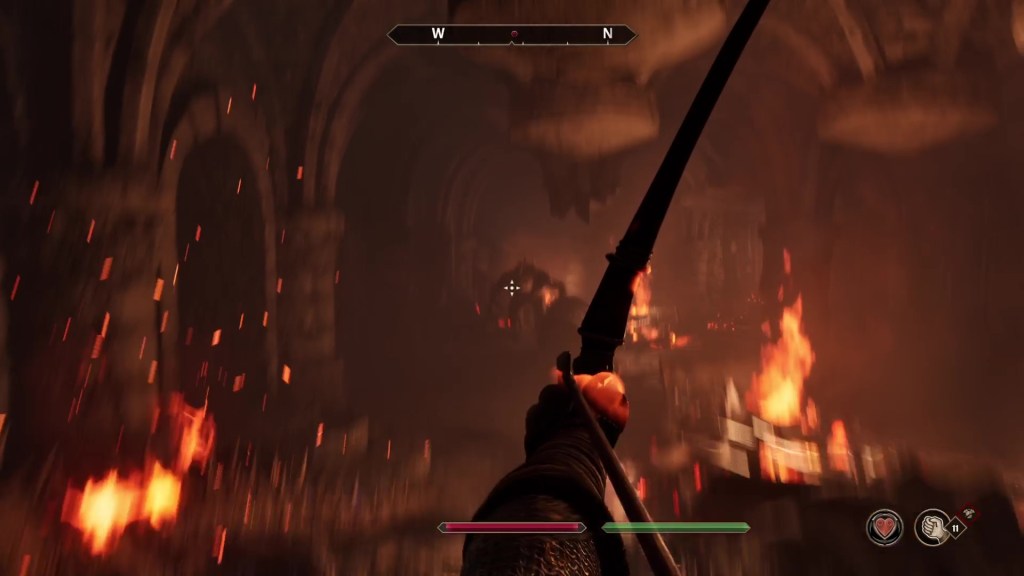
There is also a range of smaller but welcome changes, like more responsive menu-ing, increased movement speed and sprinting, health regeneration outside of combat, more reliable stagger animations based on where you aim, no fatigue penalty to attack damage, reliably recoverable arrows that both fly faster and hit harder, and tweaks to skill perk tiers – some new, some adjusted, and some just rearranged so you gain access to more useful ones earlier.
Despite these changes, old problems return when trying to boost combat-related skills if you realise you need a melee/ranged fallback, or maybe some elemental damage spells for resistant enemy types. The only sensible approach is to find and pay trainers, as low-level weapon skills and damage-dealing spells become laughably ineffective against higher level foes.
It’s been a long time since I’ve played the vanilla version of Oblivion, but tweaks to the levelling system do not feel like they drastically alter the experience.
I’ve got this far without praising the audiovisual enhancements and, for returning players, it’s an impressive overhaul that turns Oblivion’s distinctive but barren landscapes and interiors into something akin to a modern release.
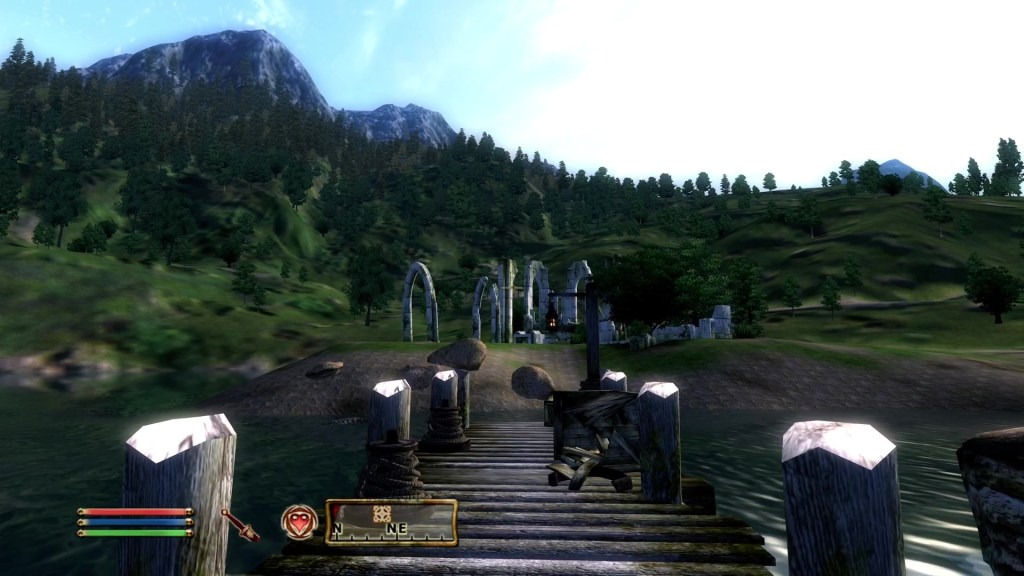
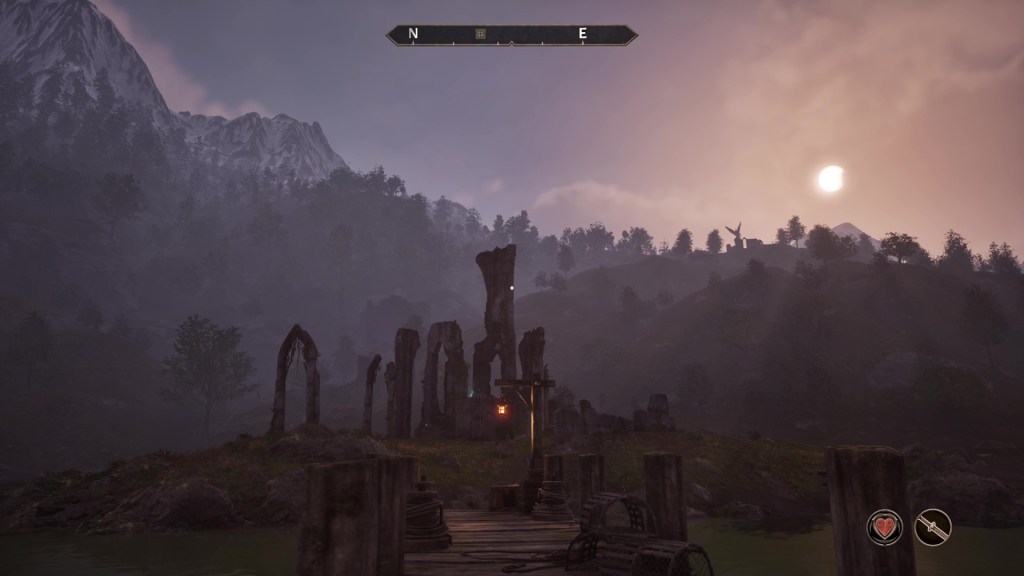
Geometric complexity, textures, vegetation, water, weather, environmental details, character models, movement and attack animations, lip-syncing and facial expressions – they all take a generational leap in quality, albeit not always a consistent leap.
I’d argue the global illumination system for the sun, moon, and other light sources feels most transformative, bathing the world in more realistic and atmospheric shades of light and dark. Oblivion always did creepy interiors well, and they feel even more terrifying this time round.
The Elder Scrolls IV: Oblivion Remastered touches up the voice work without changing the weird, wild, and openly prejudiced (in-universe) dialogue, something most notable during hilarious NPC interactions driven by the Radiant AI system. These exchanges rarely have logical replies or a consistent tone, yet the system excels at antagonistic conversations between NPCs of difference races and class (in the socioeconomic sense). There’s also limited new voice acting to better differentiate Tamriel’s many races, while some NPCs that previously had multiple voice actor lines assigned to them have been fixed.
Combat audio effects and ambience have been added to improve combat and exploration respectively, though volume levels can feel off compared to the original. In contrast, the soundtrack needed no tweaking as it still holds up brilliantly, providing memorable orchestral themes for any scenario.
Emerging from the tutorial sewers in the backwards-compatible Xbox 360 version of Oblivion (which at least holds 60fps).Emerging from the tutorial sewers in Oblivion Remastered played on an Xbox Series X.
All that said, the gameplay tweaks and audiovisual updates can only do so much when the aged Gamebryo engine is presumably chugging away just below the surface.
The increasingly repetitive nature of Cyrodiil’s overworld and dungeons is hardest to disguise, particularly when maybe two dozen quest-related locations feel truly unique in appearance or design (and The Shivering Isles expansion accounts for much of this).
Every asset used to build the world has clearly been overhauled in The Elder Scrolls IV: Oblivion Remastered, but it’s not clear if any new assets were created. The bulk of Cyrodiil is still rolling, forested hills, while the “dungeons” are crafted using just a handful of tile-sets – think cave, mine, ruin, fort, city, and Oblivion plane – each with a limited number of building blocks. The world also retains its segmented nature, with dungeons, cities, the structures within them, and even each floor of some structures connected by loading screens.
You could argue Oblivion’s dungeons are typically larger and more elaborate than Skyrim’s convenient loops, but very few have memorable puzzle rooms, unique vistas, or anything close to the epic scope of the Blackreach Cavern. It becomes a serious problem when there are well over 200 dungeons to explore and, depending on your approach to the tackling the main quest, up to 50 Oblivion portals that can spawn.
Is all this content mandatory? No, but even sticking to the primary questline left me frustrated with the degree of repetition in this replay.
Many interior locations now look stunning thanks to the overhauled visuals and lighting – though it doesn’t take long ot recognise the same rooms and hallways.
Returning to my opening line, it leaves The Elder Scrolls IV: Oblivion Remastered in a weird place. Given the response, it feels like a project targeting fans of the original – yet it retains many flaws that’ll quickly frustrate those fans. The visual overhaul and gameplay tweaks are an improvement – and there’s no denying the power of nostalgia – but it’s unlikely these remastering efforts would push me to complete it again over a modded version of the original.
With that said, I feel it’s newcomers to the IP or curious Skyrim fans that might benefit the most from this release, as they’ll find it easier to look past Oblivion’s flaws as they experience the wonder of simply exploring Cyrodiil’s cities, countryside, and dungeons for the first time.
Crow Country is an incredible homage to classic survival-horror from the 32-bit era – think Resident Evil and Silent Hill – but it’s also one of the most charming games I can think of in the genre, and a near-perfect fit for the Nintendo Switch as a result. It’s suitably creepy and tense at times, but also accessible, humorous, and often heartfelt. It’s got resource management elements and revels in the illogical puzzle design so prevalent in the genre, but it could easily serve as an entry point into classic survival-horror for new or younger players.
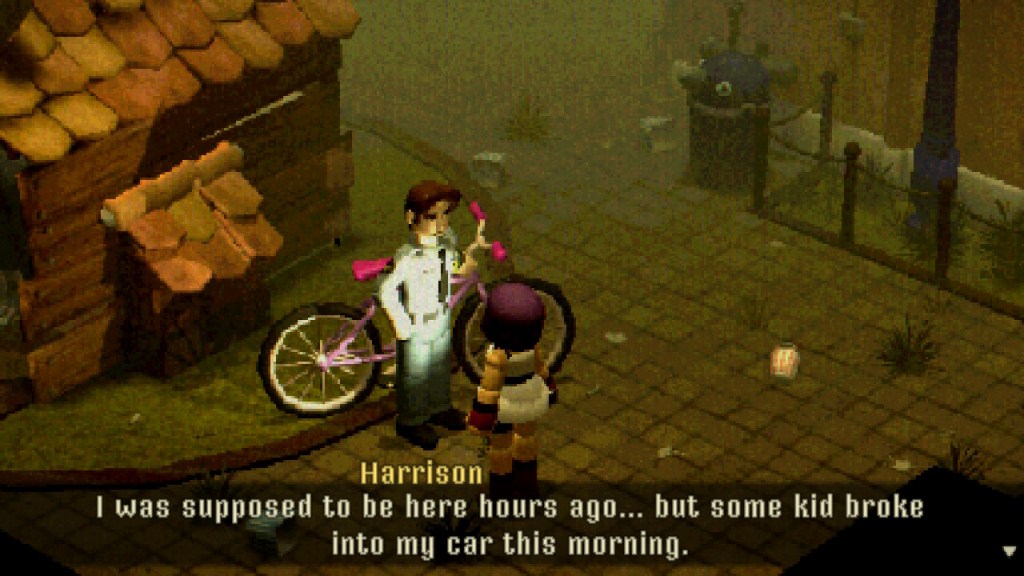
The highlight for me is the fantastic air of mystery about it. The protagonist – supposedly “Special Agent Mara Forest” – clearly knows far more then she’s willing reveal to others, and constantly slips up in conversation with others or when making observations about what she sees around her.
She arrives at the shuttered Crow Country amusement park, two years after an incident led to its closure, only to find its rundown attractions still occupied by shambling, vaguely humanoid creatures, several evasive former staff members, and other interested parties, all converging on the same evening.
Like any good horror game, Crow Country leaves the player feeling confused and vulnerable at first, but as Mara solves more puzzles, opens up new areas, interacts with survivors, and night falls, she slowly unravels an admittedly weird sci-fi-ish conspiracy and discovers the motivations of the former staff and the owner she’s desperate to find – Edward Crow.
As Mara uncovers the truth, observant players can also piece together clues from several notes and Mara’s conversations to figure out who she really is and why she’s there long before the story tells you outright. It’s not then most surprising reveal, sure, but the narrative moves at a brisk pace and never feels secondary to the gameplay.
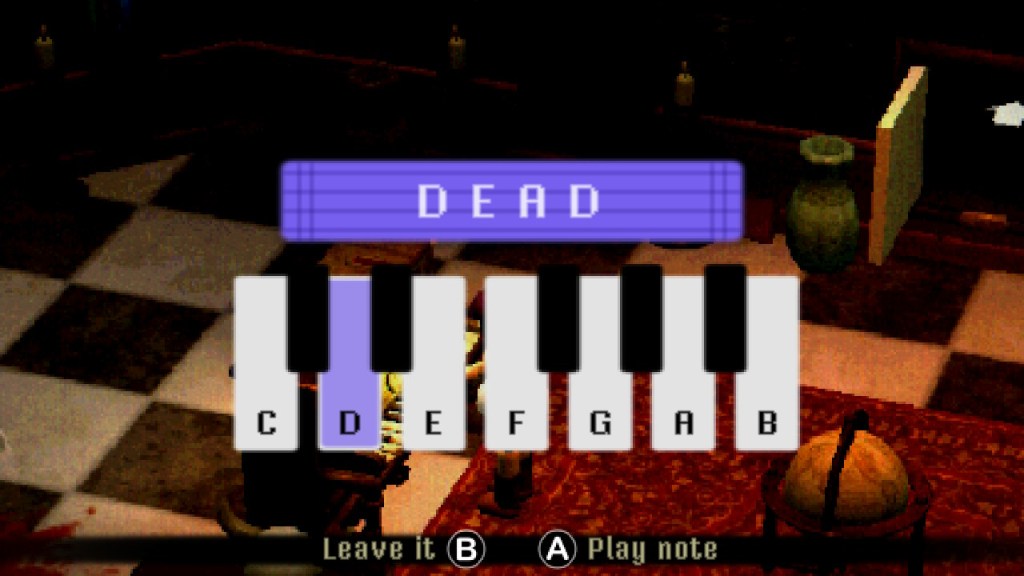
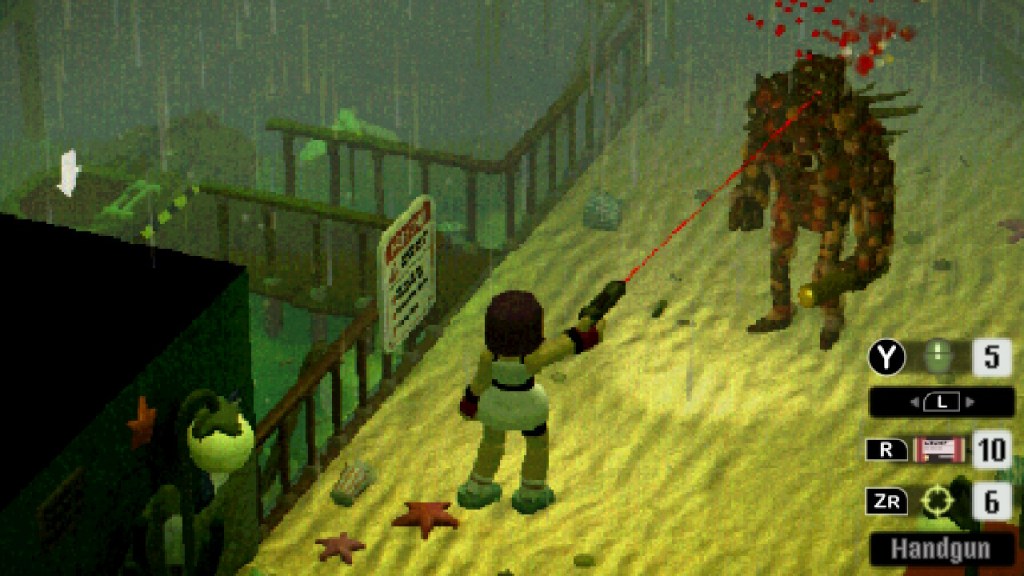
How you traverse the small but dense environments, solve puzzles, and survive will feel comfortingly familiar to survival-horror fans. You’ll explore an expanding and evolving map room-by-room; you’re locked in place to shoot using a laser pointer; you can run past shambling foes; hoover up ammunition, grenades, med-kits, and antidotes; solve puzzles and complete mini-games to find key items or secrets (like powerful weapons and upgrades for them); and soak in the wonderfully detailed, retro-styled environments complemented by creepy ambience and music. My only real criticism of Crow Country is that the gameplay offers few surprises to veterans of the genre.
Crow Country’s 5-ish hour playtime works in its favour here, as the combat is limited but never frustrating, the puzzles and mini-games always entertaining, and secrets are abundant. If you dislike the sluggish combat, you can avoid everything but the final boss if you’re nimble. Crow Country has a curious twist on the traditional survival-horror formula, as despite new “guests”, traps, and even boobytrapped items appearing as the night progresses, the horror elements diminish over time.
There are some dark and tragic moments, but it was hard not to get behind Mara’s dogged determination, fearlessness, and fondness for awkward jokes. I soon found myself less interested in hoarding resources and purging every room, and instead fixated on unravelling the true nature of the park and Mara’s connection to it.
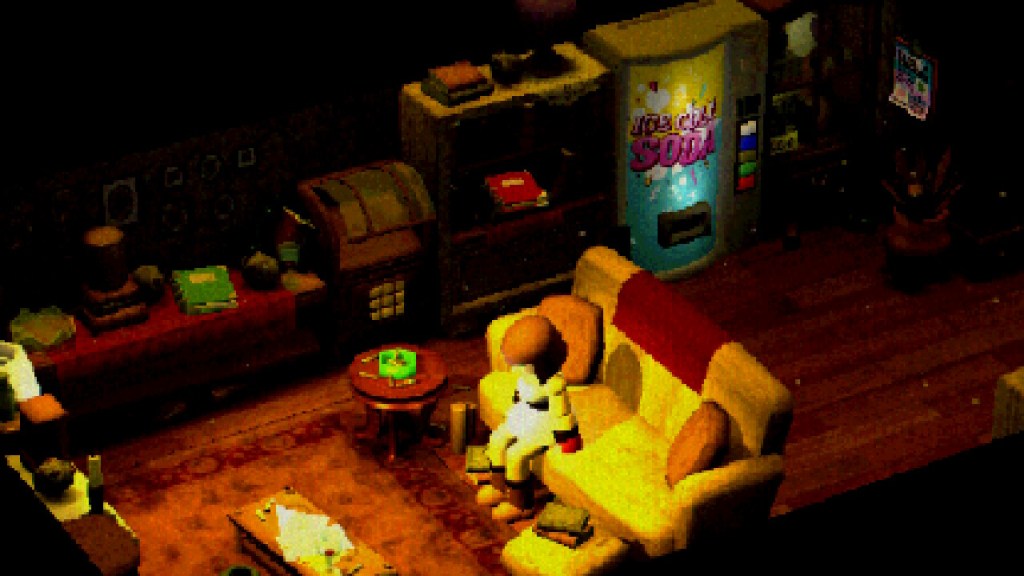
For those who value an entertaining story and good narrative pacing above survival mechanics, Crow Country also offers a ton of smart assists to avoid aimless backtracking. The map highlights unsolved puzzle locations or points of interest, and fortune teller machine can offer hints. Shortcuts and save rooms (with soothing music, of course) are smartly placed, and there’s no inventory limit or item boxes – just a maximum amount of ammunition and healing items you can carry at any given time. If you run low on supplies, returning to Mara’s car, rumaging through a trash can, or kicking a vending machine will likely spit out a box of handgun bullets or small med-kit.
Even the ranking system rewards playing it safe as it doesn’t consider total playtime or number of saves. There’s also an “Exploration” mode that disable enemies completely, or a “Murder of Crows” mode for those who want a tougher challenge with most assists disabled or limited.
Better still, irrespective of whether you’re playing it docked or in handheld mode, Crow Country looks great (especially on an OLED display), sounds great, and runs smoothly on the Nintendo Switch. The only notable difference from the next-gen console versions is that larger rooms can take a few more seconds longer to load.
I called it a homage, but perhaps the most novel thing about Crow Country is that it’s a rare example of “cosy” survival horror. The sort of game perfect for playing cozied up under blanket – on the couch or in bed – despite the horror-focused nature of the genre.
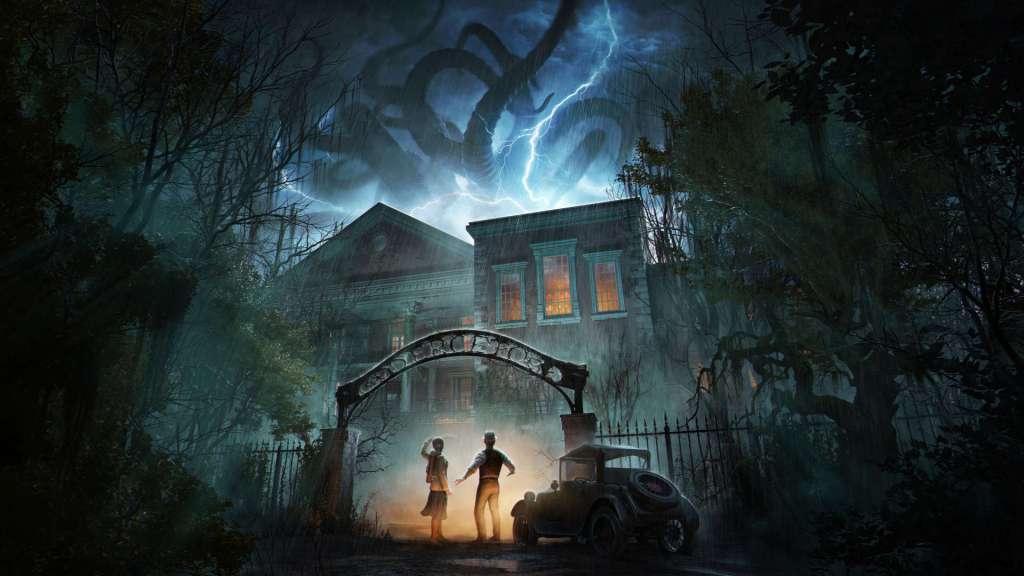
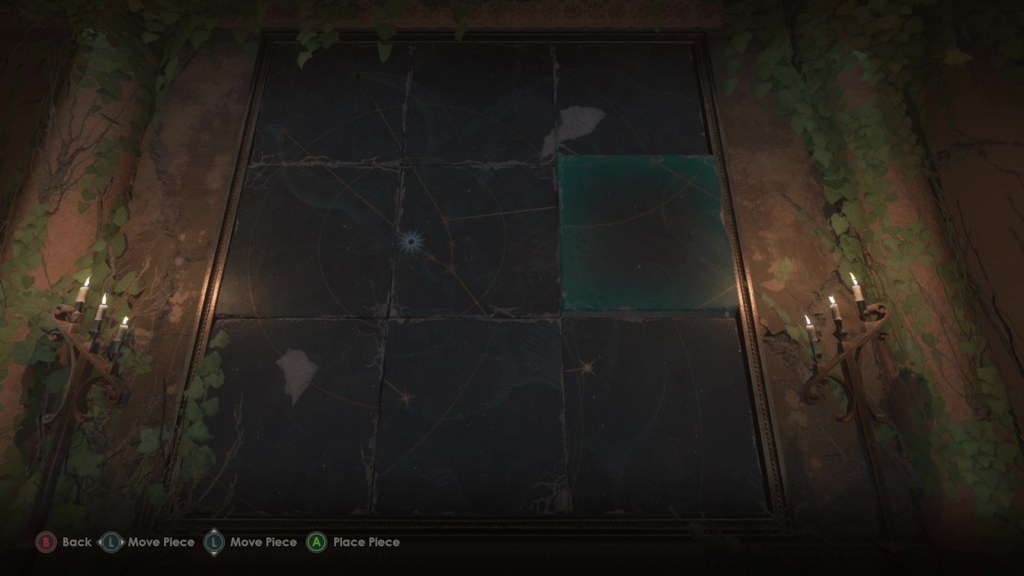
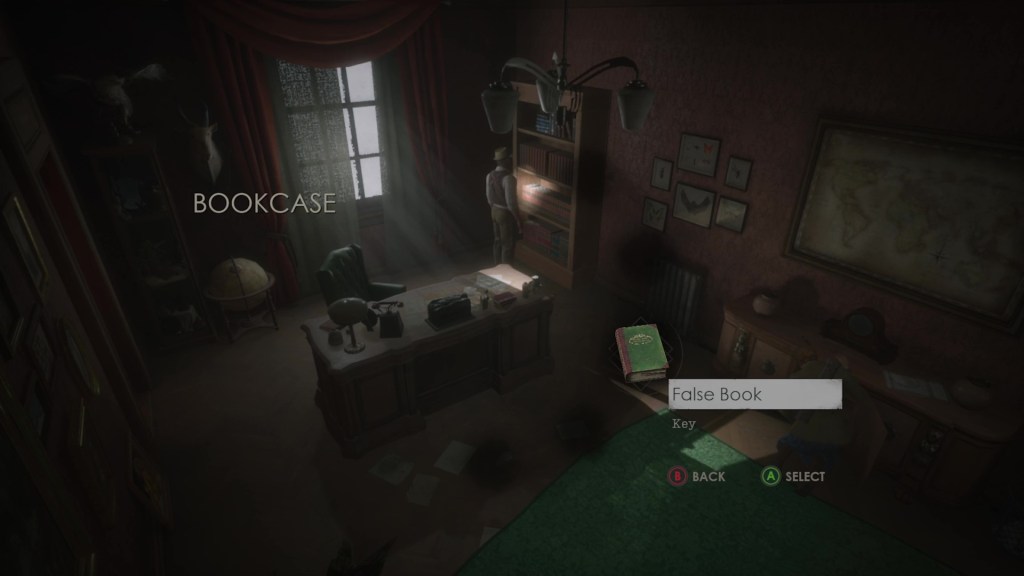
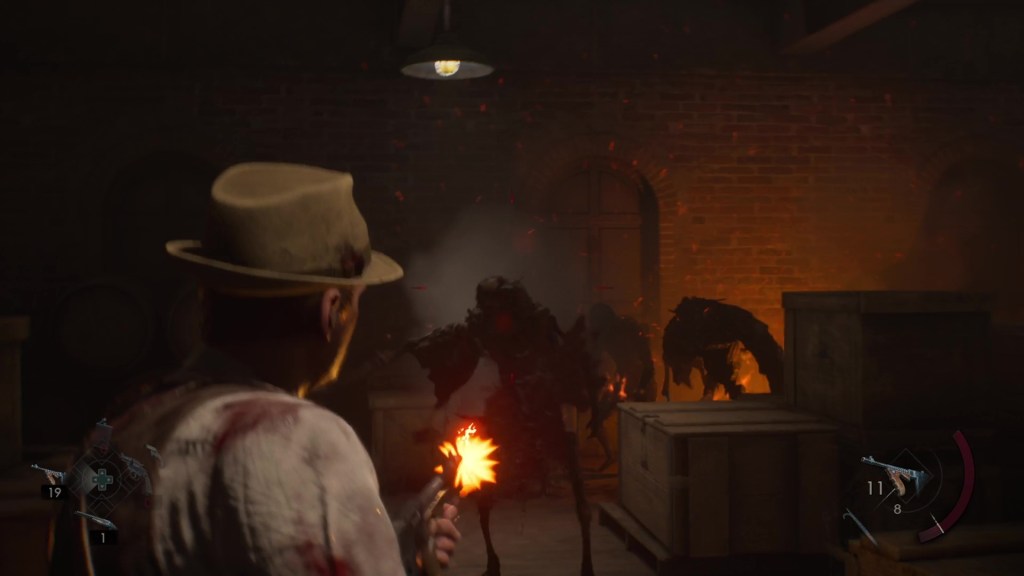
Alone in the Dark (2024) is not some underappreciated masterpiece, but it is a smart and competently designed reimagining of the influential 1993 original. It plays as a third-person adventure – taking the same approach as Capcom’s Resident Evil 2 and 3 remakes – and transforms a terribly-aged classic into something that straddles the line between narrative-driven, puzzle-oriented “walking sim” and traditional survival-horror: think limited resources, weapon durability, gruesome monsters, and puzzling your through a sprawling mansion full of unorthodox locks.
Entering a market dominated by recognisable IP it once inspired, replicating the success of recent titles like the Resident Evil 4 remake or Alan Wake 2 was unlikely; however, as a “AA”-style game priced accordingly, it sure as hell didn’t deserve to do so badly the developer Pieces Interactive was shut down a month after its launch.
Like so many mid-tier and high-profile indie games released over the last decade, Alone in the Dark (2024) committed the unforgivable crime of just being good, rather than critically acclaimed; more often than not a death sentence for IP and sometimes developers in a modern video game market seemingly desperate to gorge itself to death on a never-changing buffet. Yes, the combat is clunky, but I’d argue every other element is good to great.
The storytelling, the cast, the puzzles, and the thick atmosphere generated by the impressive visuals, ambience, and period-appropriate soundtrack; these are all essential components of a narrative-heavy horror game that takes you far beyond the walls of the Decerto manor. Even the voice work – criticised by those I’ll wager have not played beyond the opening chapter – is a great fit for the protagonists as they begin to question their own sanity and struggle with past trauma. When you throw in accessible gameplay mechanics, brisk narrative pacing, two playable characters with unique encounters, and multiple endings, Alone in the Dark (2024) gets far more right than wrong.
Unfortunately, that means little in 2024, when talent and quality seem less important than the cosmic alignment of effective marketing, a quiet release period, and luck if a game wants to stand out in a marketplace that’s saturated, risk-averse, and increasingly dominated by the same established IP we’ve seen for decades.
It’s a shame too that so many reviewers and commentators casually dismiss games like Alone in the Dark (2024) as “not good enough” in contrast to its “AAA” peers, as survival-horror fans are going to deprive themselves of one of the more interesting and stylishly told narratives in the genre. As a remake of sorts, Alone in the Dark (2024) obviously draws on concepts from the original, with ideas from Lovecraft novels and cliches you’d expect from a 1920’s period piece, but it weaves them into a briskly paced narrative with plenty of reveals, red herrings, twists, scares, and cinematic flair.
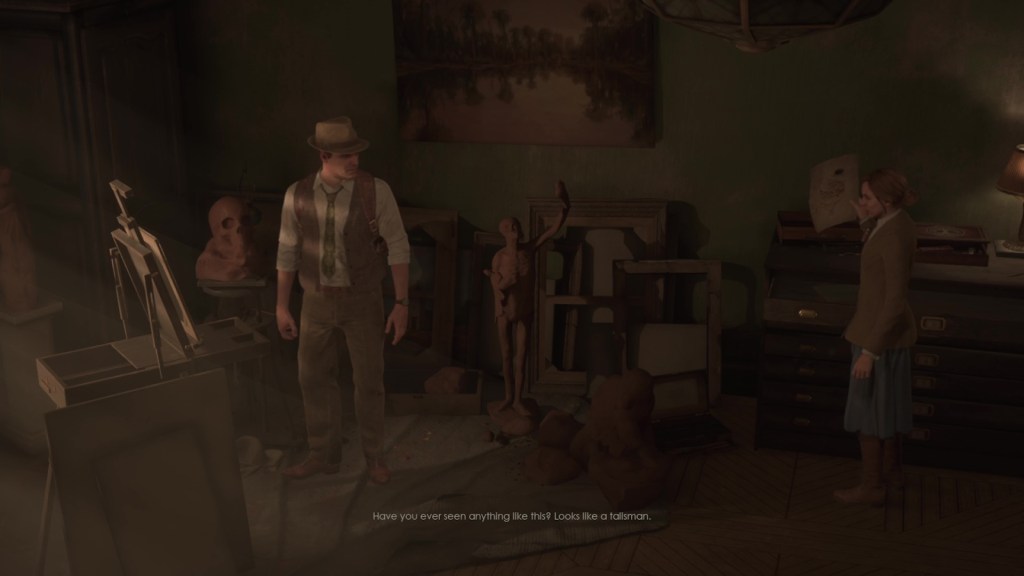
Aristocrat Emily Hartwood and grizzled PI Edward Carnby arrive at Decerto Manor looking for her eccentric uncle, who sent a confused letter about a “Dark Man” haunting him and staff engaged in occult rituals. Unlike the original – in which he’s already dead and the abandoned manor is filled with an assortment of creatures and spirits – the remake is set in a dilapidated mental health retreat run by the condescending Dr. Grey and his evasive staff.
Jeremy Hartwood has gone missing, some of the patients and staff have died or disappeared under mysterious circumstances, and yet those who remain only seem interested in preparing for a yearly ritual that supposedly has Louisiana Voodoo roots. After skulking through the creepy manor and encountering a few callbacks to the original, a search of Jeremy’s room reveals the designs for a mysterious talisman, before the protagonist you chose is pulled into a nightmarish version of the New Orleans French Quarter based on Jeremy’s twisted memories and wild imagination.
It’s a slow but unsettling opening that suddenly changes pace and throws you in the deep end, setting the stage for how subsequent chapters will play out as you explore every inch of the manor and increasingly fantastical and often beautiful dreamscapes. The dual-protagonist setup is designed for replays, despite functioning more like the original Resident Evil than Resident Evil 2’s connected A/B scenarios. There is plenty of overlap when it comes to puzzles and progression, but the focus of the story changes and, until the default finale, you’re always left wondering if anything they experience is real.
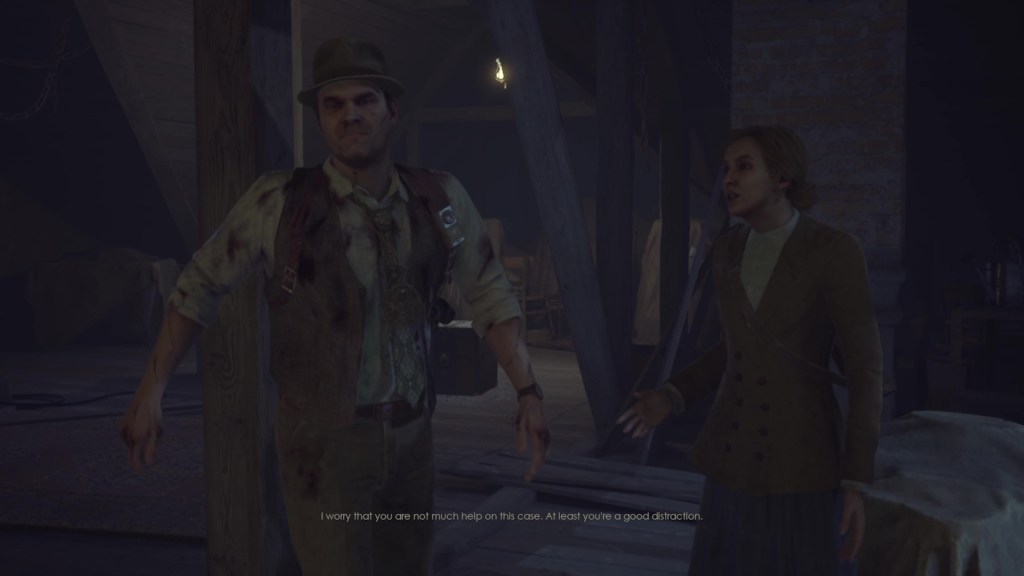
Emily sinks into melancholy as she deals with Dr. Grey’s insinuations and tries to discover if the “Dark Man” man haunting her uncle is an actual curse, or just the manifestation of her family’s mental health history. In contrast, Carnby spends more time investigating the cult-like activities of the staff, while becoming increasingly manic in his attempt to save Jeremy from an occult contract – seemingly to make up for past failings.
During the opening chapters, with identical puzzles and combat scenarios, the differences between the Emily and Carnby feel limited to when and where they encounter the secondary cast, and the nature of their interactions influenced by their personality, gender, and history. Whoever you’re not playing as becomes a foil for the lead, seemingly oblivious to the supernatural elements and often a source of humour when their paths converge. The second of five chapters gives you a little freedom as to the path you take through the manor, but the payoff is the lengthy fourth chapter that lets you tackle three objectives in any order and features a unique section for each protagonist that delves into their suppressed memories.
If you want to get the full picture – or one of three secret endings based on collectibles and optional interactions – two playthroughs are essential, and all the more enjoyable thanks to a new-game-plus update that adds in new encounters and some unexpected scares.
What I’m getting at is don’t leave games like Alone in the Dark (2024) languishing in the dark if you’re a fan of the genre – just because some circle-jerk internet chorus believes video games are worth little unless they attain a poorly-defined and often inconsistent “critically acclaimed” status. If this sort of hit-or-fail-terribly mentality continues, we’ll end up in an era of high-production value, low-risk, “AAA” homogeneity – a feat many large publishers have already attained with their remarkably expensive, polished, and heavily-marketed releases that are forgotten within a month. There’s still plenty of value in lower-budget and appropriately priced games that are just good, or hell, just interesting, especially when the quality of entertainment is so subjective anyway.
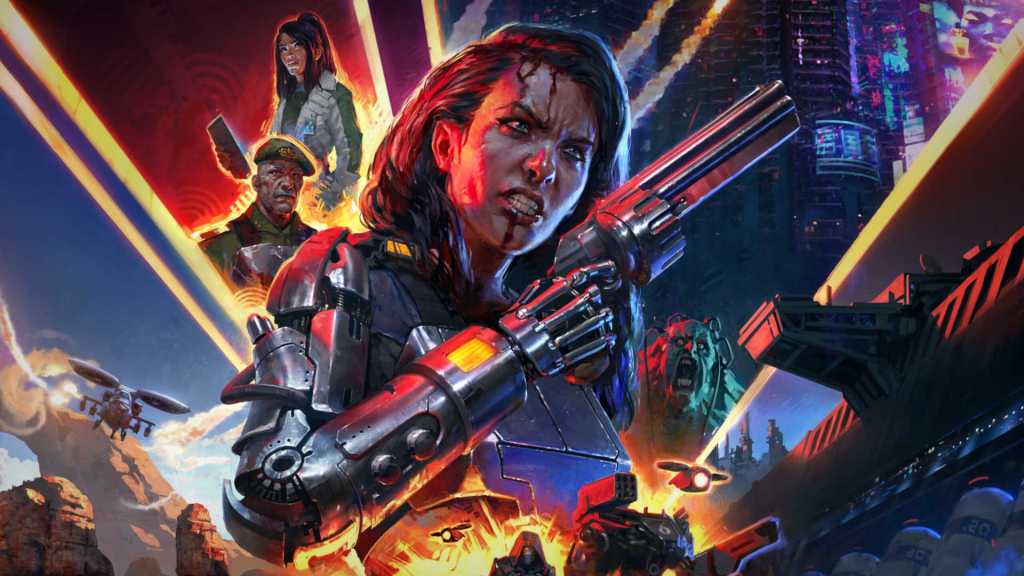
Phantom Fury requires several hours of patience before it starts to shine – and even then, you’ll have to endure a considerable degree of jank and inconsistent quality throughout. In an era where competition is fierce and patience non-existent, it received middling reviews and predominantly negative user scores. Perhaps more annoying for the fans of the genre, Phantom Fury was yet another retro-inspired shooter published under Gearbox, which must have suffered from a turbulent development cycle. It’s got plenty of B-movie charm, solid shooting, and some standout level design, but these moments are interspersed with clunky or dull sections, often designed to highlight derivative and undercooked mechanics that ultimately dilute the experience rather than enhance it.
Phantom Fury serves as a sequel to 2019’s Ion Fury and a prequel to 2016’s Bombshell which first introduced bomb disposal expert Shelly Harrison. It features all the cliched villainy you’d expect, with power-hungry military men, unethical scientists, no shortage of betrayals, and plenty of cringeworthy one-liners. It dips briefly into Shelly’s past to flesh out her character, and it even features a cameo from John Blade – protagonist of 1998’s Sin – who gifts you his iconic magnum for the finale. That said, it’s not a game you should play for the plot as, at best, it provides a barely coherent excuse to push you from level to level and provide some justification for Shelly’s vendetta.
Unlike Ion Fury – which used a modified version of the Build Engine that powered its inspiration, Duke Nukem – Phantom Fury emulates classic 3D shooters, such as Quake II, Half-life, and Sin, using an Unreal Engine 4 build that’ll look and feel familiar if you’ve played Graven. Rather than blisteringly fast movement, snappy shooting, coloured key hunts, and gory sprite-work, Phantom Fury is a more grounded 3D FPS, with greater verticality, more physics objects, more complex set-pieces, and chunkier gore – but also an identity crisis.
The opening level provides a hint of what’s to come, as you’re forced to read emails for codes, manipulate devices using terminals, stack crates, sneak through vents, and enter “0451” on a keypad to progress – all while being bombarded with updates to your mission log. It’s not bad in and of itself, and I’d argue a game like Graven benefitted from exploration, puzzling, and secret-hunting that was more enjoyable than the combat ever was. My issue is that Phantom Fury could stand on its own two feet as a pure FPS. It offers a diverse and situational arsenal, and plenty of mid- to late-game encounters that’ll test your mobility, tactics, and aim.
However, the first third seems unfocused, happy to funnel you between bland corridor firefights against a small and familiar roster of enemy archetypes, frequently interspersed with gimmicky and janky set-pieces. The early game also saddles you with just a basic pistol, a pitifully weak pump shotgun, and the iconic Loverboy revolver that is still powerful, but also less reliable at locking on to enemies for a double-tap. To rub salt in the wound, my settings would often reset when loading a save, the weapon-wheel could stop working until I paused and un-paused the game, and rare hard crashes had a nasty habit of happening right at the end of gruelling battles or boss fights.
Yet despite those issues, by the time I entered the White Sands laboratory near the 3-hour mark, with nearly half the arsenal unlocked, Phantom Fury was starting to feel more like the iconic 3D shooters it wants to emulate. It pushed me to keep mobile, prioritise targets, constantly swap to the most effective tool for the job, and hoover up health and ammo pick-ups amidst the chaos.
The degree of interactivity in the game world felt less like puzzle-based roadblocks, and more integral to the combat experience. Exploding barrels and steam vents sent enemies flying; the crates and walls I used for cover could crumble under fire; while in the background glass and props shattered, alarms went off showering the area in water or smoke, and soundtrack ramped up and down in sync with the action. Holding objects as shields or flinging them as weapons never felt reliable, but Shelly’s bionic arm allowed me to punch melee enemies into gibs or briefly block incoming fire as I got close with the triple-barrelled Motherflakker shotgun in hand.
It was also around that point the level and encounter design began to feel a little more refined, consistent, and polished. Phantom Fury follows the traditional design of tight corridors leading into open arenas, but each level felt more interconnected and made better use of 3D space. You would emerge above or below areas you fought through earlier, open up smart shortcuts back after completing a sub-objective, while a greater variety of enemy archetypes would limit your ability to hunker down behind corners.
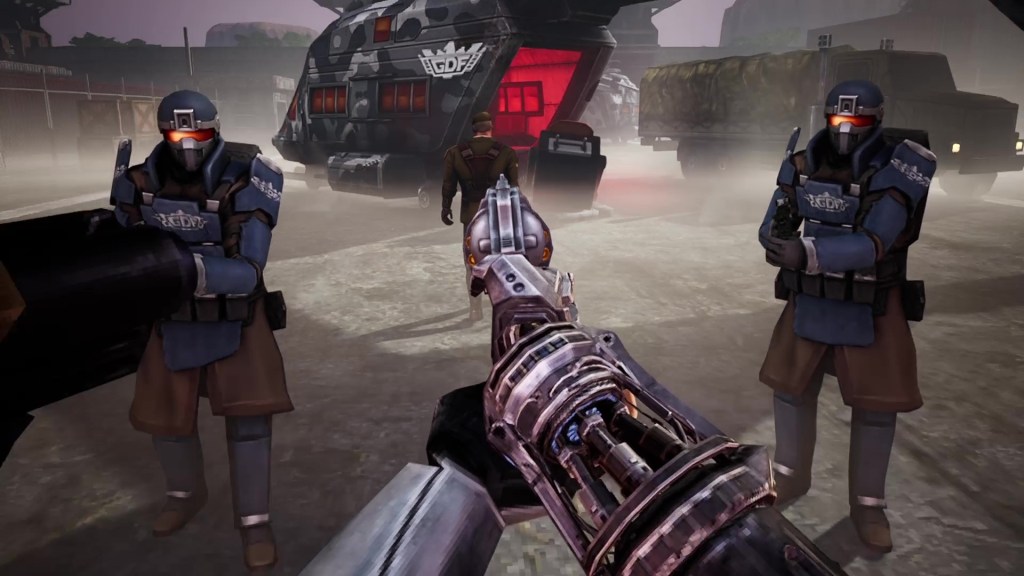
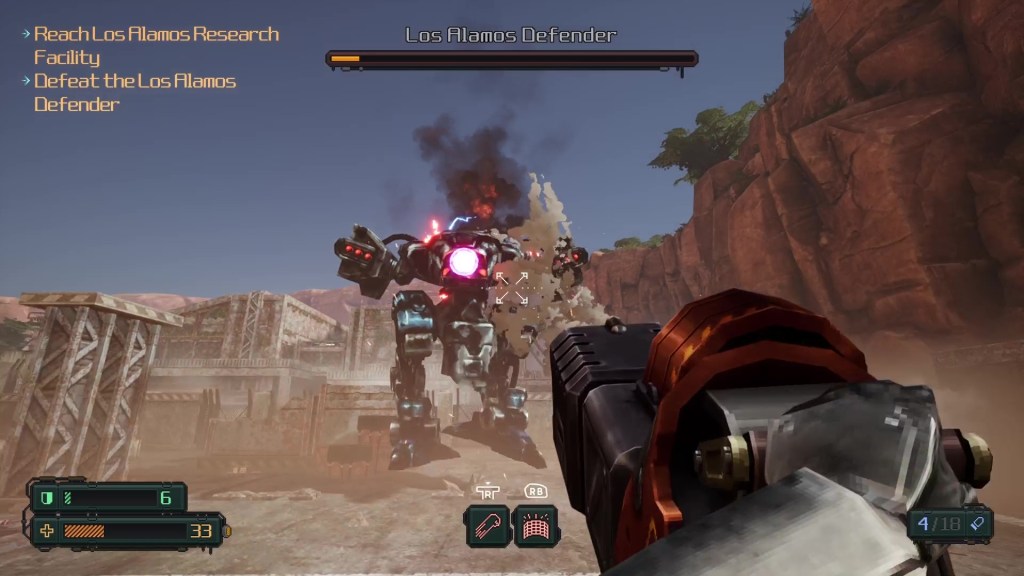
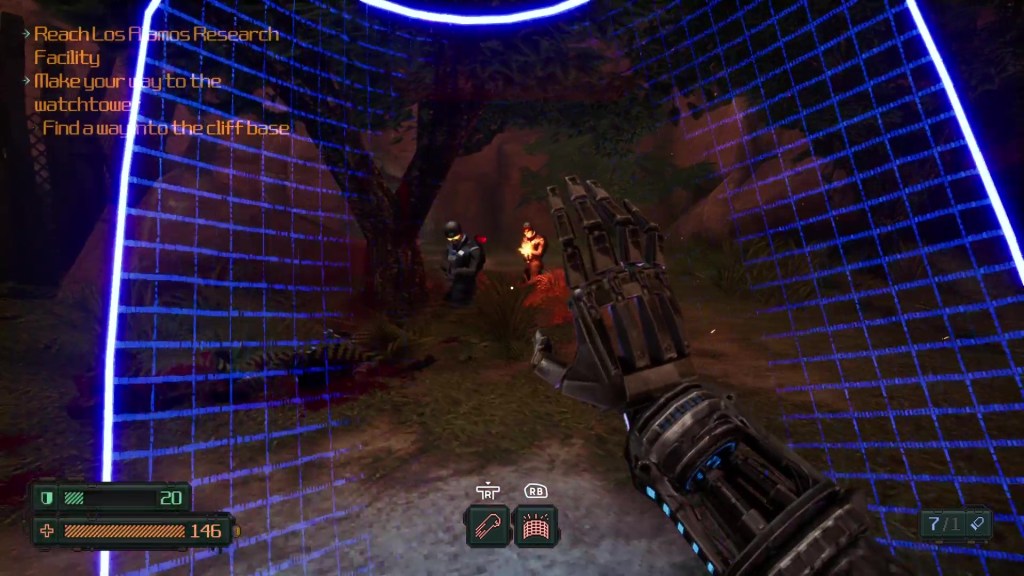
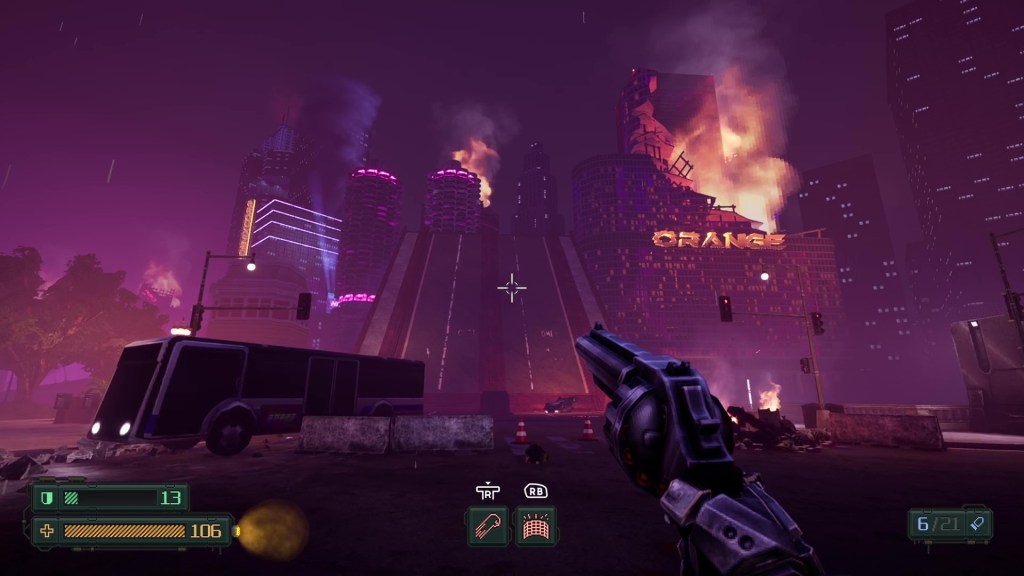
Standout examples include the aforementioned “Buried Lab” that takes inspiration from Half-life’s “Blast Pit”, as you work your way around a central chamber reactivating a locked-down facility, dealing with rogue GDF forces and escaped mutants. After that came the “Train to Flagstaff” level, which sees you battling through claustrophobic carriages, before fighting your way back across the top of the train and fending off a helicopter. The “Grand Canyon Facility” is another interconnected laboratory level with some great vistas, while the “Los Alamos” levels begin with an outdoor rampage and giant mech battle, before completely shifting gear as you explore a creepy abandoned facility, juggling power distribution to access new areas and fending off mutants in the dark. The game culminates with running battles through the ruined streets of Chicago, a scrappy firefight up a skyscraper, and multi-phase rooftop boss battles.
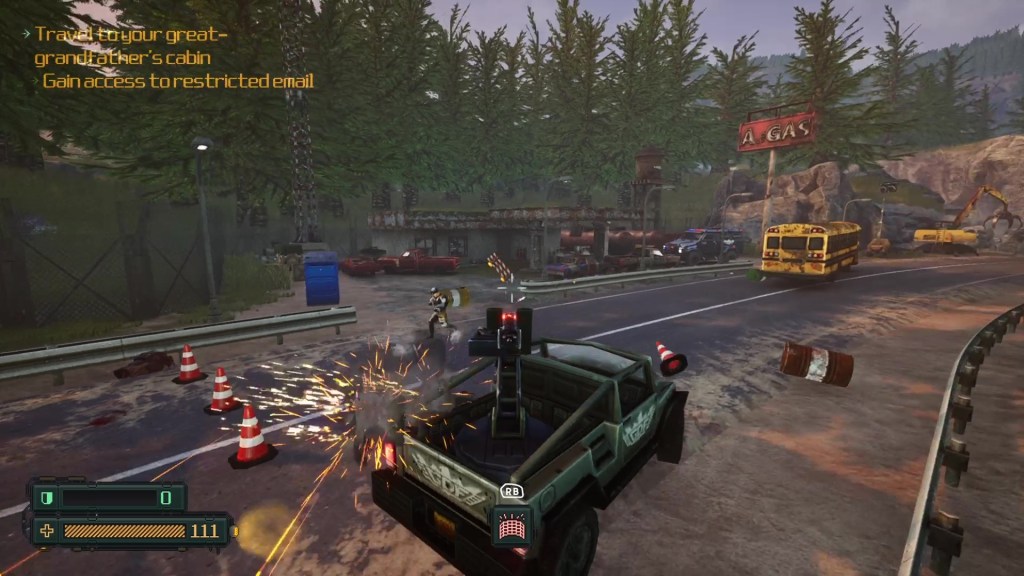
Unfortunately, Phantom Fury’s is also described as a “road movie adventure”, which means vehicle sections that range from mediocre to frustrating. Your first encounter with a GDF jeep makes the Warthog sections in 2001’s Halo look remarkable in comparison, with clunky handling, boring terrain, and a useless machine gun that takes an age just to kill a basic grunt. A section in a stolen jet is entirely on-the-rails, leaving you to simply aim and alternate between another useless machine gun and moderately more useful missiles. A submersible section is perhaps the worst, combining imprecise movement with inaccurate torpedoes and swimming mutants that’ll insta-kill you if they get close.
None of these sections are particularly long in the grand scheme of things, but they’re sandwiched between the good levels, felt the most janky, and always served as a downer.
As a consequence – and even after two major patches – it’s not easy to recommend Phantom Fury without highlighting the caveats. After a plodding opening hour or two, it gets into a groove – but it’s one that’s periodically interrupted by weak vehicle sections. What’s worse is that they never feel like a core part of the gameplay loop – just gimmicky additions that would have been better left as short cutscene transitions so the devs could double-down on polishing the on-foot sections. If you’ve got this far though, I’d say fans of the genre should grab it on a sale, just temper your expectations for an hour or two, and try focus on the 80% of the game that Phantom Fury gets mostly right.
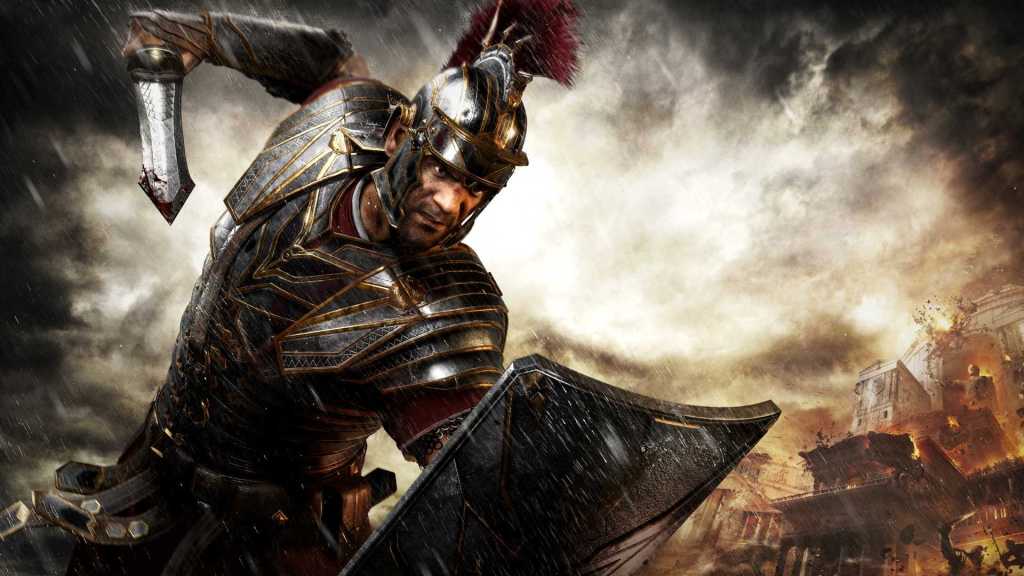
I only picked up an Xbox One three years into the last generation, and Ryse: Son of Rome didn’t even enter my mind when I was looking for what few exclusives I’d missed. I eventually added it to my library when it was heavily discounted and promptly ignored it for another 5 years according to my transaction history. Having finally played through the campaign mode in 2024, two thoughts stood out: one, the negative sentiment towards Xbox after the botched Xbox One launch must’ve been severe if both this game and IP were swiftly forgotten; and two, I really miss big-budget games that could be completed in a dozen or less hours, and had actual endings that let me walk away with a sense of completion.
Which is not to imply Ryse: Son of Rome is some underappreciated masterpiece. By 2013 standards, it would have felt distinctly average aside from the technical highlights. By 2024 standards, I found some of its flaws now feel like positives – so long as you go in with your expectations in check. It functions as a compact version of the formulaic action-adventure that now dominates blockbuster games: a third-person perspective with lavish character models and animations; a strong focus on the presentation with lengthy cutscenes for storytelling; and a cinematic flair to the action, with tons of canned animations and the sensation the game is sometimes playing itself for fear you interrupt the transitions into cutscenes. The only thing it’s missing is an open-world structure – which I now consider that a good thing.
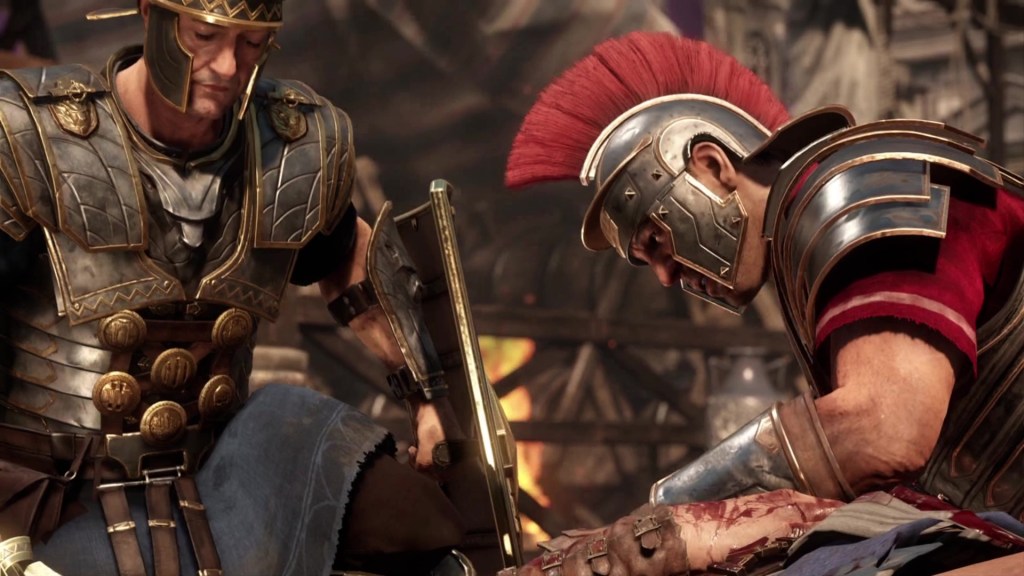
What made it most enjoyable to me in 2024 was the pacing of its brief campaign; brevity that serves the gameplay loop well, as it probably wouldn’t hold up past the 8-hour mark, no matter how much audiovisual spectacle is thrown at you. You control Roman soldier Marius Titus, in an alternate history Rome, during the time of Emperor Nero (and yes, he has much the same physique as Demetrian Titus in Warhammer 40,000: Space Marine if that came to mind!). Political change is in the air and the vast expanse of the Empire is making it difficult to govern. After a chaotic prologue sets the stakes, Marius recounts his story to the emperor leading up to that point, beginning with a visit to his Senator father and family in Rome after completing his training. The reunion is interrupted when a barbarian war party raids the city; his mother and sister are on screen just long enough to die and provide motivation for another hyper-masculine, vengeance-driven campaign; and his father only lasts a little longer before telling him to save Rome in his dying breath.
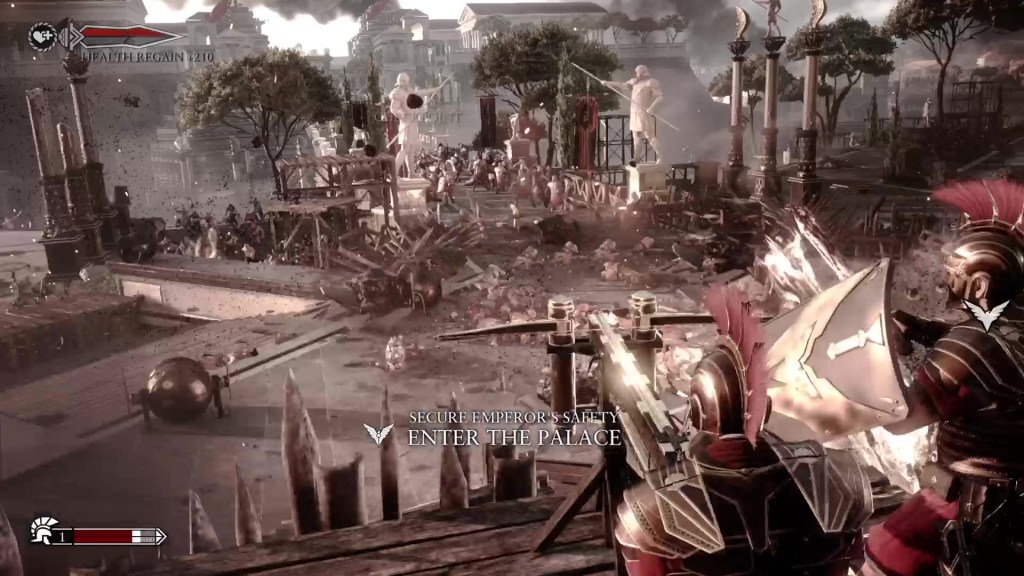
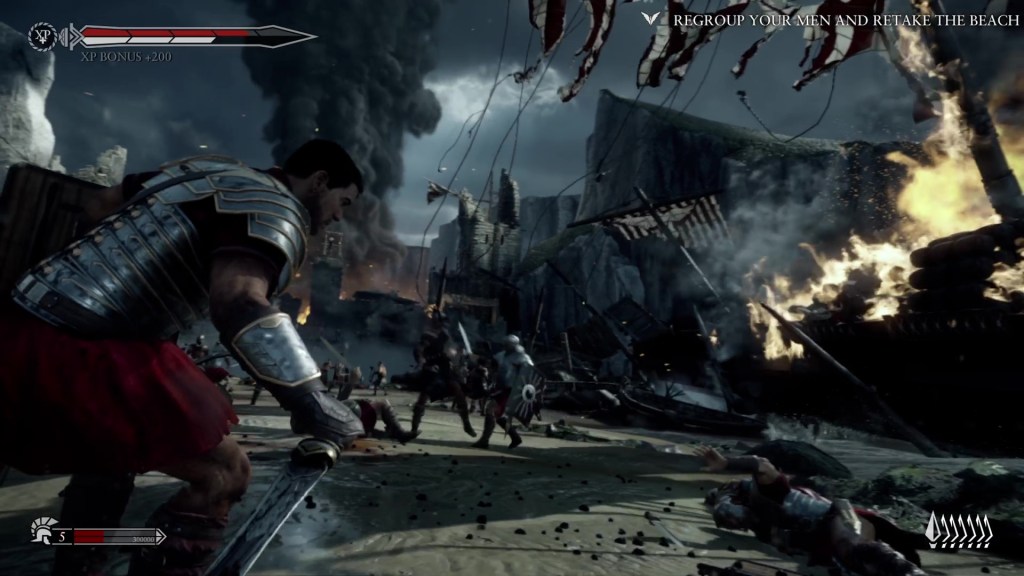
What follows is a visually diverse and often spectacular campaign that’ll see you invade Britannia in the Roman equivalent of the D-Day Landings, battle southern rebels and wild Northmen in the fog-swathed Highlands, evacuate a fortress city under siege, and finally return to a collapsing Rome after Marius realises a cowardly emperor and his psychopathic sons might be the real problem as “barbarian” hordes rise up as a result of Roman oppression. Naturally, you’ll meet and kill several historical figures from legend in the process. On the sidelines, there’s another battle being waged by Roman gods trying manipulate mankind through prophecy and direct intervention, with Marius taking up the mantle of Damocles to enact revenge. I found the storytelling still holds up thanks to the impressive visuals and sense of scale (well, for the time), the lengthy but well-directed cutscenes, and some excellent voice work throughout.
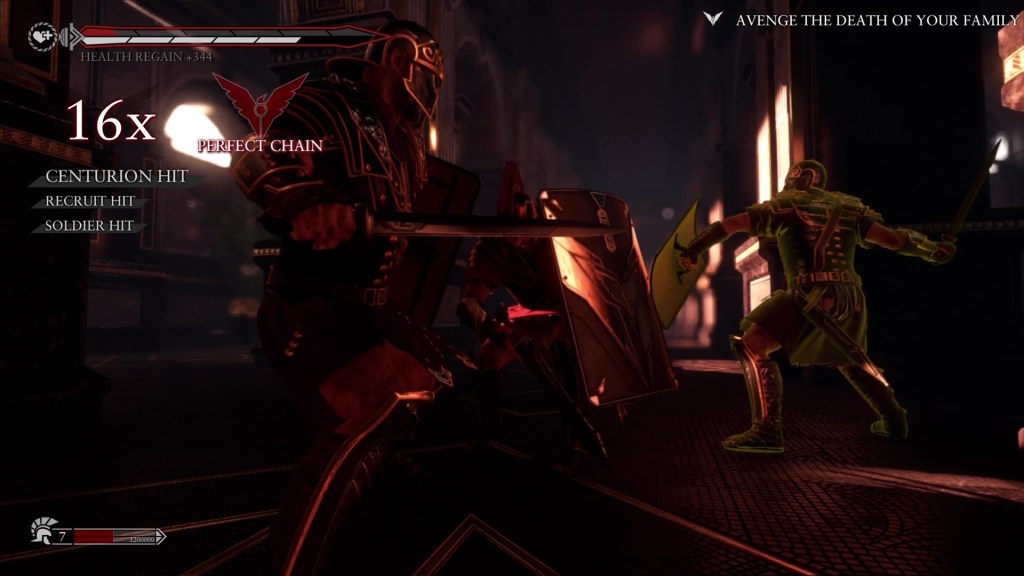
Now I’ve got this far without discussing gameplay, as while tutorials make it sound complex, the mechanics are simple, satisfying, but increasingly repetitive by the end. Ryse: Son of Rome uses the classic attack, dodge, block, and counter rhythm that Batman: Arkham Asylum pioneered in 2009 – just with a sword-and-shield focus, less “gadgets”, and gory takedowns. You build up combos with basic strikes; you block or parry with your shield; dodge glowing attacks; kick or use charged attacks to break an enemy’s guard; use a focus ability to slow time for free hits, and trigger QTE-driven executions on a single or pair of targets. These executions never fail once started, but if you match the prompts, you get bonus points towards health and focus restoration, a temporary damage boost, or XP that goes into a perfunctory skill tree that boosts basic attributes and execution bonuses. It’s an intuitive enough system that looks and feels great when you hold off a surrounding horde and execute them all in gory fashion.
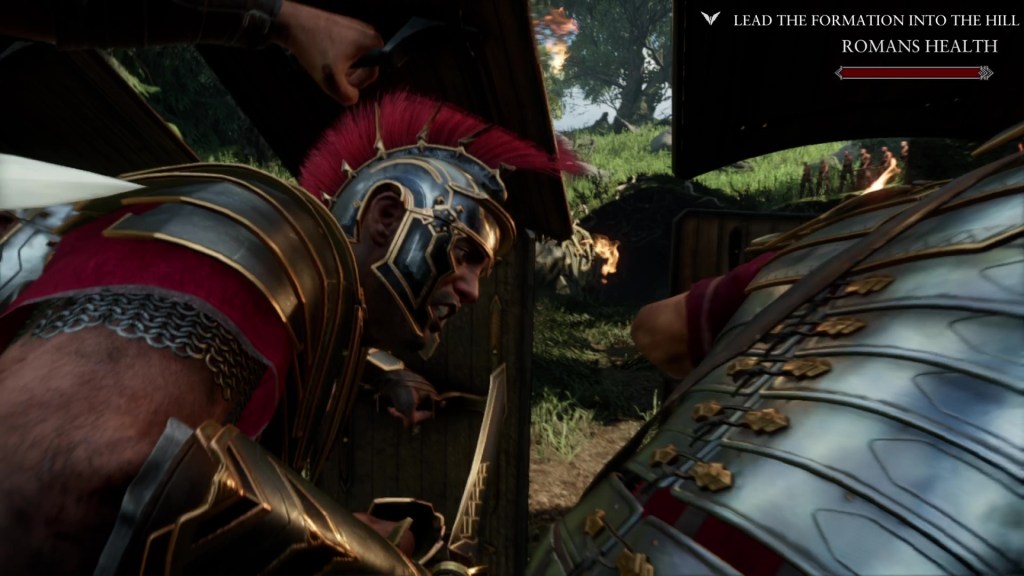
The problem with Ryse: Son of Rome is that it barely evolves over what was a 7-ish hour campaign for me – possibly less if you just ignore the underwhelming collectibles. For the bulk of your playtime, you move down glorified corridors with beautiful and sometimes chaotic backdrops full of battling soldiers, frequently getting locked into combat arenas – sometimes literally – until you defeat all the enemies. If you’re lucky, there might be two paths you can take, or a dead-end with a collectible. To spice things up, you’ll sometimes fight alongside fellow soldiers, triggering sequences where you march in a shielded formation and fling spears at archers, defend a point by assigning shield-bearers and archers to cover paths, and even engage in turret sequences using implausibly rapid-fire crossbows. Each act also features a boss fight or two, but these are often simplistic one-vs-one battles that only ask you observe attack patterns in each phase, then trigger the right counter to chip away at their health bar. Even on higher difficulties, they’re underwhelming compared to common late-game battles that throw numerous enemy variants at you simultaneously.
Now despite wrapping up on a negative note, most of my gameplay concerns only came to mind after I had finished the campaign and had time to mull over the experience. When you consider Sony released The Last of Us in the same year, pushing the technical limits of the PlayStation 3 and their storytelling ambitions, it’s easy to see why Ryse: Son of Rome failed to stand out. However, when you consider 2020’s The Last of Us: Part II now demands 25+ hours of trudging through misery interspersed with despair to see the end, I think there’s still good reason to return to older and shorter big-budget titles – even if they were considered unremarkable at the time. If you missed it at launch, Ryse: Son of Rome still offers a single satisfying playthough for those short on time but after a “AAA” experience.
If someone told me they thought the Hammerwatch games were boring, I’d be hard-pressed to argue despite enjoying them so much. The developers Crackshell were inspired by the early Gauntlet games from the mid- to late-’80s (something made obvious the moment you discover a secret level) so Hammerwatch offers up a mix of systematic exploration, switch and key hunts, hundreds of secrets to find, deadly traps to avoid, and chaotic combat against hordes of monsters and damage-sponge bosses – all of which feels much more exciting if you bring a friend or three along for the ride.
The game uses a top-down perspective with gorgeous pixel-art and sprite-work, coupled with a catchy “8-bit orchestral” soundtrack from composer-duo Two Feathers that has been stuck in my head for over a decade. On paper, it sounds solid but unlike so many modern games, progression and pacing are rigidly methodical and formulaic, which won’t appeal to everyone.
If I had to pick one argument as to why I love the Hammerwatch IP, it would be that the games feel like the antithesis of modern ARPGs like Diablo III or IV, Path of Exile, and Grim Dawn. All excellent games in their own right, but all with a focus almost entirely on character and gear progression through repetition. Even if they offer epic stories and stylish cinematics, their game worlds are designed for infinite grinding and many use procedural generation. As such, the layout of a dungeon rarely matters, there are few locations that feel unique, and it’s rare you get to make lasting change to the environment despite all your time and effort.
In contrast, every campaign in the recently remastered Hammerwatch Anniversary Edition makes learning the level layout essential to finding exits, secret hunting, upgrading your hero, and surviving hordes of monsters and deadly traps.
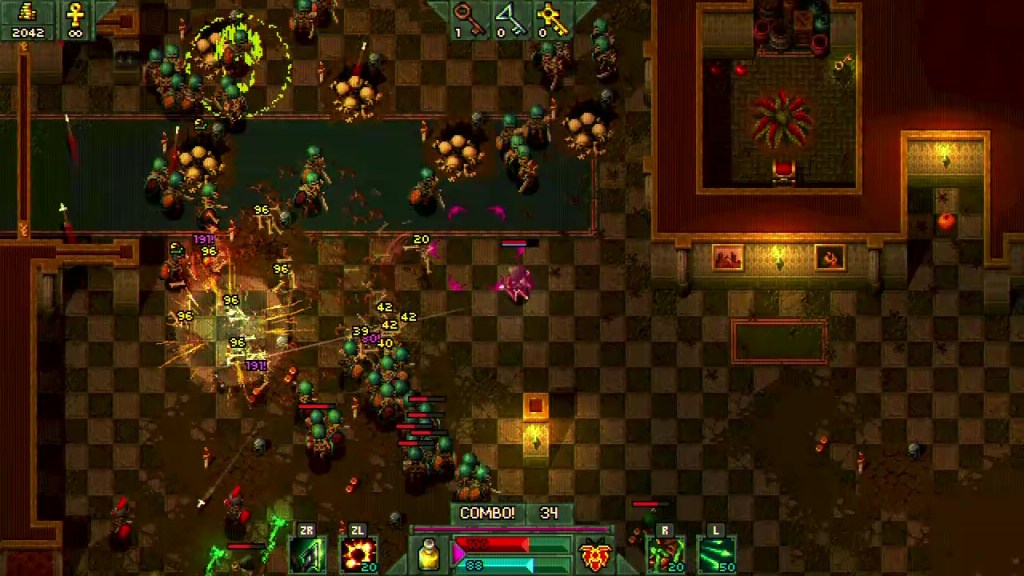
None of which makes Hammerwatch novel in the traditional sense – just pleasingly anachronistic in contrast to modern games, as it rewards systematically tackling everything on offer and there’s actually a finite amount. You push forward room by room, revealing the dungeon layout and expanding a useful auto-map; you keep an eye out for switches and traps; and you plan how best to kite enemies that’ll shred your health bar in seconds if you end up surrounded. Scattered checkpoints function as save and respawn points; food and potions keep your health and mana topped up; gold is spent on trainers to unlock or improve hero skills; while dozens of secrets range from more gold and accessories to extra lives, and there are even hidden collectibles if you want the “true” ending to some campaigns.
Unlike many other ARPGs in which repetition equates to progression, Hammerwatch doesn’t have respawning monsters and there’s no XP or loot gained from slaying them. Instead, thorough exploration, hoovering up every last piece of gold, and secret hunting is how you improve your hero. Collectible power-ups provide an incremental but permanent buff to your core attributes; weapon upgrades, higher-tier offensive skills, and a bigger mana bar all boost your damage output; while upgrades to your armour level, defensive skills, and health bar make you more resilient.
The more you explore and the more enemies you clear out, the easier it is to backtrack through sprawling levels on the hunt for the secrets and gold you need to become more powerful. Finding every power-up and upgrading everything is not essential but also can’t grind endless trash mobs if you’re having difficulty with a boss encounter.
Played from a top-down perspective, with twin-stick-style controls and only a handful of abilities to consider per class, Hammerwatch is simple to pick up and the on-screen action is typically easy to follow – useful in a game where mobility and a bit of strategy also count for a lot. However, with the prospect of limited lives, the risk of stumbling into insta-kill traps, and tough boss encounters that can feel like bullet-hell shooters, it remains a challenging game irrespective of your chosen difficulty – at least if you stick to the default settings.
Hammerwatch Anniversary Edition offers a short but useful list of modifiers, independent of difficulty, that you can pick from before starting a campaign. For new players (or those with an inexperienced co-op companion) infinite lives or bonus life pick-ups let you to focus on exploration and secret hunting with reduced risk. For wizards and warriors alike, buffs to health and mana regeneration can keep them in the fight without the need to backtrack for consumables.
At this point, it’s worth wrapping up by discussing why I’m highlighting the more recent (and pricier) Hammerwatch Anniversary Edition, instead of the original release I first played a decade ago. Part of the that is simply to support the developer and hope profits eventually go to a console port of Serious Sam’s Bogus Detour (the best Serious Sam game since the original pair), but I also thought it would be useful given the developer’s website and storefront listings are surprisingly low on detail and initially put me off picking it up until it was suitably discounted. First up, the remastering effort is excellent – just in sense it looks like you might remember it. Go back and take a look at the original however, and the improvements to the artwork, sprites, atmospheric effects, auto-map, and control scheme are obvious and much needed.
From a gameplay perspective, you have updated introductions and conclusions for each campaign that tie into the larger narrative introduced in Hammerwatch II; you have access to all seven classes with new customisation options and some nice situational voice lines; and there’s a simple tiered accessory system that add a little more diversity to character builds – though you can only carry one at a time.
Most significant for returning players is the substantial “Shaftlocke Tower” campaign, which remasters assets from the rogue-like Heroes of Hammerwatch, and turns them into a traditional campaign even longer than the length of the original, packed with an expanding hub, more intricate levels, tougher combat encounters, more bosses, and more secrets. The only downside is that, if like me, you first replay the original Castle Hammerwatch and brisk Temple of the Sun campaigns back-to-back, Shaftlocke Tower can push that formulaic structure to breaking point.
Wrapping up, despite the higher price point and the reworked “more of the same” approach to the new campaign, I’d still recommend Hammerwatch Anniversary Edition to existing fans, those that wanted a traditional campaign from Heroes of Hammerwatch, and as the best starting point for new players, whether on PC or any of the consoles – even if it took a few patches to get to the “definitive” experience. It’s not for everyone and fans of modern ARPGs might find it too dull – but if you get a kick out of systematically clearing dungeons, room by room, floor by floor, and hunting for secrets, Hammerwatch Anniversary Edition offers a lot of quality content and an indie price point.
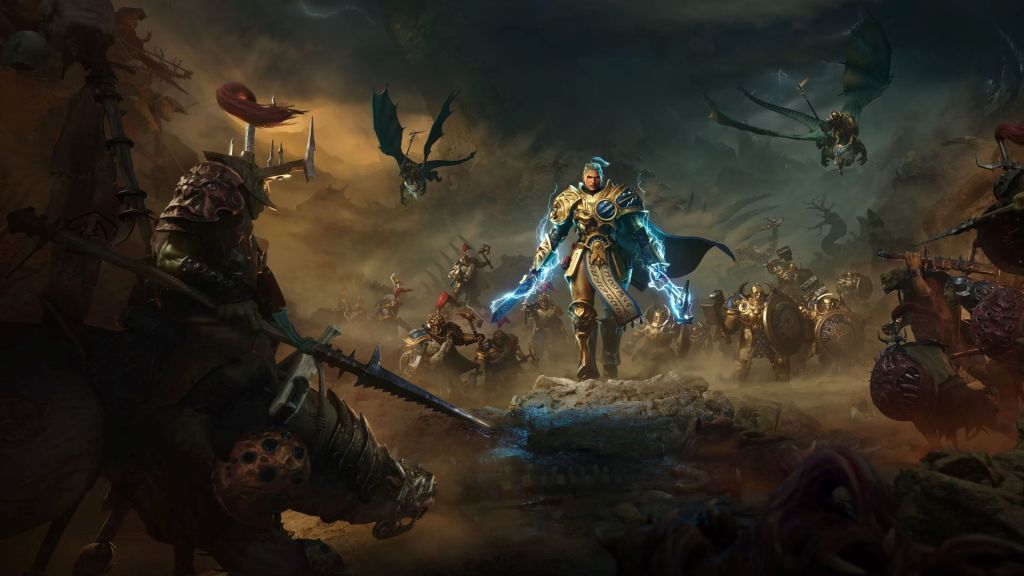
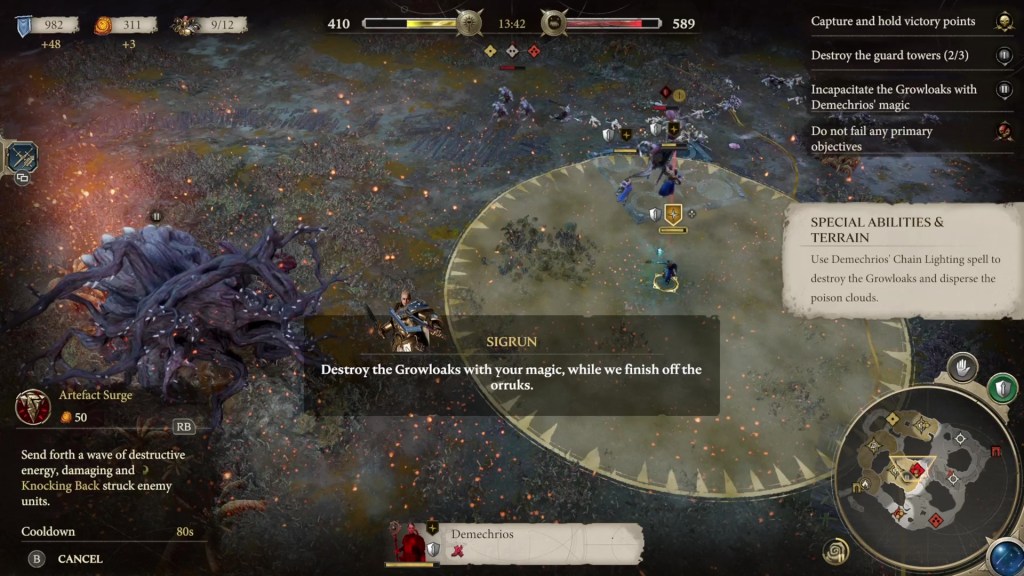
As someone who has always enjoyed playing real-time strategy ports on console – going all the way back to Command & Conquer and Red Alert on the PS1 – Warhammer Age of Sigmar: Realms of Ruin feels like a case study on what does and doesn’t work when you have to work around the limitations of a gamepad.
During the cinematic-heavy campaign, there were times I was reminded of the methodical, scripted approach Blizzard pioneered with the StarCraft and WarCraft III – a design that works well enough on console when the player has more control over the pacing. The rest of the time – by which I mean a third of the campaign missions and every other mode: AI skirmishes, Conquest, or multiplayer – it often felt like trying to play a fast-paced, lane- and territory-control-focussed MOBA with a severe handicap.
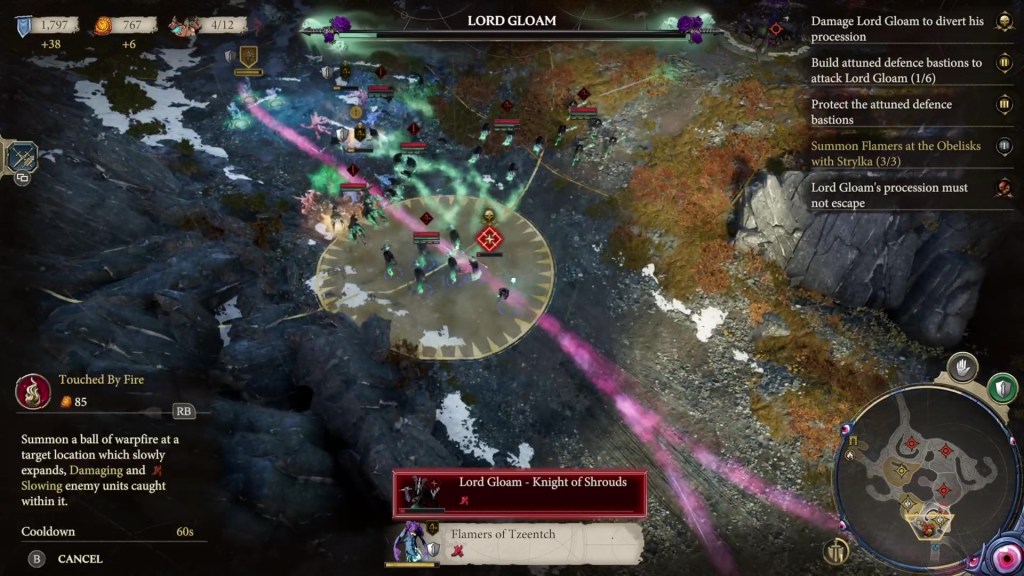
Starting with the positives, there’s a cinematic 18-mission campaign, with four difficulty settings and optional mission challenges, complemented by AI skirmish maps and a Conquest mode – think a succession of increasingly tough skirmish maps with modifiers. With beautiful environments, detailed character models, and intricate unit animation, Warhammer Age of Sigmar: Realms of Ruin’s in-engine cutscenes do an impressive job presenting another grim, violent, yet often amusing and absurd Warhammer story. It’s full of contrived scenarios, improbable attrition rates, one-note faction leaders making poor decisions, and – more so than any recent RTS I can think of – it shamelessly functions as a glorified tutorial for basic commands, faction abilities, and game modes.
The Stormcast Eternals seek an artefact of power that may help them reclaim the Region of Ghur; the Ork Kruleboyz are in pursuit of the same prize to elevate the status of their Warboss; and a few flashback missions reveal how The Disciples of Tzeentch originally battled the undead Nighthaunt faction for possession of the artefact. It’s all stylishly presented and – if you can get to grips with the gamepad controls and gameplay basics – the campaign is decent fun and moves at a brisk pace, switching up factions, objective types, and introducing a few novel scenarios. There are times you’re just battling from point-A to point-B down branching corridors, claiming Arcane Conduits to build outposts and generate resources as you go, but there are a few missions that rely almost exclusively on heroes; one that functions as an unforgiving tower defence; one that features clunky stealth; several that have you battle over control points, and even gimmicky boss battles that add some twist to chipping away at a giant HP bar.
The campaign also serves to highlight what the control scheme and game design gets right. Much like the underappreciated Halo Wars 1 and 2, Warhammer Age of Sigmar: Realms of Ruin focuses on streamlined base-building, managing only two resources, and smaller skirmishes influenced by unit composition, positioning, and the strategic use of abilities – more so than sheer numbers. You can upgrade you primary building to recruit new unit types and unlock three-tiers of unit and outpost upgrades – many of which are mutually exclusive abilities or passive buffs to specialise units. Each faction also has two defence-oriented structures – a tower that deals minor damage but buys you time to muster your army, and a healing bastion to support defensive groups.
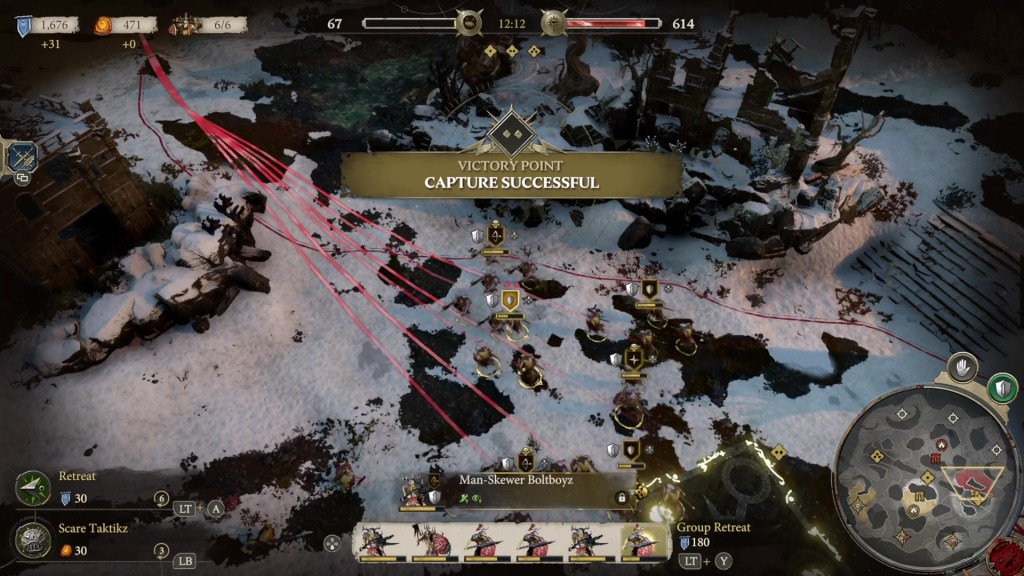
The controls are what you’d expect from a modern console RTS with one situationally useful addition – “DirectStep” control. The camera latches to your selected unit or group, it’s easier to aim and trigger abilities, and you assign movement or attack-move waypoints to individual units. It’s a smart option for managing small skirmishes but it decreases situational awareness, and I found myself falling back on the emulated reticule controls. In the introduction, I mentioned Warhammer Age of Sigmar: Realms of Ruin could feel like a MOBA, and that’s because it adheres to the rule-of-three design and forces you to multi-task. There are three unit types in the combat triangle (shields vs. bows, bows vs. swords, and swords vs, shields); often three objectives to clear out or three control points to hold; and there are typically three paths you need to defend around any Arcane Conduit. It should come as no surprise the d-pad is used to manage 3 control groups, pad with the last input used to quickly cycle through units within a group.
On paper and in practice, the controls and streamlined gameplay loop work well enough in the campaign – even on tougher missions that feel like skirmish maps with the AI playing by a general ruleset, rather than custom scripting. The problem is how quickly they buckle when you’re under pressure. In addition to juggling multiple control groups spread across a map, you’ve got to cycle units to access their abilities, deal with barely coherent formations, and interrupt dubious automated decisions. The challenge feels greater still when you realise how quickly the balance of combat shifts when something goes wrong – allowing other players or the AI to push you into a losing spiral. In Warhammer Age of Sigmar: Realms of Ruin, the less of the map you control, the less you can upgrade or reinforce your troops, and the less multitasking your opponent requires to contain and destroy you.
The most persistent issue is micro-managing your way around the combat-lock mechanic. Units engaged at melee range can’t disengage – unless they’re sent retreating back to your main structure before you can regain control. With no obvious formation behaviour and ranged units prone to outrunning melee units, you need to constantly assign individual attack orders based on type, then utilise abilities to further modify the flow of battle – usually by buffing your troops or inflicting an area-of-affect attack. You can alternate between move and attack-move commands, and you can define the firing-arc of ranged units, but to effectively micromanage just one army, you need to use all three available control groups. On top of that challenge, you’ve still got pathfinding issues and, despite several upgrades allowing you to focus on ranged damage, hybrid units are prone to engaging in melee once they get close – even if their target is combat-locked with another unit.
As a result, Warhammer Age of Sigmar: Realms of Ruin sits in a weird middle ground, demonstrating both smart design decisions that make a lot of sense in a console RTS – but it also demands a degree of manic multitasking simply not suited to a gamepad. Most campaign missions are either scripted enough or offer maps defensible enough that you can push out cautiously and regroup if things go wrong. However, that’s simply not an option on AI skirmish or Conquest maps, where even the low-difficulty AI can simultaneously contest all control points, harass your outposts, and spam abilities in battle against your primary force. It had me wishing for a pause-and-command option even if it was antithetical to the developer’s intent. An inadvertent positive is that a few multiplayer matches against other human players felt more balanced, as my opponents stuck to managing a single but mobile army I could frantically counter with my own.
There are few games as deserving of preservation as the original Tomb Raider. Not because it’s some timeless masterpiece that holds up today, but as a reminder of where we’ve come from, and how far we’ve come. If you’re a fan of games set 3D environments and played from a third-person perspective – the vast majority of blockbuster titles – you could trace at least some part of their ancestry back to 1996’s Tomb Raider.
Replaying it in 2024, in its freshly remastered form, has been unexpectedly compelling – albeit with a mix of highs and lows I expected. There was raw nostalgia for my 11-year-old self, sitting in front of a small CRT screen, playing it on a SEGA Saturn rented from the local video store – my first experience exploring a truly 3D world after growing up with a NES that was as old as I was, and infrequent visits to arcades to play on-the-rail light-gun games. It was a pivotal moment that ensured video games would became a lifelong hobby – with my very own PSOne and a copy of Tomb Raider II the following year cementing my love of the character and IP.
If you only have experience with the Crystal Dynamics trilogies – 2006’s Legends or 2013’s soft reboot – Lara Croft in 1996 was a rare example of a female protagonist, at least outside of RPGs with character creation, and, rarer still, possessed a physicality typically reserved for male leads. She was an acrobatic heroine with calves, quads, and glutes so strong she could lunge-jump her own height and was strong enough to push and drag around 8 cubic-metre blocks of stone. The first Tomb Raider would pit her against an equally capable villainess and give her the chance to save the world at the expense of power and fame. I doubt representation was Core Designs’ original intent, but Lara nonetheless proved instrumental in drawing more female gamers into a hobby that all too often felt like young to middle-aged men developing games for young to middle-aged men.
Of course, nostalgia can only take you so far and it was impossible to enjoy the remaster without looking at it through the lens of 28-years of gaming advances. Revolutionary for the time – and possessing an impressive sense of scale and verticality that early 3D FPS and dungeon crawlers lacked – Tomb Raider now offers a purity of design, so uncluttered by secondary mechanics it almost feels novel. The bulk of the experience is simply observing, planning, and traversing blocky 3D environments using Lara’s equally rigid, grid-based move-set. The goal? Rarely more complex than finding key items or switches within a level to open the exit to the next, before a crude in-game cutscene or flashier CG variant pushed the story forward.
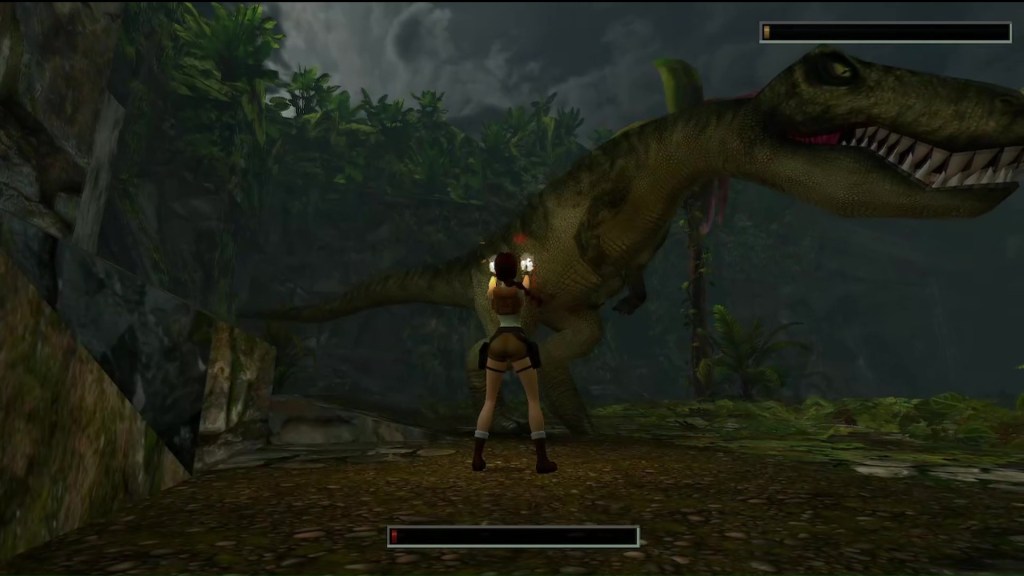
To spice things up, Lara will sometimes need to solve basic spatial puzzles that typically involve slowly pushing or pulling blocks; while other times she’ll need to draw her weapons to slay a shameful number of endangered species, a few that should’ve stayed extinct, tough mythical creatures, and a handful of human bosses that are an unfortunate reflection of cultural and racial stereotypes in the 1990s. Much like the platforming, combat is all about using Lara’s rigid move-set to avoid enemies that follow far less predictable patterns – often in tight spaces with perilous drops. Combat never feels more than functional, but many encounters can be rendered trivial if you horde powerful ammunition or find high-ground to exploit the limited AI pathfinding. Just don’t stop to ponder who left modern ammunition and health kits in ancient ruins supposedly unexplored in centuries.
By far the greatest challenge comes from mastering the original controls, especially as the alternative controls offered in this remaster are a twitchy abomination not worth considering. It’s a rough transition from modern games – games that strive to make you not think about the complexity of traversal – however, once you’ve get to grips with Lara’s move-set, they feels perfectly suited to the blocky but carefully crafted environments. It’s a game that requires patience, with a strong focus on planning a sequence of moves and lining up jumps, rather than being reactive, and you’ll want to save regularly if you don’t enjoy hearing Lara’s scream followed by a sickening crunch. The obvious caveat to this design is how clumsy and frustrating simple tasks end up feeling – such as lining Lara up to interact with a switch or pick-up, and how long it can take to trek back to the start of a jumping sequence if you mess up.
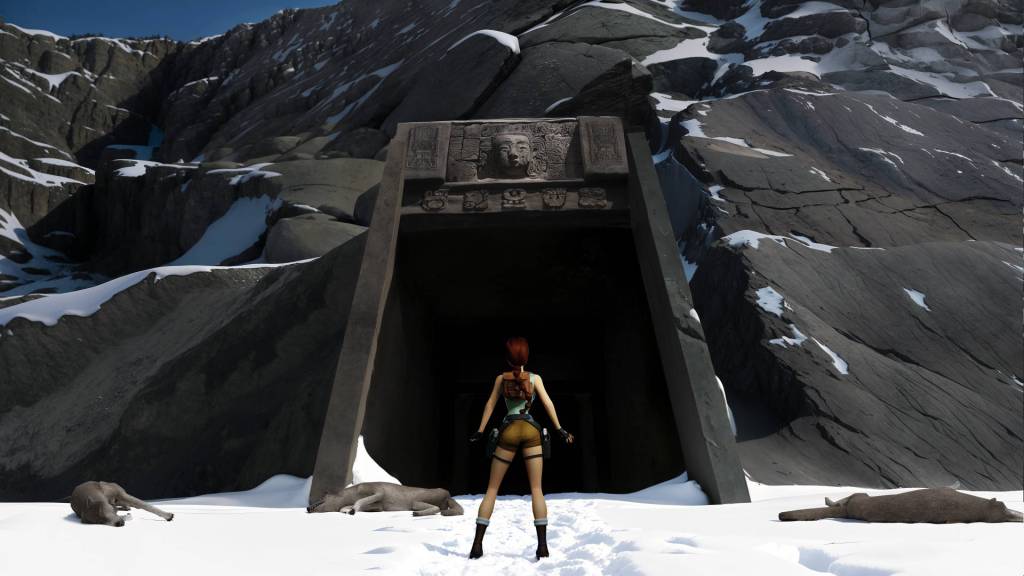
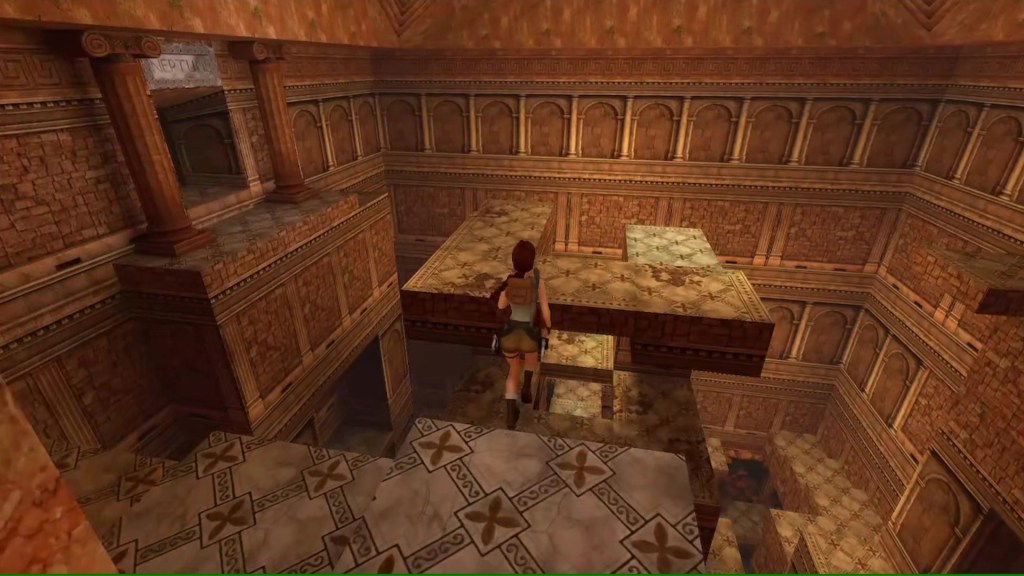
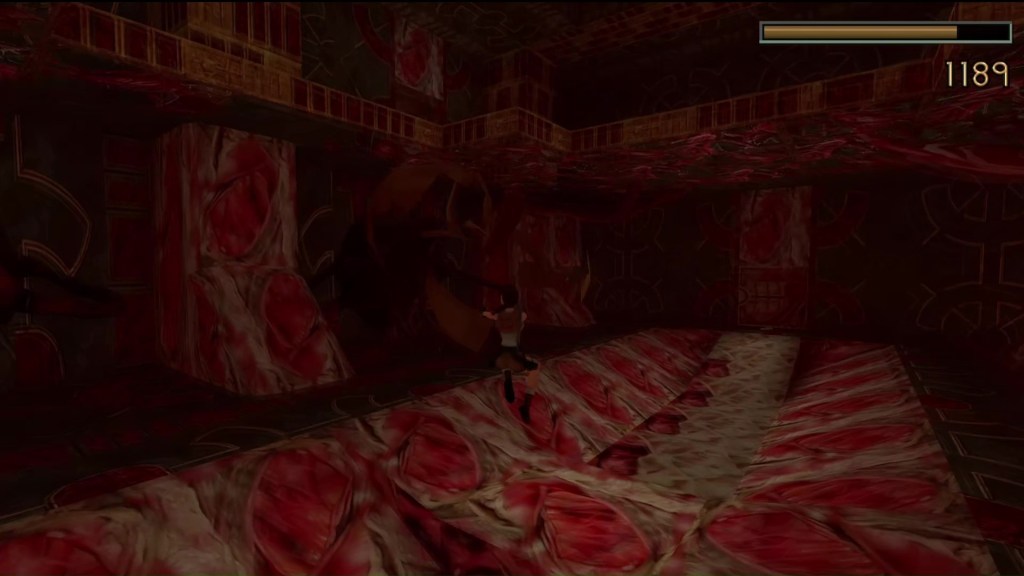
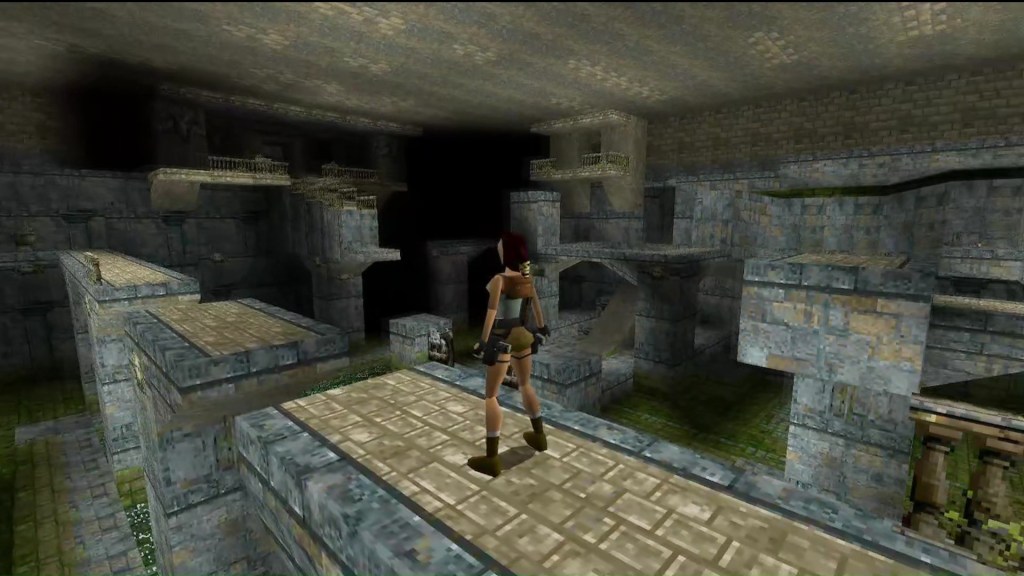
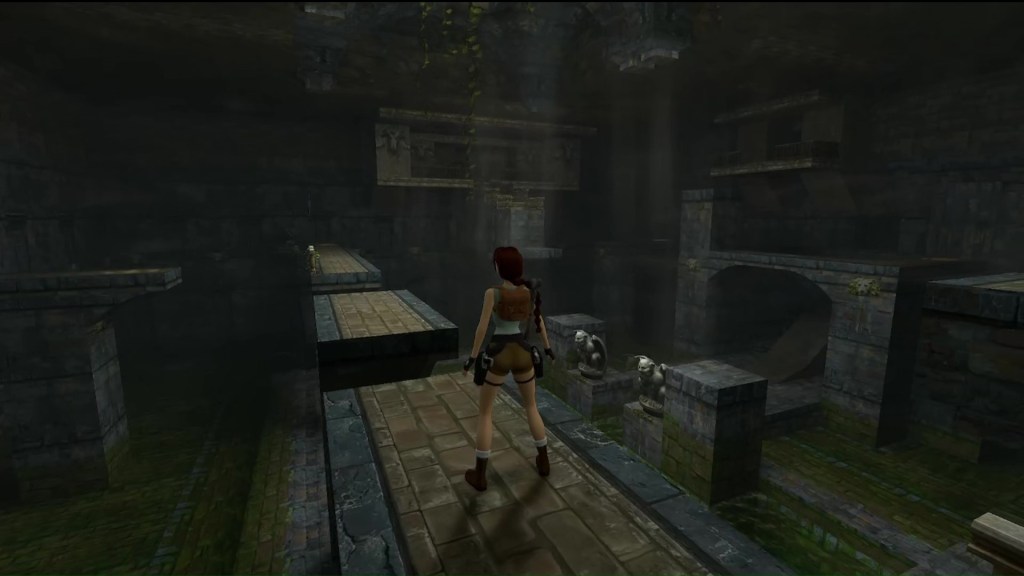
Moving on to the remastering effort itself – Tomb Raider I Remastered feels smartly touched up and respectful of the original vision, while the only major gripe I have is aforementioned and entirely optional alternate controls. Texture work, character models, and lighting have been overhauled – with the addition of more props where appropriate, and minor geometry changes to introduce new light sources like open ceilings. The world itself is still blocky, and the seams between textures are still obvious, but they feel suitably detailed for modern TVs, those representing water surfaces or lava are better animated, and some even have an impressive parallax effect to simulate depth.
All character models retain their somewhat angular designs and jerky motion, but they look much more detailed and have been embellished with plenty of added detail – including updated faces and basic lip-syncing for in-game cutscenes. Pixelated 2D sprites for pick-ups and props have been replaced with 3D models, and you can enable an interaction icon to make them easier to find – along with switches and key holes. The new lighting model – especially in rare locations that use beautiful new sky-boxes – looks great, adds to the immersion, and even simulates taking on the colour of the environment. There are more atmospheric effects like dust and mist, while a few locations even have puddles with reflections!
Talking of atmosphere, Tomb Raider I Remastered still relies primarily on ambient audio to capture that feeling of isolation you’d expect exploring long lost tombs – but it feels like they’ve added a few more music triggers and possibly repurposed a few tracks from the later games. In short, this remaster excels at presenting Tomb Raider as you might remember it. There are oddities, like how some areas feel too dark and the new 3D models for key items too small, but you can always swap back and forth between the remastered and classic visual mode – though you then have to deal with a stuttering 30fps cap that feels awful compared to the remasters 60fps achieved through frame interpolation.
All of which brings me to who I’d recommend Tomb Raider I Remastered to. From a pure preservation angle and for those interested in the history of video games, it’s an essential remaster. For those just considering the entertainment potential – this is more for fans of the original, especially those without the patience to deal with DOSBOX settings on PC, or console players that once had to deal with a frustratingly restrictive save crystal mechanic. As a long-time fan, the first three acts in Peru, Greece, and Egypt remain the highlight – and levels like The Lost Valley, St. Francis’ Folly, Temple Midas, Obelisk of Khamoon, and Sanctuary of the Scion have not diminished with age. If anything, they finally have a degree of visual spectacle to complement their impressive scope.
For everyone else still curious in Lara’s original outing, I’d rather suggest Crystal Dynamic’s excellent 2006 reboot, Tomb Raider: Anniversary, which can still serve as an excellent stand-alone experience.




 gameblur-v2.0